Import from China to United Kingdom in 2026: Duties, Documents and Landed Cost
Published by Aeonix Trade.
Last fact-checked: 9 November 2026.
A Manchester shop books one 20ft of stainless kitchen tools, handed over FCA at the Ningbo container terminal, for discharge at Felixstowe. The factory sheet says FOB and "export customs included." Under FOB the seller clears export and pays to load the goods on the ship. This is a container. ICC recommends FCA for containerised cargo, because the cartons are handed to the carrier before the vessel is loaded. Write the place: "FCA Ningbo container terminal."
If you import from China to United Kingdom, the duty is not a number you can copy from a chat. Importing from China to United Kingdom still starts with that lookup, not with a flat percent. United Kingdom import duty on China origin is the rate in the Trade Tariff for the commodity code your broker will file. The standard VAT rate, as printed by HMRC on 9 November 2026, is 20% for most goods. Some goods are 5% or 0%. That page is VAT rates.
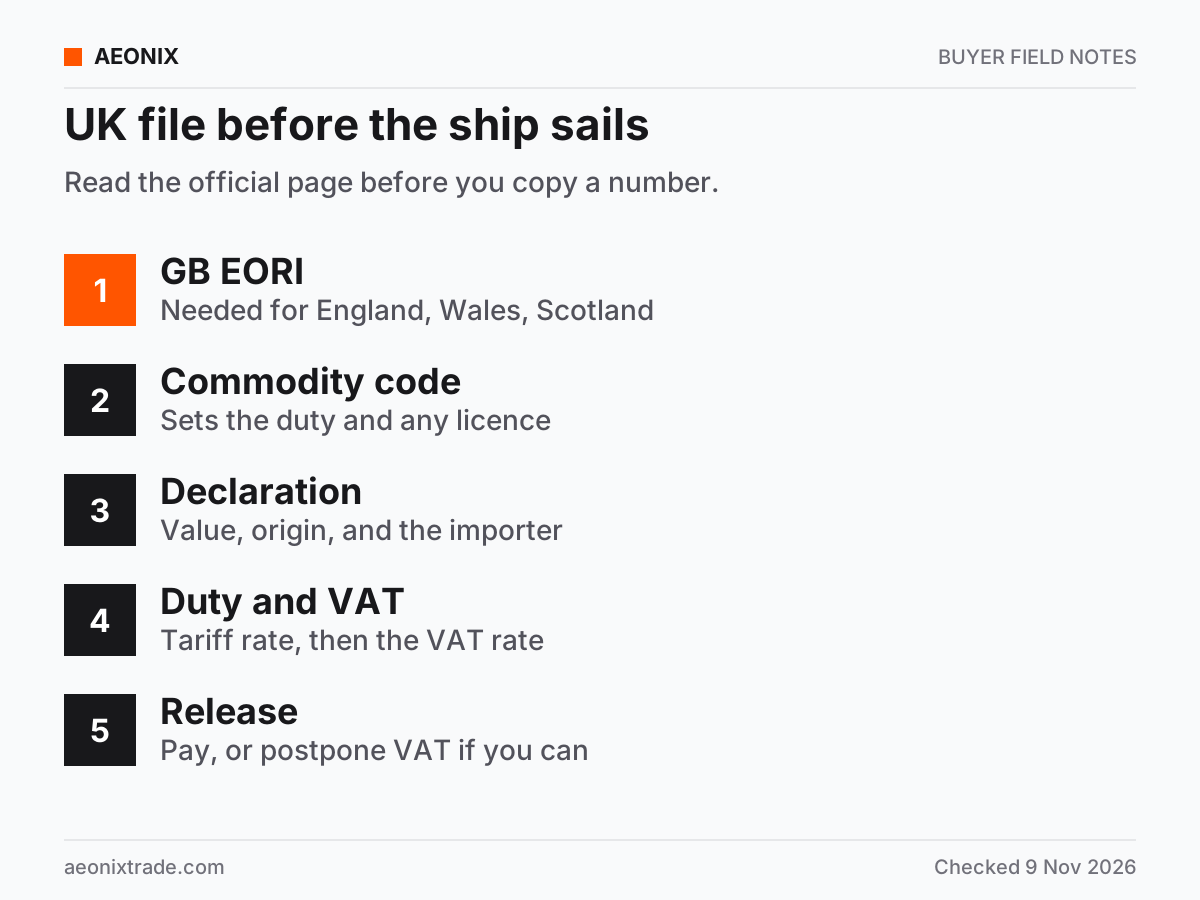
The sequence above is the order on GOV.UK's import steps, not a promise about how many days Felixstowe will take.
A typical Felixstowe container
To import goods into England, Wales or Scotland you need an EORI that starts with GB. If the number you already hold does not start with GB, you need a new one. Northern Ireland is a separate question on the same page. Get the number from Get an EORI number before the ship leaves Ningbo. A UK VAT number is not that registration.
The commodity code goes on the import declaration. It sets the duty and whether the tools need an import licence. Your agent can help you find it. The page that says so is Import goods into the UK, and the lookup is the Trade Tariff. Six digits on the supplier invoice are the start of a longer code. Agree the code before the factory prints the cartons. The HS code note is the argument to have before production.
The £135 line this container is not
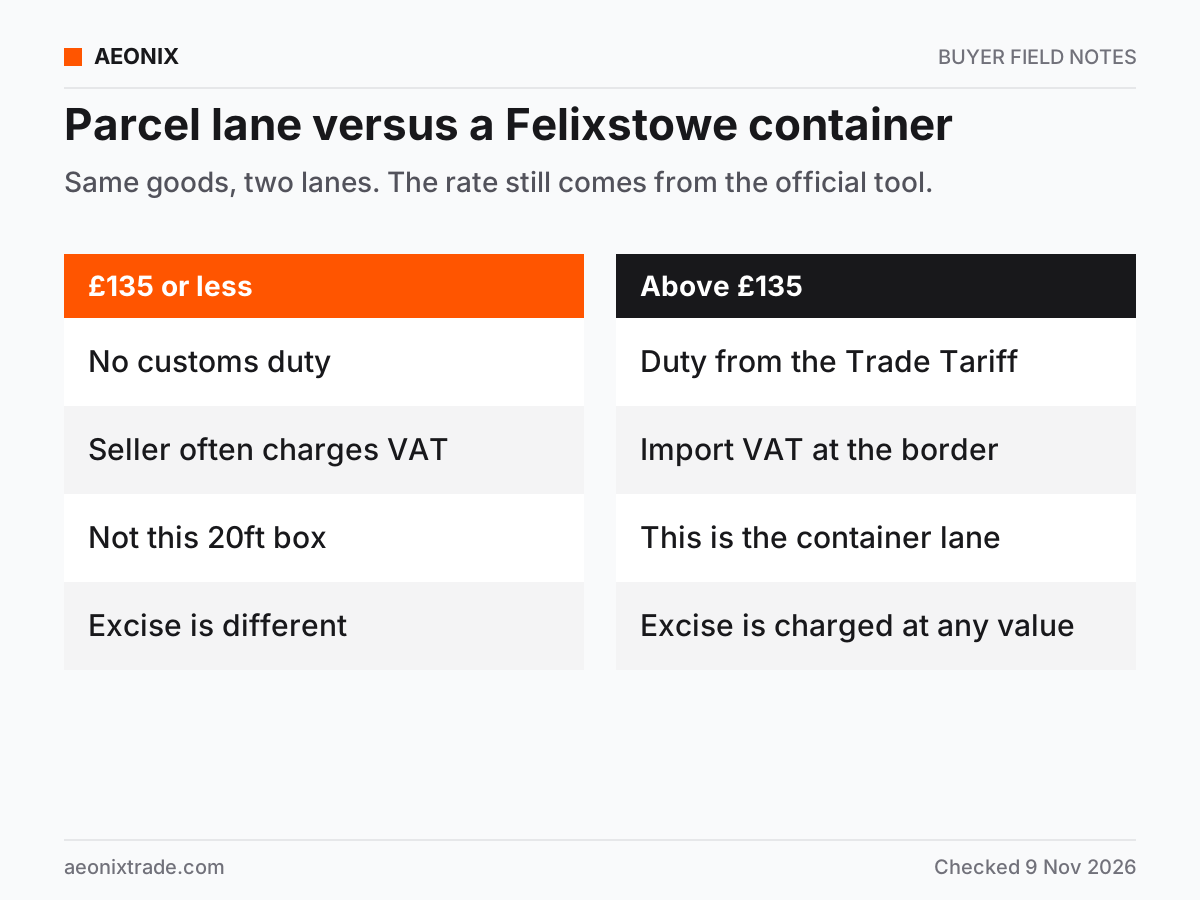
HMRC's page on goods sent from abroad, read on 9 November 2026, charges Customs Duty in Great Britain on goods sent from outside the UK when they are excise goods, or when they are worth more than £135. Non-excise goods worth £135 or less: no customs duty. Goods above £135: the rate depends on the type of goods and where they came from, and you read it in the Trade Tariff. Excise goods pay duty at any value. The page is Tax and customs for goods sent from abroad.
A 20ft of kitchen tools is above £135. Do not quote the replenishment as if the parcel line applied. For consignments of £135 or less sold directly to customers in Great Britain, the seller charges UK VAT at the point of sale, unless it is a business sale and the customer has given a UK VAT number. Low-value consignment relief, the old import-VAT exemption at £15 or less, has been removed for Great Britain. That rule is on VAT and overseas goods sold to UK customers. It is not the duty notice for this container.
VAT on the declaration
Import VAT is normally charged at the same rate as if the goods had been supplied in the UK. The value for VAT is the customs value, plus incidental costs such as commission, packing, transport and insurance to the first destination in the UK, plus Customs Duty and any excise or other charge, except the VAT itself. That is Paying VAT on imports. Customs value itself follows the WCO valuation rules your broker applies to the invoice and the freight evidence.
If the company is registered for VAT in the UK, it can account for import VAT on the VAT Return instead of paying it upfront and reclaiming later. HMRC calls that postponed VAT accounting. You do not need approval to use it. It covers goods imported into Great Britain from outside the UK, and into Northern Ireland from outside the UK and the EU. A business with no UK establishment still needs someone in the UK to deal with customs and to complete the declaration. The page, last updated 16 June 2025 and read again on 9 November 2026, is postponed VAT accounting.
The standard rate is 20%. Children's car seats are an example of the 5% rate, and most food and children's clothes are examples of the 0% rate. Kitchen tools are not those examples. Confirm the line for the exact SKU on the VAT rates page before you lock the resale price. Do not copy 20% onto a SKU the page puts in another column.
Landed cost before the deposit
Put the lines on the landed-cost sheet before you accept the MOQ. Write "see the Trade Tariff" on the duty row. Write the VAT rate only after you have opened the HMRC page for this product.
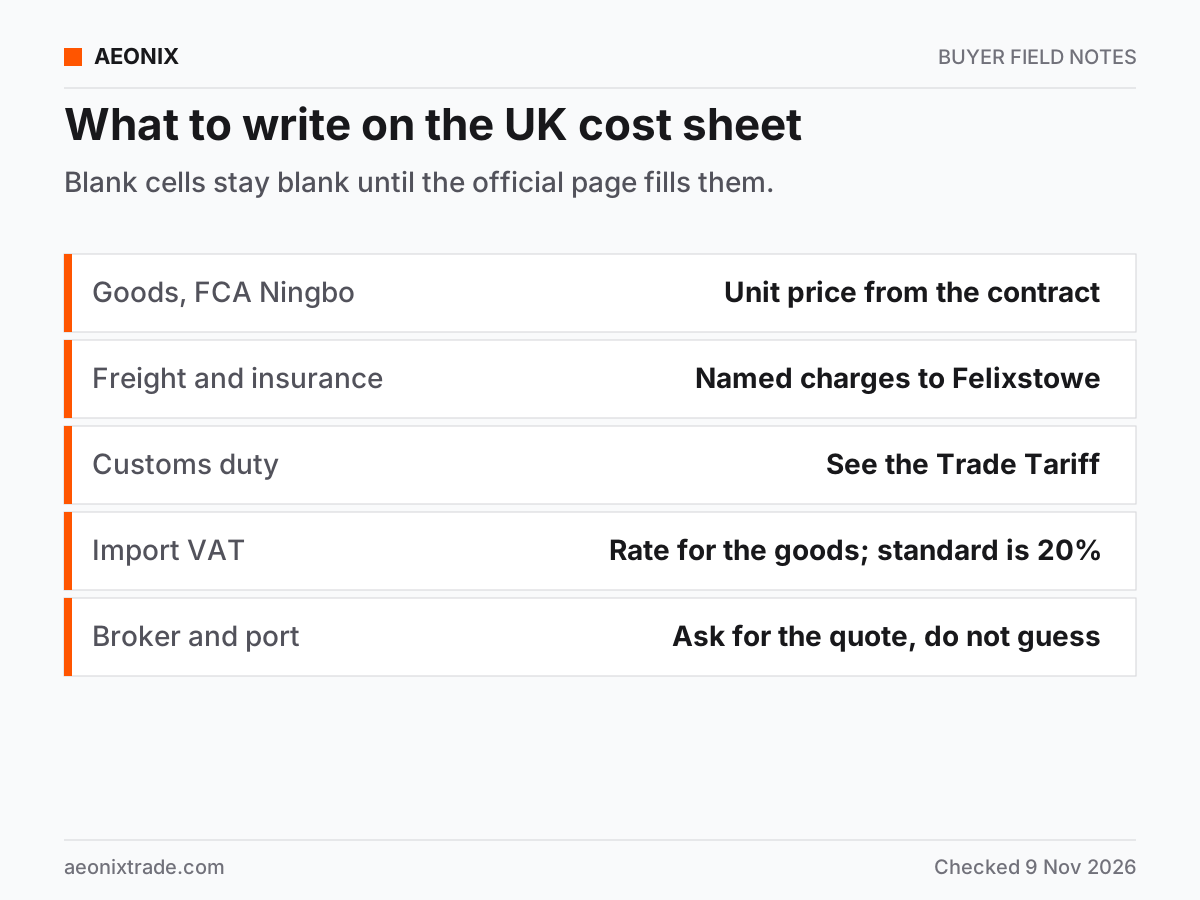
| Line | Ask for this | Do not assume |
|---|---|---|
| Goods, FCA Ningbo terminal | Unit price, MOQ, and what is inside the carton | That FCA includes the ocean freight |
| Freight and insurance | A quote to Felixstowe with the charges named | That "freight included" means the box is in Manchester |
| Customs value | The value the declaration will use | That the FCA unit price is the customs value |
| Duty | The Trade Tariff measure for China origin | A rate copied from another country's guide |
| Import VAT | The rate for this SKU. Standard rate is 20% as of 9 November 2026 | That every SKU is 20%, or that VAT disappears because the customer is British |
| Broker, port, inland | Who files, and the truck to your warehouse | That the forwarder's UK agent is your importer |
Where this lane goes wrong
- Paying the deposit, then discovering a VAT number and no EORI. They are different registrations.
- Letting a Chinese forwarder be "the importer" on a DDP offer. If your company will sell the tools, your company should be able to explain the declaration.
- Quoting a full container on the £135 parcel rule. The duty on this box is the Trade Tariff measure.
- Using postponed VAT accounting without a UK VAT registration. HMRC says the business must be registered.
- Wiring the balance to an account name that does not match the seller. Check that before the TT, the way the supplier check describes.
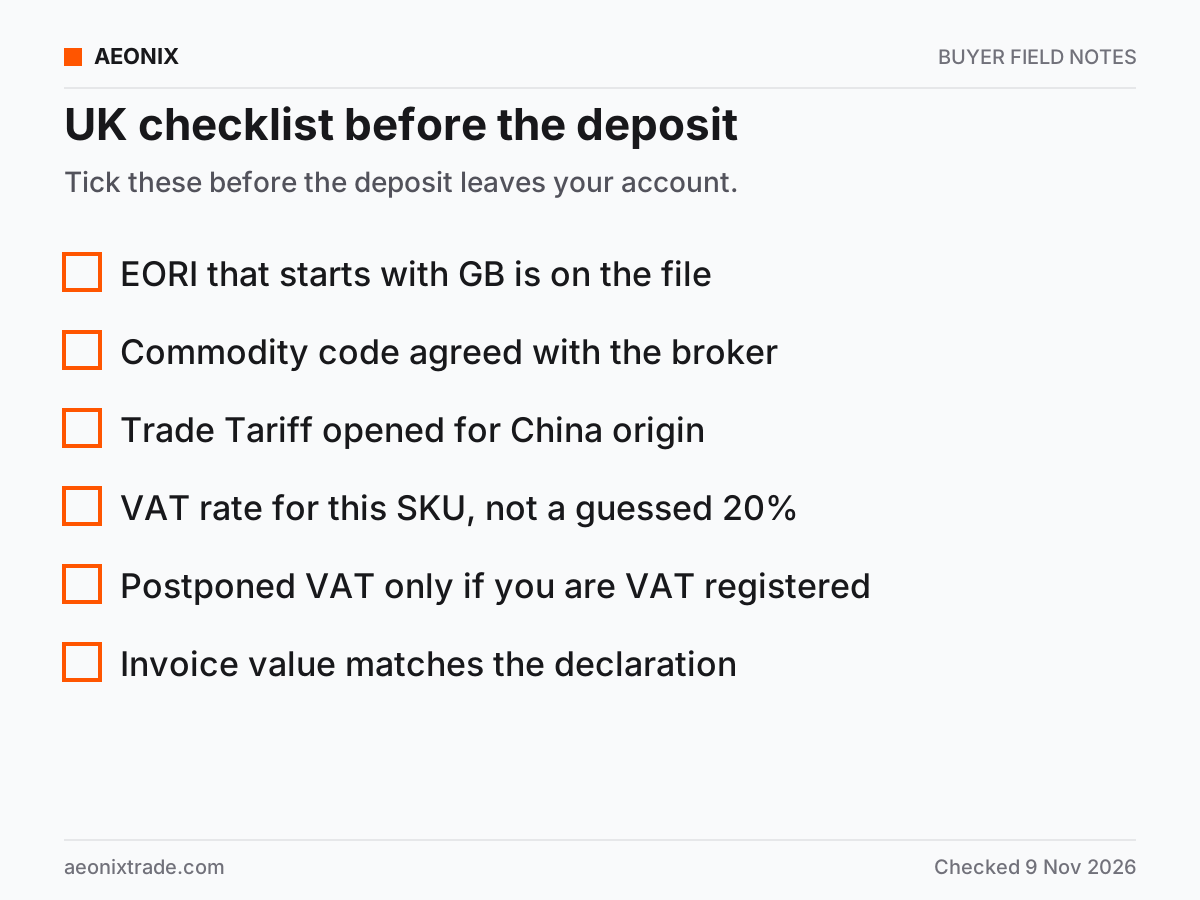
The general order of the file is the first-time compliance checklist. After the vessel berths, the clocks are the arrival sequence. A shared container, if this order is too small for 20ft, is the LCL service and the LCL walkthrough. The same buyer questions for Canada are in the Canada guide, and for a non-EU Pacific lane in the Australia guide. The hub for every country note is import from China.
Questions buyers ask
Can I start without a full container?
Yes. LCL still needs the same EORI, the same commodity code, and the same duty and VAT treatment. The £135 line is about the value of the consignment, not about whether the cartons share a box. A mixed LCL consignment above £135 is not a parcel.
Who pays the duty and the VAT?
The importer on the declaration. FCA Ningbo means you arrange the freight and you face Felixstowe. A DDP offer only moves that job if the named importer is someone who can actually clear and who will give you the paperwork.
How long does release take?
GOV.UK does not print a fixed number of days for a Felixstowe container. Build the calendar from the carrier's arrival notice and the broker's filing, not from a blog.
See also which Incoterm to use and the customs clearance sequence.
Official sources
- VAT rates: standard rate 20%, reduced 5%, zero 0%, as read on 9 November 2026.
- Tax and customs for goods sent from abroad: the £135 customs-duty line for Great Britain.
- VAT on overseas goods sold to UK customers: point-of-sale VAT at £135 or less, and the removal of the £15 relief.
- Paying VAT on imports: what is added to the VAT value.
- Postponed VAT accounting: VAT-registered businesses, no separate approval. Page updated 16 June 2025.
- Import goods into the UK: GB EORI and the commodity code.
- Get an EORI number.
- UK Trade Tariff: the live duty lookup. No duty percent is copied onto this page.
- Incoterms 2020.
- WCO customs valuation.
If you want the Ningbo handover and the document set checked before you wire the deposit, use the RFQ form.
Submit sourcing request
Can't find what you need?
Start with a product or image link, an approximate quantity and destination. Other details can follow.