Import from China to Pakistan in 2026: Duties, Documents and Landed Cost
Published by Aeonix Trade.
Last fact-checked: 9 November 2026.
A Karachi wholesaler books one 20ft of household plasticware, handed over FCA at the Ningbo container terminal, for assessment at Karachi. The factory writes FOB. For a container, ICC recommends FCA rather than FOB. Write "FCA Ningbo container terminal."
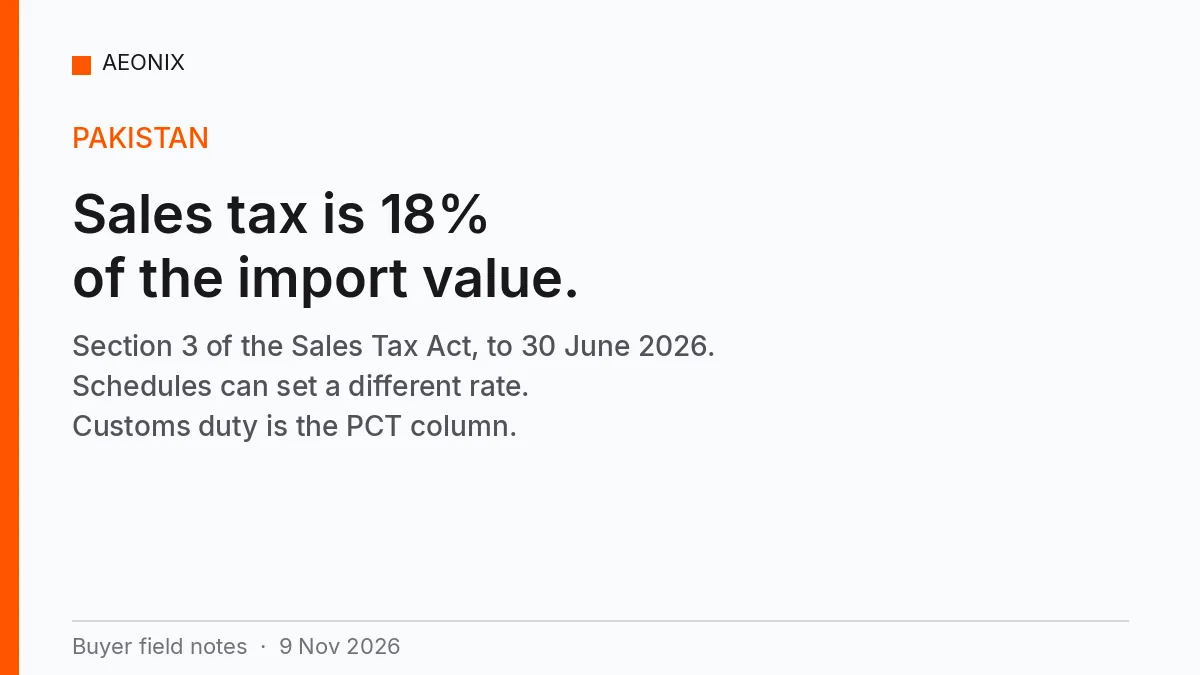
To import from China to Pakistan, keep two official books open. Importing from China to Pakistan splits into the tariff and the Sales Tax Act. Customs duty is the CD% column in the Pakistan Customs Tariff for the PCT code. Sales tax on the import is in the Sales Tax Act. The Act, as FBR publishes it amended up to 30 June 2026, charges sales tax at eighteen per cent of the value of goods imported into Pakistan. That is section 3(1). Eighteen per cent is 18%. It is the standard rate, not a promise that every PCT code is taxed at 18%. The file is the Sales Tax Act, amended up to 30 June 2026.
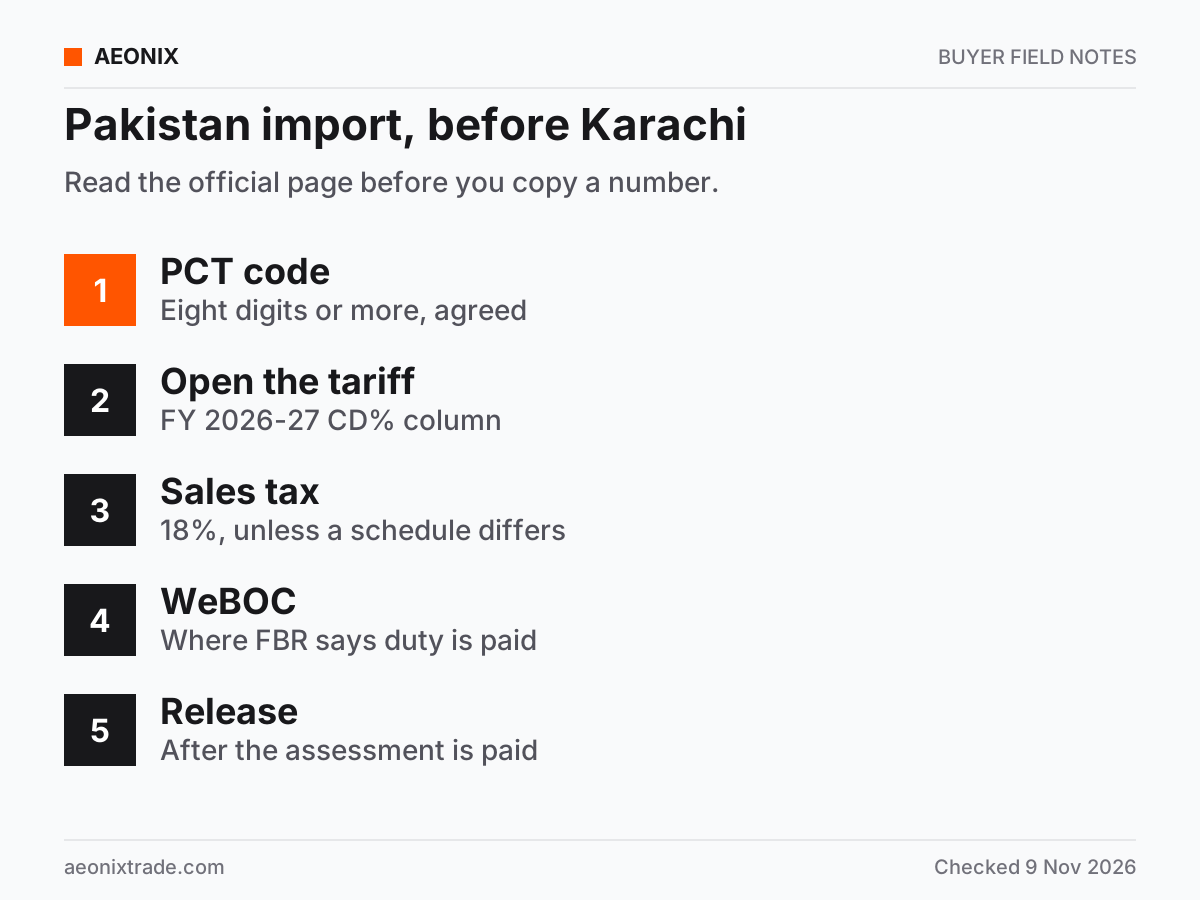
A typical Karachi container
FBR's tariff file for FY 2026-27 prints a PCT code, a description, and a CD% column. Plasticware is not duty-free because it is household. Open the code you will declare. The file, fetched on 9 November 2026, is the Pakistan Customs Tariff FY 2026-27. FBR's index for that tariff is Customs Tariff. Pakistan import duty on China origin is that CD% unless the entry shows a preference the origin documents support. The CD% column is not, by itself, a China preference. Do not print a preference rate the entry cannot claim.
FBR says customs duty can be paid through WeBOC. The page is Pay Customs Duty. Have the importer's own WeBOC access, or a written authority to the agent who will key the declaration, before the ship leaves Ningbo. An agent who pays is not the owner of the goods.
When 18% is not the whole sales-tax answer
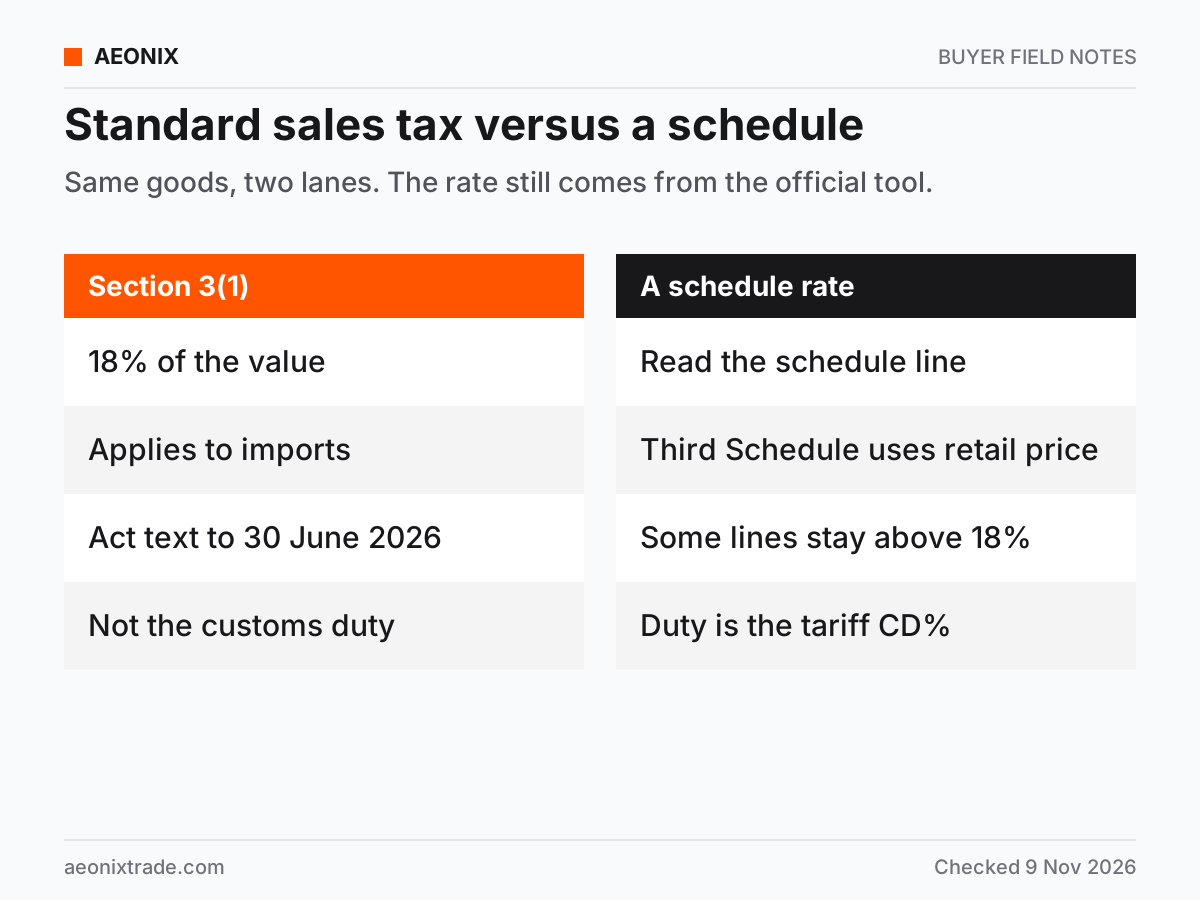
Section 3(2) of the Act says goods named in the Third Schedule are charged at eighteen per cent of the retail price, and that the importer has to print the retail price and the tax on the pack. FBR's circular of 11 September 2026 says a note was added so rates higher than eighteen per cent can continue after goods move onto that schedule. The circular is Circular No. 01 of 2026. Household plasticware may or may not be on the schedule. Read the schedule for the PCT. If it is listed, the base is the printed retail price, not the FCA unit price. If the schedule prints a rate above 18%, use that rate.
FBR's introduction to sales tax says goods imported into Pakistan are liable at the time of import unless they are exempt under section 13 and the Sixth Schedule. "It is plastic" is not an exemption. The page is Sales Tax Basics. Other taxes can appear on an assessment, including additional customs duty or regulatory duty where a notification says so. Those rates are not copied here, because they are not a single number in the Act section quoted above. Read them on the assessment the declaration produces.
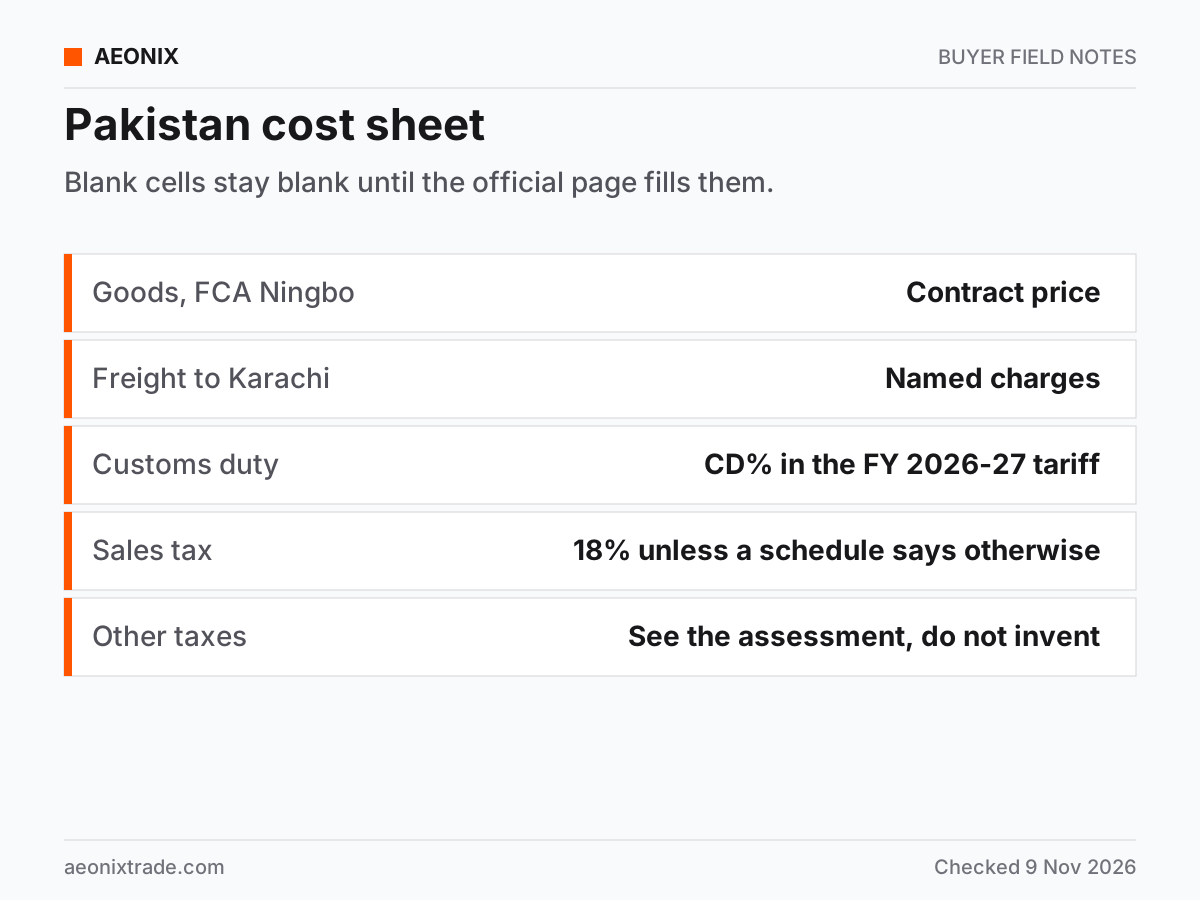
Landed cost before the deposit
Build the sheet with the landed-cost guide. Customs value follows the WCO valuation of the invoice and the freight evidence. The FCA unit price is the start of that value, not the end. Sales tax at 18% is then applied to the statutory value, unless a schedule moves the base or the rate.
| Line | Ask for this | Do not assume |
|---|---|---|
| Goods, FCA Ningbo | Unit price and the polymer specification | That FCA includes freight to Karachi |
| Freight and insurance | Named charges to the port | That the port charge is the sales-tax base |
| Customs duty | The CD% for this PCT in the FY 2026-27 tariff | A China preference the entry does not claim |
| Sales tax | 18% of the value, as of the Act updated to 30 June 2026, unless a schedule differs | That every household item is outside sales tax |
| Third Schedule | Whether this PCT is charged on retail price | That the factory price is the retail price |
| Who files in WeBOC | Your importer account or a written authority | That a DDP forwarder is your importer |
Where this lane goes wrong
- Quoting "18% all in" and then meeting a Third Schedule retail-price assessment.
- Using last year's tariff PDF after FBR has posted the FY 2026-27 file.
- Leaving the WeBOC user as a broker you cannot remove, so the next shipment cannot be filed in your name.
- Closing the cartons before anyone has checked whether the pack needs a printed retail price.
- Paying the TT to an account that does not match the seller. Use the supplier check first.
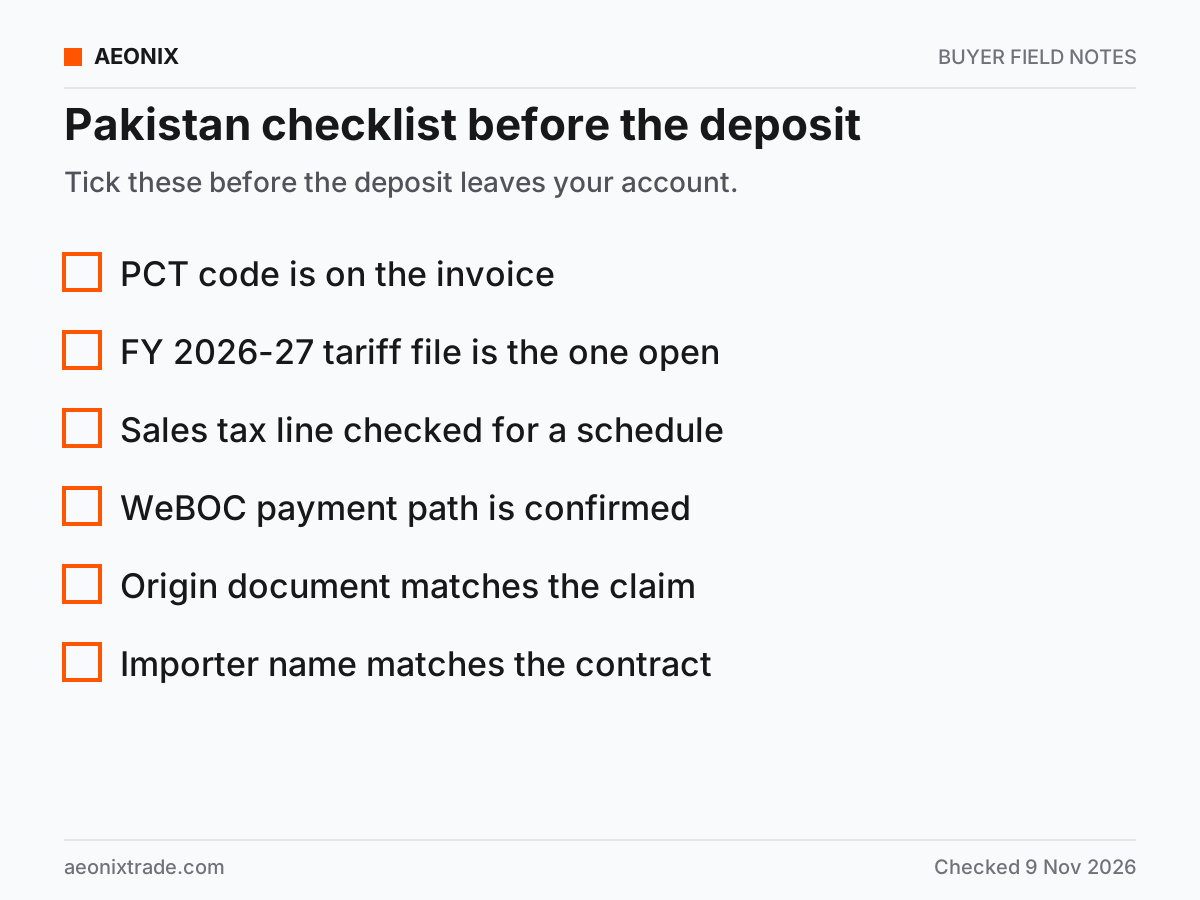
The wider file is the first-time compliance checklist. After the ship berths, use the arrival sequence. A smaller lot can move as LCL. Turkey's VAT book is a different statute: the Turkey guide. Nigeria's VAT rate is different again: the Nigeria guide. The hub is import from China.
Questions buyers ask
Can I start with less than a container?
Yes. LCL does not change the PCT code, the CD% column, or section 3. It changes the freight bill and the sales-tax value that freight feeds.
Is the duty zero under a China agreement?
Only if the entry you file shows that preference and the origin document is the one customs accepts. The FY 2026-27 CD% column is what this page can point to. It is not a preference certificate.
Who pays sales tax?
The importer, at import, unless the Sixth Schedule exempts that good. FCA Ningbo means the person who will sell the plasticware in Karachi should be able to explain the WeBOC declaration.
See also which Incoterm to use and the customs clearance sequence.
Official sources
- Sales Tax Act 1990, amended up to 30 June 2026: section 3(1) charges eighteen per cent on goods imported into Pakistan. Section 3(2) charges eighteen per cent of the retail price for Third Schedule goods.
- FBR Circular No. 01 of 2026, 11 September 2026: rates higher than 18% can continue on Third Schedule goods.
- Sales Tax Basics: imports are taxable unless exempted under section 13 and the Sixth Schedule.
- Pakistan Customs Tariff FY 2026-27: the CD% column. No duty percent is copied here.
- FBR Customs Tariff index.
- Pay Customs Duty: payment through WeBOC.
- Incoterms 2020.
- WCO customs valuation.
If you want the Ningbo handover and the PCT checked before the deposit, use the RFQ form.
Submit sourcing request
Can't find what you need?
Start with a product or image link, an approximate quantity and destination. Other details can follow.