Import from China to Kenya in 2026: Duties, Documents and Landed Cost
Published by Aeonix Trade.
Last fact-checked: November 9, 2026.
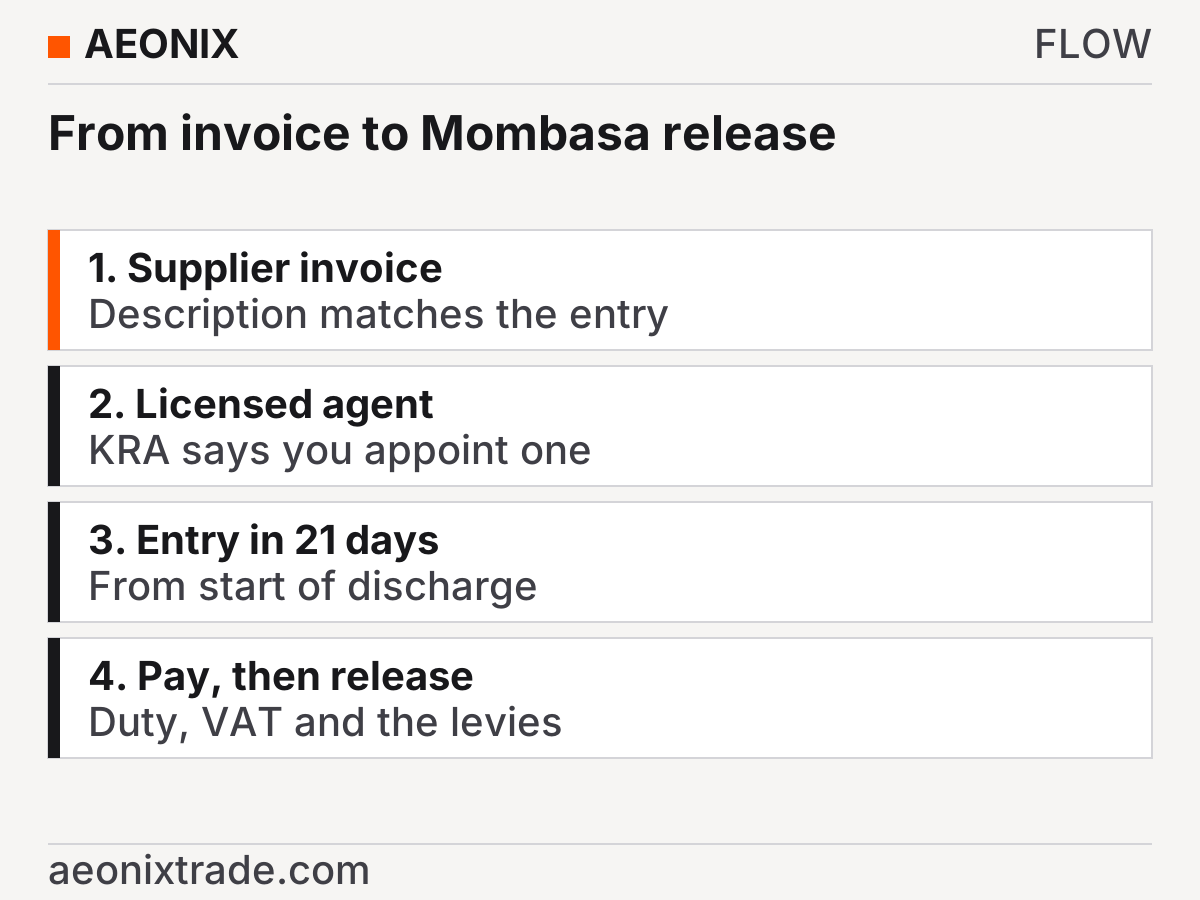
A Nairobi retailer takes 6 CBM of stainless kitchen tools, FOB Ningbo, and treats the forwarder's "we handle Kenya" line as the import. It is not. Kenya Revenue Authority's import page says the importer appoints a licensed clearing agent, and that goods must be entered within twenty-one days after discharge starts, or on arrival if the goods are vehicles. Importing from China to Kenya is that entry, plus the duty, VAT and levy lines the agent assesses. The factory unit price is only the first line.
A typical case
The tools are ordinary housewares, not a vehicle and not alcohol. The supplier's invoice is in US dollars, FOB Ningbo, cartons on one packing list. The buyer wants them in a Nairobi shop, so the sea leg is LCL or a small share of a container into Mombasa, then a truck. Nothing in that sentence is a tax rate. The rate arrives when the agent classifies the tools and KRA assesses the entry.
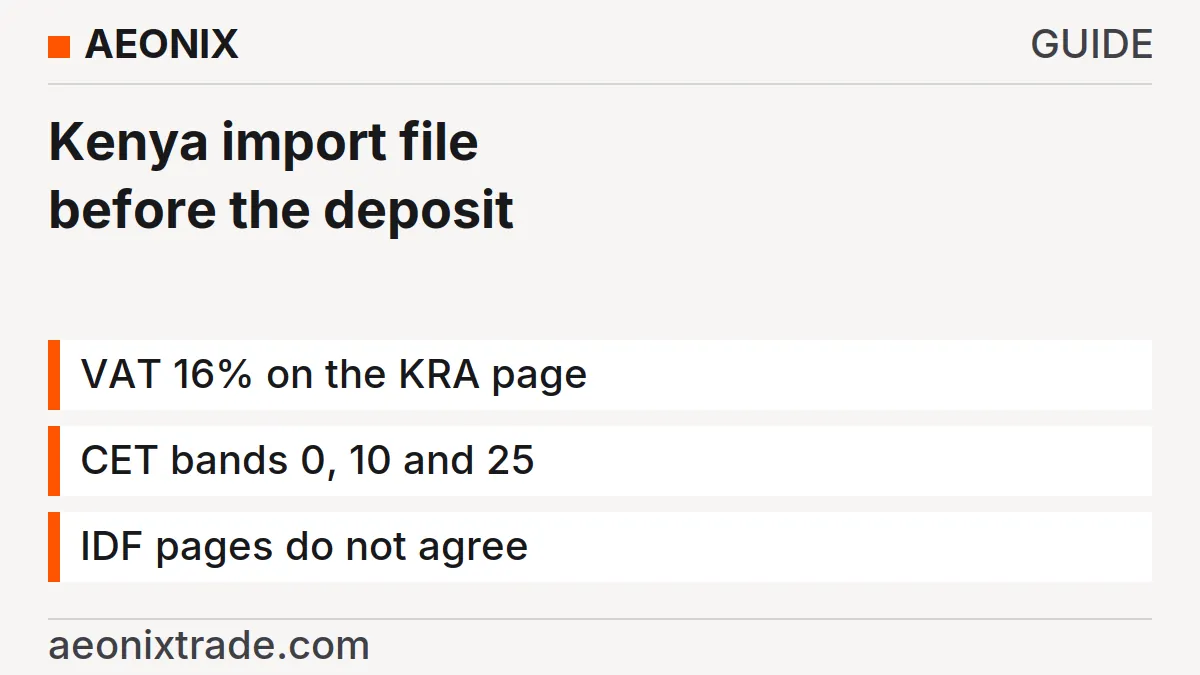
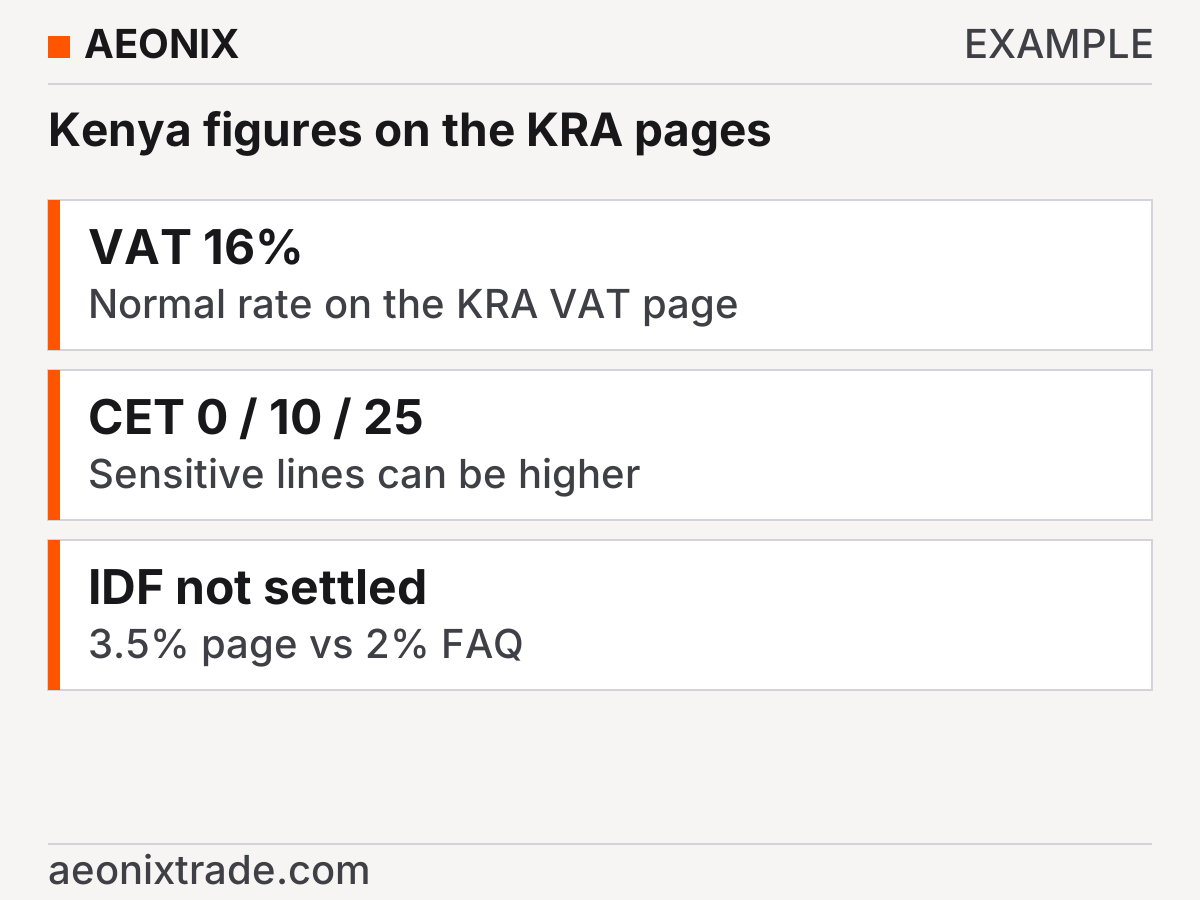
KRA's import page, read on 9 November 2026, says import duty rates vary between 0%, 10% and 25% under the East African Community Common External Tariff, and that sensitive items attract duty higher than 25%. The same page says the normal VAT rate is 16%, and that items exempted under the VAT Act of 2013 attract 0%. It also says an import declaration fee of 3.5% and a railway development levy of 2% are levied on the value of imports under the Miscellaneous Fees and Levies Act of 2016. Those are the sentences on that page. They are not a quote you can paste onto a purchase order until the assessment matches them.
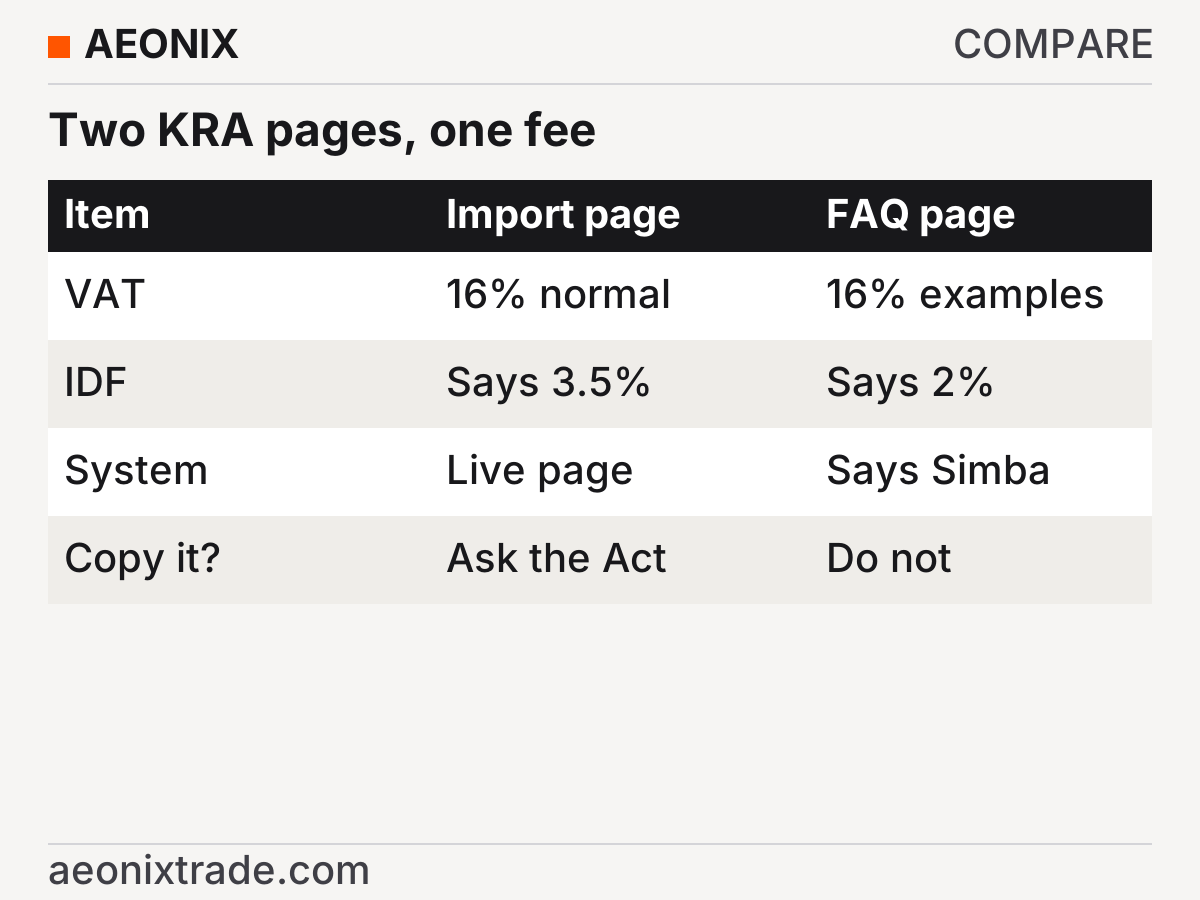
A second KRA page, the customs and border control FAQ, still says the import declaration fee is 2% of the customs value, and it still tells importers the entry is processed on the Simba 2005 system. The two KRA pages do not agree on the fee. The consolidated Act on Kenya Law did not return a readable copy on this check: the site answered with an HTTP 202 bot challenge and an empty body. Do not pick 3.5% or 2% because one of them feels newer. Ask the agent to show the line against the Act in force on the day of entry.
What the 16% is, and what it is not
KRA's VAT page says the general rate is 16% for taxable goods and services other than zero-rated supplies, and that the zero rate applies to supplies listed in the Second Schedule of the VAT Act, 2013. It also says an 8% rate had applied to certain petroleum products before 1 July 2023 and was deleted by the Finance Act, 2023. Kitchen tools are not that petroleum note. Whether they are standard-rated, zero-rated or exempt is the classification, not a category nickname.
The same VAT page says a person who supplies, or expects to supply, taxable goods and services of Kshs 5 million or more in a year must register for VAT. That is a registration threshold for suppliers in Kenya. It is not a rule that a small parcel from Ningbo skips import VAT. KRA's import page charges VAT on the import, and it says import VAT on taxable goods is collected as the goods come in. Read the HS code against the tariff the agent will actually declare. The Chinese invoice code is a hint, not the entry.
Excise is a separate question. KRA says excise depends on whether the item is excisable, and that the rates sit in the Excise Duty Act 2015. Housewares usually are not. A gadget with a battery, a drink, or a cosmetic can be. Do not borrow a neighbour's "no excise" note.
Who is allowed to file
KRA's import page says the importer needs a licensed clearing agent to capture the declaration. An agent who offers to "use their PIN" is offering their name. Know whose name is on the entry before you pay the Ningbo factory. If you are the importer, the entry should be able to say so. If a local partner must be the importer, that is a contract term, not a surprise at the port.
The twenty-one days run from the start of discharge. A box that sits while you argue about the HS code is eating that clock. Build the landed-cost sheet before the deposit: the FOB goods price, then the sea freight, insurance if you buy it, then duty, VAT and the levies the agent will assess, then Mombasa handling and the truck to Nairobi. Leave the tax lines blank until the agent fills them from the live rules. Do not add Ningbo export clearance or origin haulage on top of that FOB price. Those legs are already the seller's.
FOB Ningbo, Incoterms 2020, means the seller delivers on board and clears the export. The ICC Academy's FOB note keeps the haul through loading, including the origin LCL warehouse on the way to the ship, with the seller. The sea freight is still yours, and so is the Kenya import entry. Compare that with a delivered quote only after both include the Kenya assessment. The FOB page is the term. The LCL page is the shared box. Neither one is a Kenyan tax ruling.
When the cargo arrives
The ship discharges at Mombasa. The agent enters the goods, you pay the assessed taxes, customs may verify, and compliant entries are released. KRA's import page lists that path as IDF lodgement, entry and payment, verification, then clearance. What happens after release, the free time and the truck, is the same shape as any arrival. The walk-through is on what happens when cargo arrives. The South Africa guide is a different customs authority and a different rate card: importing from China to South Africa. Do not copy a SARS figure onto a KRA entry.
| Line on the sheet | What to write |
|---|---|
| Duty | 0%, 10% or 25% on the KRA page, or higher if the heading is sensitive. The agent confirms the heading. |
| VAT | 16% normal rate on the KRA VAT page, or 0% if the goods are exempt or zero-rated. Not the Kshs 5 million registration rule. |
| Import declaration fee and railway levy | The import page says 3.5% and 2%. The FAQ says 2% and names Simba. Do not type either pair until the Act is shown. |
| Excise | Only if the Excise Duty Act makes the item excisable. |
Before you pay the deposit
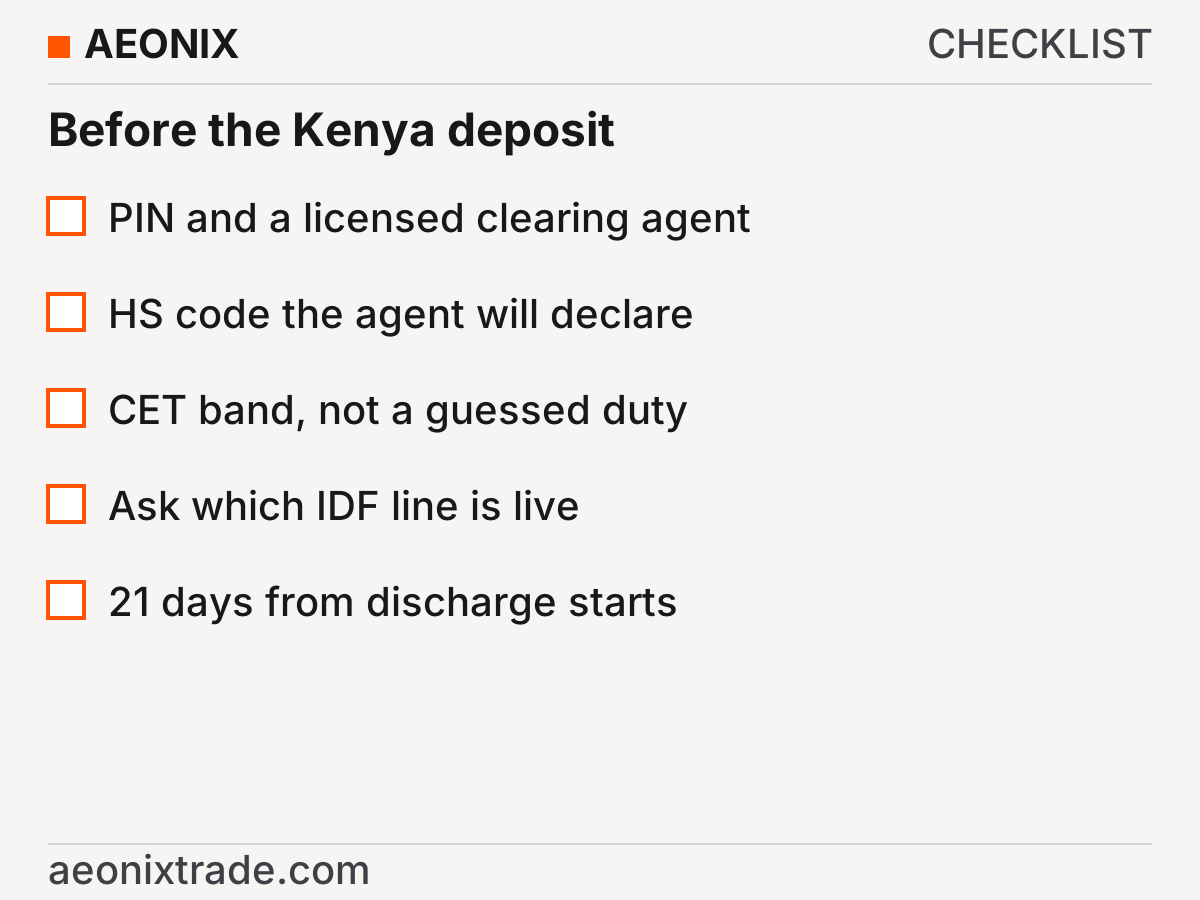
- Name the importer and the licensed clearing agent in writing.
- Agree the heading the agent will declare, and which CET band it sits in.
- Ask the agent to point at the live fee section, not at a blog and not at the Simba FAQ.
- Keep the invoice, packing list and payment proof. The entry has to match them.
- Price the truck after release. A Mombasa release is not a Nairobi shelf.
Mistakes
- Treating "KRA says 16%" as "my tools are 16%." Exempt and zero-rated lines exist. The heading decides.
- Adding 3.5% and 2% because the import page was the first result. The FAQ on the same authority still says something else, and the Act did not load.
- Letting the supplier ship to a consignee who is not the importer you can stand behind.
- Starting the twenty-one-day clock in your head from the day you notice the ship, rather than from the start of discharge.
- Comparing this file with a South Africa landed cost. Different law, different port, different bill.
Questions buyers actually ask
Can I clear a small LCL shipment myself?
KRA's import page says you acquire a licensed clearing agent to process the documents. A small cube does not retire that sentence. Confirm with the agent whether your name can be the importer.
Is the import declaration fee 2% or 3.5%?
On 9 November 2026 the KRA import page said 3.5% plus a 2% railway levy, and the KRA customs FAQ said 2%. Kenya Law did not serve the Act. The fee on your entry is the one the assessment shows.
Does the Kshs 5 million rule mean my first order is free of VAT?
No. That figure on the KRA VAT page is the registration threshold for a person supplying taxable goods in Kenya. Import VAT is a different sentence.
Who pays duty if the quote says FOB?
You do, unless a later contract moves the Kenya entry onto the seller. FOB does not include Mombasa duty or VAT. See the import-from-China hub for how the rest of the file is usually split, and send the Ningbo quote through the RFQ form if you want the Kenya lines rebuilt before you pay the deposit.
The quote and the entry are covered in which Incoterm to use, importing into Nigeria, and the customs clearance sequence.
Official sources
- KRA: importing and exporting. Twenty-one days to enter, licensed clearing agent, CET bands of 0%, 10% and 25% with sensitive lines higher, VAT 16% or 0% if exempt, and the 3.5% import declaration fee plus 2% railway levy as that page states them. Read 9 November 2026.
- KRA: value added tax. General rate 16%, zero rate for the Second Schedule, the deleted 8% petroleum note, and the Kshs 5 million registration threshold. Read 9 November 2026.
- KRA: customs and border control FAQ. Still states a 2% import declaration fee and names the Simba 2005 system. Cited because it conflicts with the import page, not because it should be copied.
- ICC Academy: FOB, Incoterms 2020. The seller clears export and carries the goods through loading on board. The buyer pays the main freight and handles import formalities. Checked 10 November 2026.
Submit sourcing request
Can't find what you need?
Start with a product or image link, an approximate quantity and destination. Other details can follow.