Import from China to Germany 2026: EORI, CE & GPSR
Published by Aeonix Trade.
2026 import checklist
Import from China to Germany in 2026: EORI, CE and GPSR checklist
Confirm EORI, import VAT, CE, GPSR, REACH/RoHS files, documents and customs release timing before the supplier ships.
- Confirm EORI, VAT handling and importer-of-record responsibility before purchase order approval.
- Classify the product by HS code and estimate customs duty, import VAT and anti-dumping exposure.
- Check GPSR, CE, REACH, RoHS, WEEE or other EU compliance files before production release.
- Prepare invoice, packing list, transport document, origin support and technical documentation.
- Align Incoterms, carrier route and delivery window with German customs release timing.
Last fact-checked: November 6, 2026.
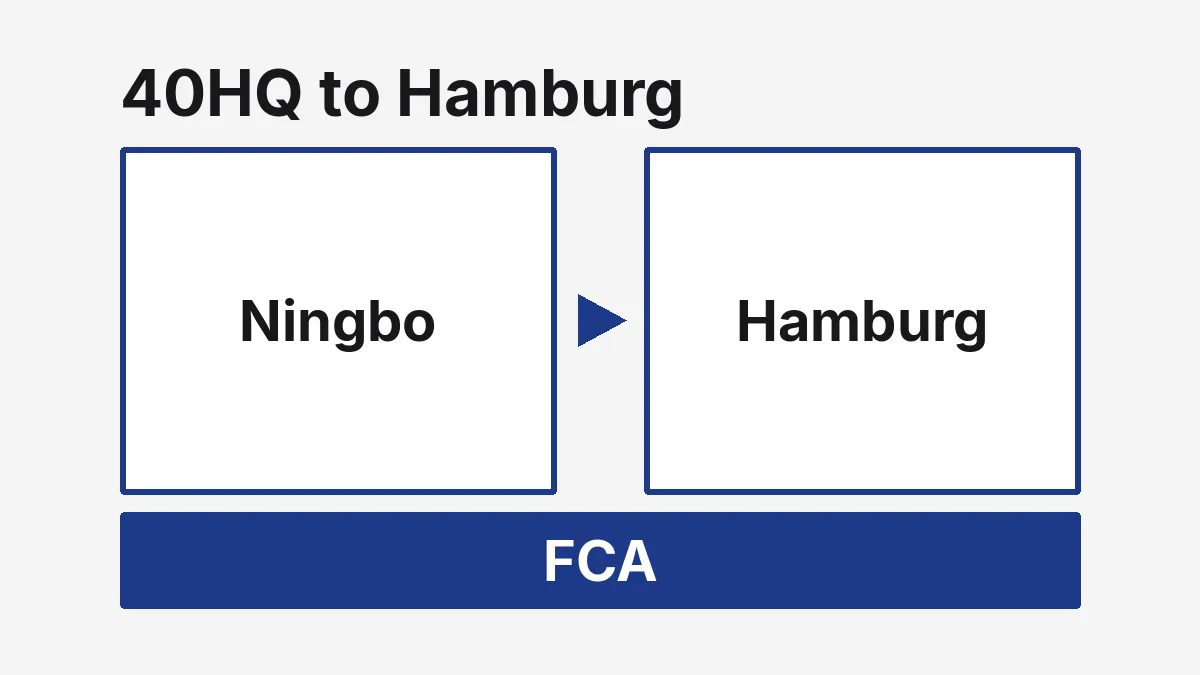
A Hamburg distributor books one 40HQ of cabinet hardware, handed over FCA at the Ningbo container terminal, for discharge in Hamburg. The factory sheet says FOB and "export customs included." Under FOB the seller handles export clearance and the cost of loading on board, and delivery is on the ship at the named port. This shipment is a container. ICC recommends FCA rather than FOB for containerised and LCL cargo, because the cartons are handed to the carrier before the vessel is loaded. Write the place: "FCA Ningbo container terminal."
The same EU layer is in the France, Netherlands, and Spain guides. Germany changes the filing desk and the product file you have to be able to show.
A typical Hamburg container
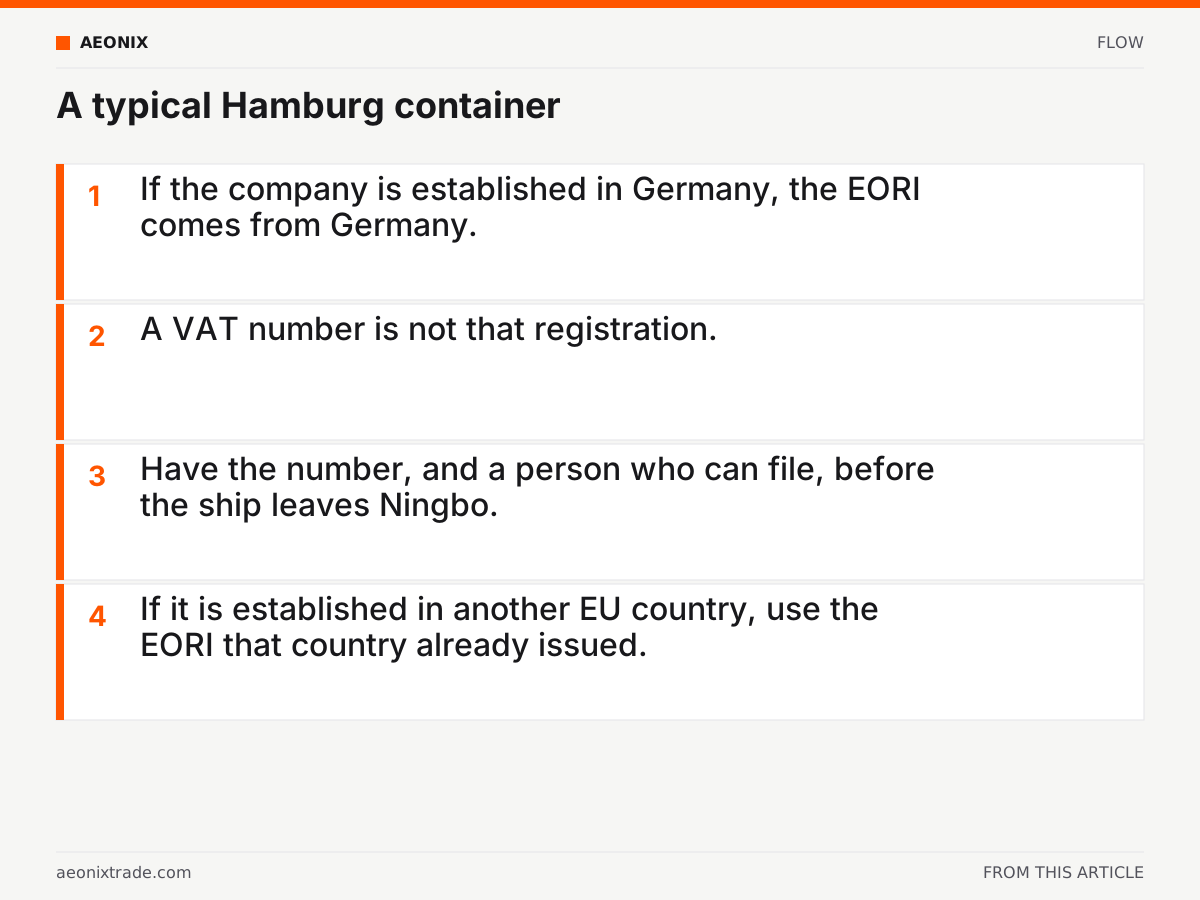
If the company is established in Germany, the EORI comes from Germany. If it is established in another EU country, use the EORI that country already issued. An operator not established in the EU applies where they first lodge a declaration. That rule is on the Commission's EORI page. A VAT number is not that registration. Have the number, and a person who can file, before the ship leaves Ningbo.
The duty line is the Common Customs Tariff measure for the code your broker will actually declare. The six digits on the supplier invoice are the start of a longer European code. Your broker owns the rest. Anti-dumping and other additional measures, when they exist, show up on that measure. They do not show up as a discount on the FCA price. The HS code note is the argument to have before production, not after the arrival notice.
GPSR, CE, and the parcel rule this container is not
December 13, 2024 matters because the General Product Safety Regulation began applying across the EU. For a German buyer that means a product-safety file and a named responsible person you can explain when the goods are placed on the market. The Commission's GPSR factsheet and the product-safety page are the pages to read with your technical file. The legal text sits on EUR-Lex. CE marking is a separate, category-specific question. Confirm it on Your Europe for the exact SKU before the factory prints the carton. REACH and RoHS files, when the hardware actually needs them, sit in that same pack. A forwarder cannot write them in Hamburg.
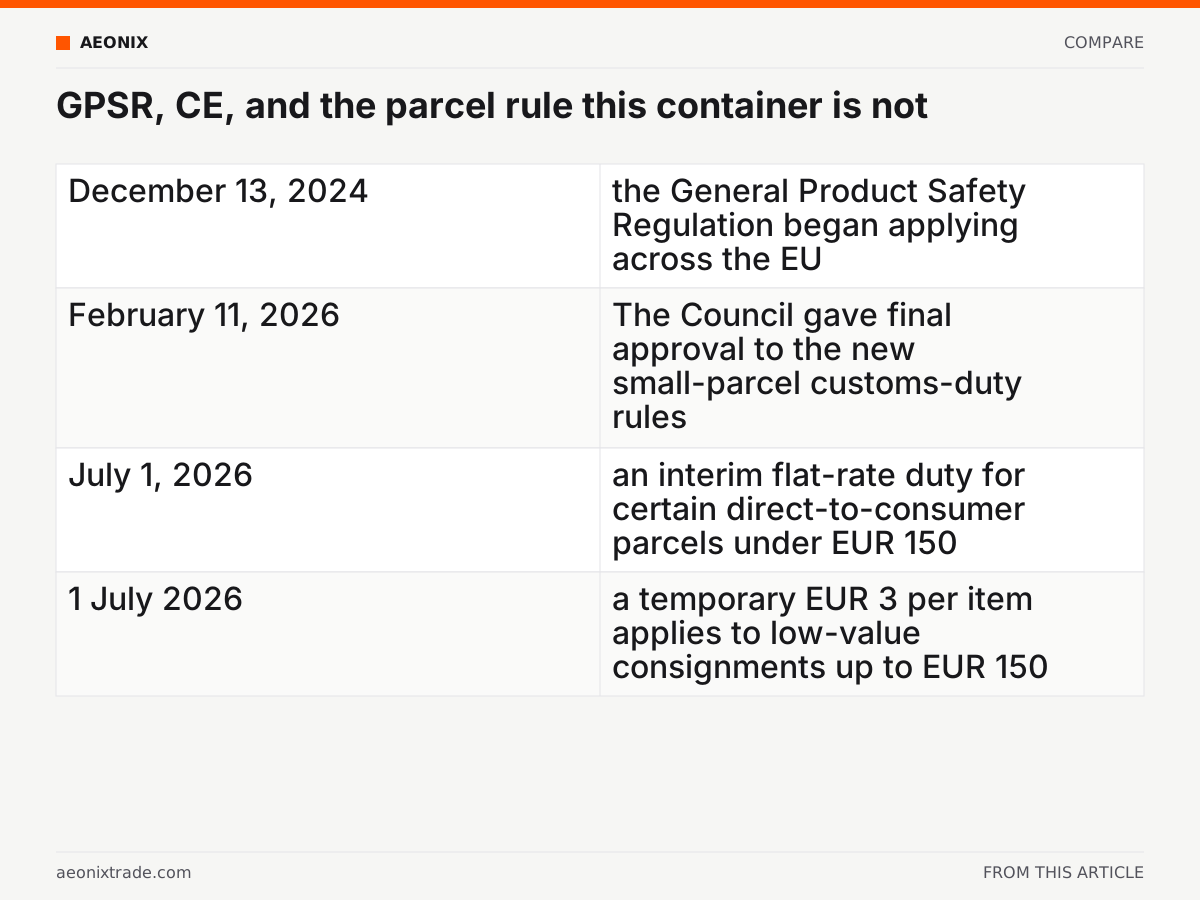
February 11, 2026 is the second date to keep visible. The Council gave final approval to the new small-parcel customs-duty rules, with an interim flat-rate duty for certain direct-to-consumer parcels under EUR 150 starting on July 1, 2026 and the broader under-EUR-150 customs-duty relief disappearing once the EU Customs Data Hub is live, currently expected in 2028. From 1 July 2026 a temporary EUR 3 per item applies to low-value consignments up to EUR 150, until 1 July 2028, when the EU Customs Data Hub for e-commerce is due and normal duties apply (Commission guidance). The announcement is the Council's February 11, 2026 press release. A 40HQ of cabinet hardware is not that parcel lane. The duty on this container is the tariff measure, read with German customs.
Landed cost before the deposit
Put the lines on the landed-cost sheet before you accept the MOQ. Customs value follows the WCO valuation rules your broker applies to the invoice and the freight evidence. Duty and import VAT come from the live measure and from German customs. Write "see the official page" on those rows. Do not copy a rate out of another EU guide or out of last year's order.
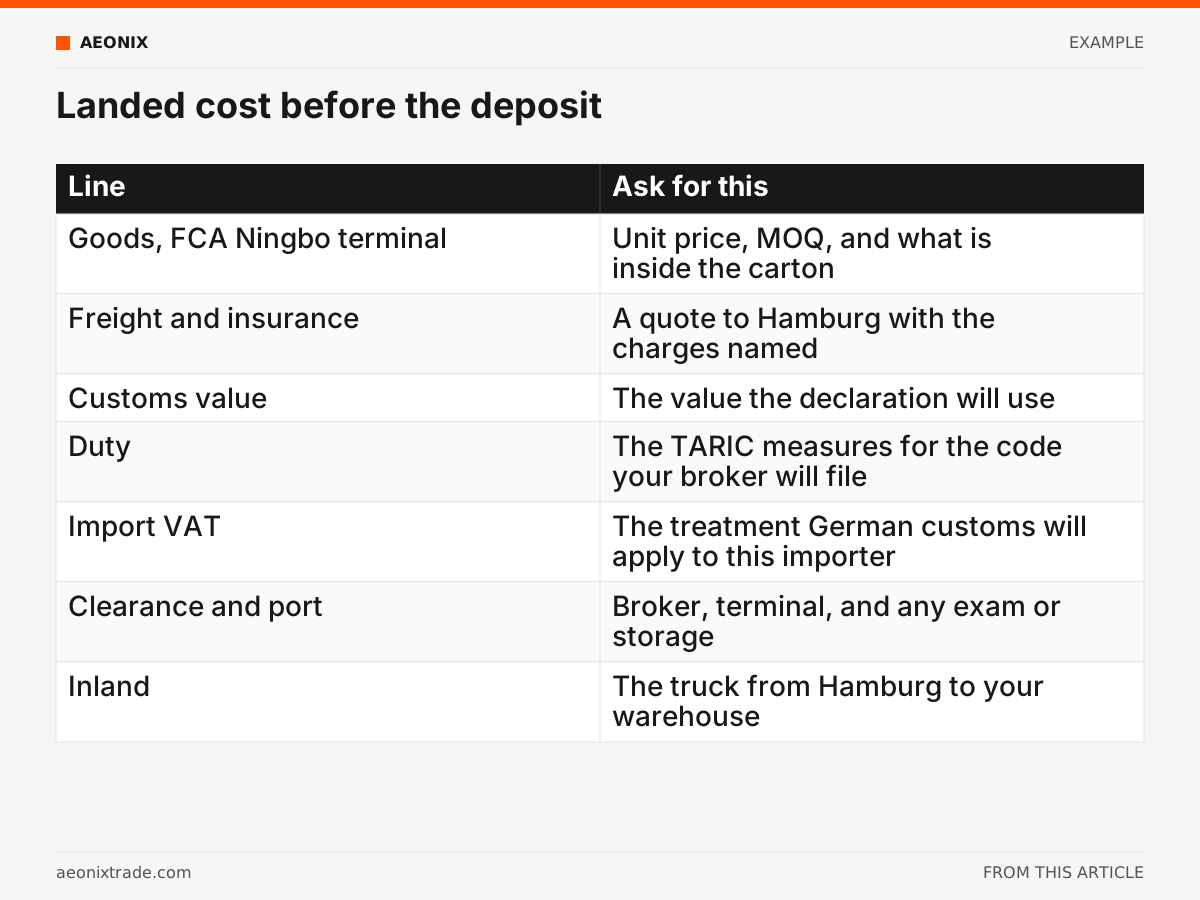
| Line | Ask for this | Do not assume |
|---|---|---|
| Goods, FCA Ningbo terminal | Unit price, MOQ, and what is inside the carton | That FCA includes the ocean freight |
| Freight and insurance | A quote to Hamburg with the charges named | That "freight included" means the box is in your warehouse |
| Customs value | The value the declaration will use | That the FCA unit price is the customs value |
| Duty | The TARIC measures for the code your broker will file | A rate copied from a chat or from another country page |
| Import VAT | The treatment German customs will apply to this importer | That VAT disappears because the customer is German |
| Clearance and port | Broker, terminal, and any exam or storage | That the forwarder's destination agent is your importer |
| Inland | The truck from Hamburg to your warehouse | That port release is the same thing as delivery |
Where this lane goes wrong
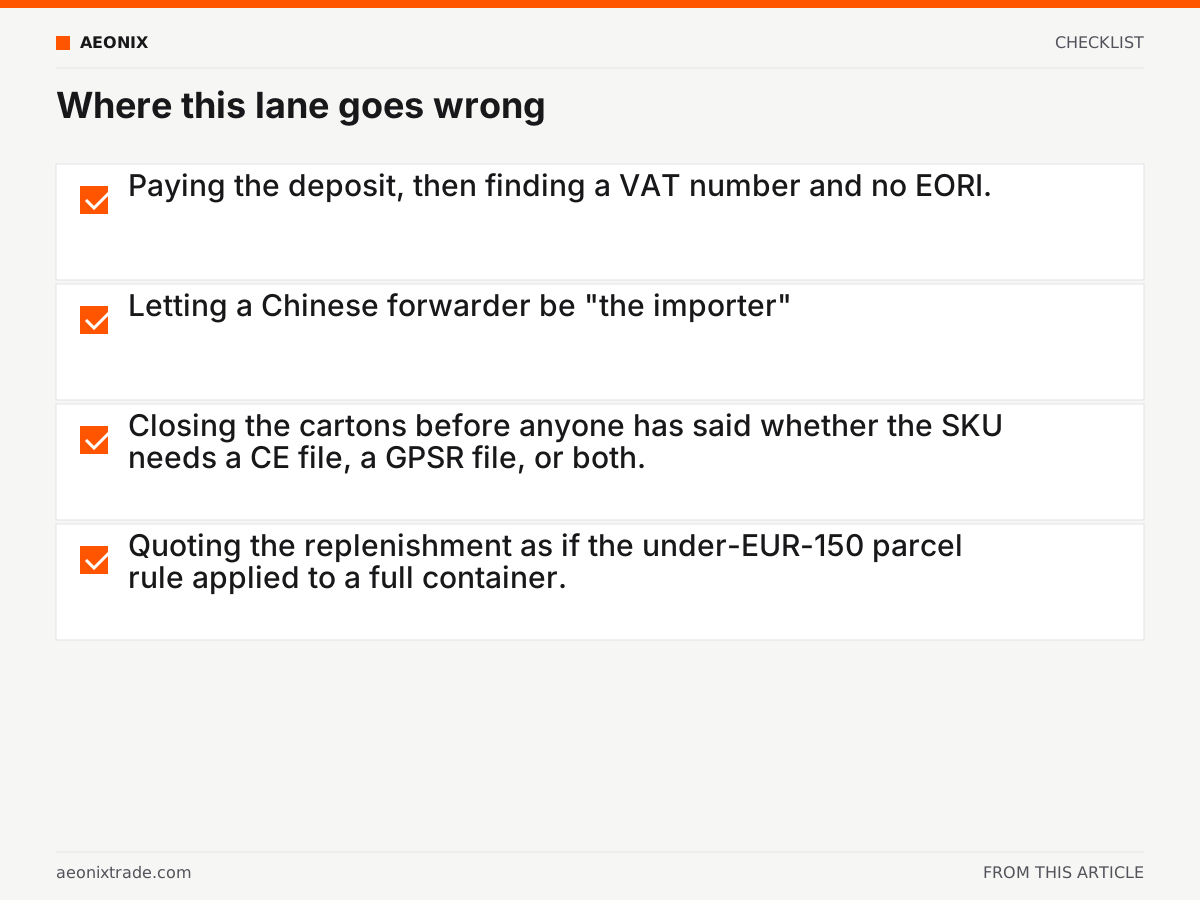
- Paying the deposit, then finding a VAT number and no EORI. They are different registrations.
- Letting a Chinese forwarder be "the importer" on a DDP-style offer. If your company will sell the hardware, your company should be able to explain the declaration.
- Closing the cartons before anyone has said whether the SKU needs a CE file, a GPSR file, or both. A forwarder in Hamburg cannot write that file on the quay.
- Quoting the replenishment as if the under-EUR-150 parcel rule applied to a full container.
- Wiring the balance to an account name that does not match the seller on the contract. Check that before the TT, the way the supplier check describes.
The general order of the file is the first-time compliance checklist. After the vessel berths, the clocks are the arrival sequence. The German differences are the declaration, the VAT, and the product file. The Germany commercial guide is market background. It is not the tariff.
If you want the Ningbo handover and the document set checked before you wire the deposit, use the RFQ form.
Official sources
- EU EORI: who issues the number.
- Common Customs Tariff: where duty and extra measures are published. Read the live measure.
- German customs, duties and taxes: the import-charge page for this declaration.
- German customs import declaration guide: how the import declaration is completed.
- GPSR factsheet: Commission factsheet on the regulation that began applying on December 13, 2024.
- EUR-Lex, General Product Safety Regulation: the legal text. Read it with the factsheet above.
- Your Europe, CE marking: when a CE mark is required.
- Council press release, February 11, 2026: the small-parcel duty announcement. Pair it with the tariff and with German customs. It is not the duty notice for this container.
- Commission guidance on the temporary flat fee: from 1 July 2026, EUR 3 per item on low-value consignments up to EUR 150, until 1 July 2028.
- Germany Country Commercial Guide, import requirements: market background from the U.S. Commercial Service.
Submit sourcing request
Can't find what you need?
Start with a product or image link, an approximate quantity and destination. Other details can follow.