Importing from China to the Netherlands in 2026: A Buyer-Ready Guide
Published by Aeonix Trade.
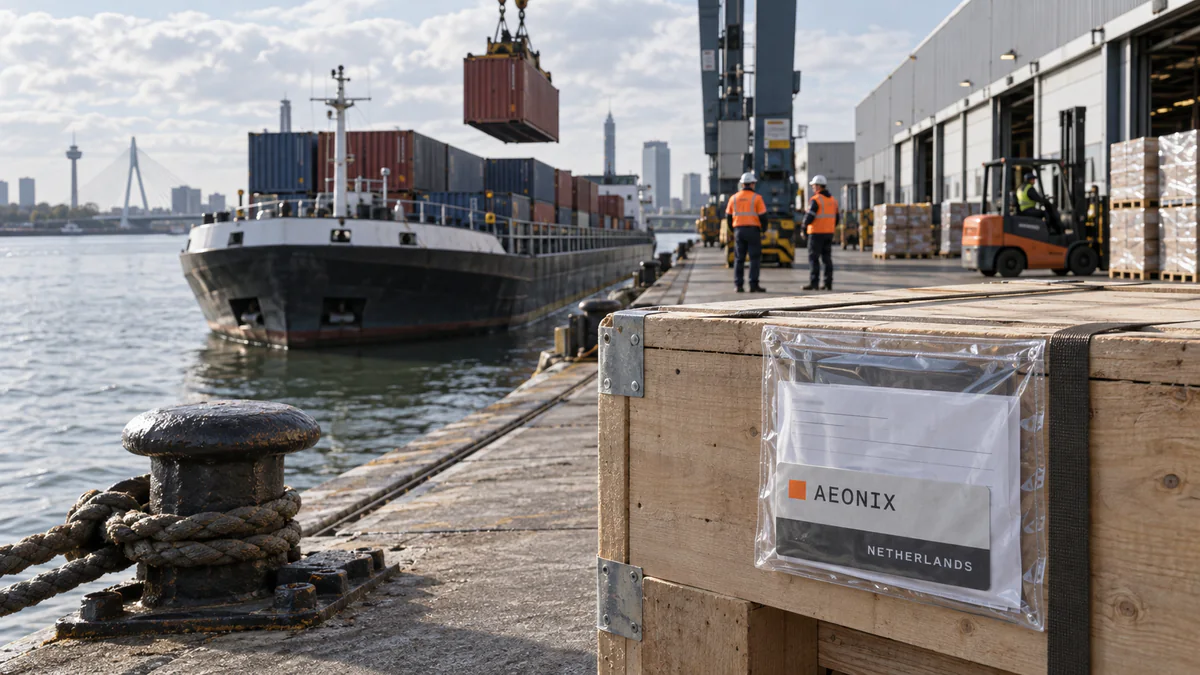
2026 import checklist
Import from China to the Netherlands in 2026: EORI, VAT and EU compliance checklist
Confirm EORI, HS classification, import VAT, CE/GPSR files, Port of Rotterdam routing, documents and delivery timing before supplier payment.
- Confirm the EORI holder, VAT treatment and importer-of-record responsibility in the Netherlands or EU.
- Classify the product by HS code and estimate customs duty, import VAT and anti-dumping exposure.
- Check CE, GPSR, REACH, RoHS, WEEE or food-contact files before approving packaging or labels.
- Prepare invoice, packing list, transport document, origin support and technical documentation.
- Compare air, LCL and FCL around Rotterdam release timing, storage risk and final warehouse delivery.
Last fact-checked: April 4, 2026. This guide is based on the official sources listed at the end.
Quick answer: The Netherlands still works in 2026 when VAT design, customs ownership, and onward-movement planning are solved before the vessel booking. The route remains commercially powerful because the logistics infrastructure is strong and the customs process can be highly effective for prepared importers, not because Rotterdam magically fixes weak importer design.
The weak version of the route is the common myth that Rotterdam automatically solves everything. It does not. Buyers still need the right importer structure, EORI, VAT treatment, and product-screening logic before the goods move.
If you want help turning this checklist into a live sourcing plan, see our the Netherlands sourcing support.
Quick Verdict: Is importing from China to the Netherlands still worth it in 2026?
The Netherlands remains one of the strongest EU entry routes for disciplined importers with the correct VAT and customs structure.
It is not automatically the best route for every buyer. The gateway advantage only works when the importer can legally and operationally use the Dutch setup well.
- Good fit: structured EU importers using the Netherlands as a real gateway or domestic destination.
- Weak fit: buyers assuming Article 23 or other VAT advantages apply automatically.
- Core rule: design the importer structure first, then decide whether the Dutch entry point really fits.
Why the Netherlands can still reward direct buying in 2026
The Netherlands still works because it combines strong port logistics, clear customs handling, and a real commercial advantage for buyers who can keep their VAT and release model under control.
China still offers the supply flexibility that makes the route worthwhile, but the business win comes from how the importer handles entry and onward movement, not just from how cheap the supplier quote looks.
- Dutch entry can still be a strong cashflow and logistics choice when structured correctly.
- China remains attractive for price, MOQ flexibility, and product range.
- The route rewards planning, not assumptions.
Who this route fits, and who should wait
The best-fit buyer is a structured importer that can use the Dutch customs and VAT model properly and already knows where the goods will go after release. These buyers can turn the Netherlands into a true control point for EU inventory flow.
The poor-fit buyer is someone who picks Rotterdam because it sounds efficient but has not solved importer-of-record, VAT, or onward movement design.
- Best fit: importers with clear EU routing, customs ownership, and VAT treatment.
- Watch out: buyers assuming Article 23 is automatic or universally available.
- Poor fit: route decisions driven by port reputation instead of importer structure.
What buyers should prepare before the first order
The Netherlands route should start with the importer structure, EORI, and VAT treatment. If the buyer wants to use Dutch entry efficiently, those questions need answers before the booking is made, especially if the route depends on Article 23 thinking.
The next preparation step is product screening and real landed-cost modeling. A gateway route is only useful if the buyer knows what happens after release and how the inventory will move onward.
Starter checklist
- Confirm the EORI and Dutch or EU importer structure before the PO is finalized.
- Check whether the VAT treatment, including an Article 23 permit where relevant, is actually available to the importer or tax structure being used.
- Model duty, VAT, destination charges, and onward movement before deposit.
- Screen the product for any extra control or in-scope CBAM exposure.
- Assign owners for customs release and post-release movement.
Dutch gateway route test before you choose Rotterdam
The Netherlands is strong when the buyer can explain the route from vessel arrival to final EU delivery before the booking is made. The gateway is useful only when the importer, VAT design, and onward movement all fit the legal structure being used.
That means the right first question is not whether Rotterdam is efficient. It is whether this importer can legally and operationally use Dutch entry well.

Starter checklist
- Importer owner: the buyer knows which Dutch or EU entity imports and whether EORI and customs ownership are already in place.
- VAT owner: Article 23 or any other Dutch VAT treatment has been checked against the actual permit or legal setup, not assumed from a sales pitch.
- Declaration owner: one customs-side partner is named to file and monitor the Dutch declaration before arrival.
- Onward-movement owner: the buyer knows how the inventory moves after Dutch release and which documents or responsibilities follow that movement.
- Failure test: the route still works even if Dutch entry is slightly delayed or Article 23 is not available to the structure being used.
Policy watch: Dutch gateway strength only works when VAT and pre-arrival data are both clean
The Netherlands remains strong in 2026, but buyers should not overstate why. Article 23 can be a major cashflow tool, yet it depends on a permit and the right legal setup. The route should be sold as powerful when structured correctly, not as universally easy.
By 2026, buyers should also treat ICS2 as fully active and CBAM as definitive for in-scope goods from January 1, 2026. That means pre-arrival data and category screening both belong early in the buying process.

- Do not promise Dutch VAT advantages without checking eligibility first.
- Treat ICS2 data quality as part of the release plan.
- Screen CBAM early for in-scope industrial goods.
What happens after cargo arrives in the Netherlands
After arrival in the Netherlands, cargo enters temporary storage, customs declaration, duty and VAT handling, and then release for circulation or onward EU movement. The route is smooth when entry and post-release ownership are both defined before arrival.
Where buyers get hurt is assuming the gateway solves uncertainty. In reality, the gateway only exposes whether the uncertainty was already in the file.

Starter checklist
- Make sure the customs-side partner has the full importer and product file before declaration.
- Confirm that pre-arrival data, declaration data, and onward-movement planning are aligned.
- Handle duties, VAT, and release charges without delay.
- Coordinate onward EU movement only after the Dutch release path is actually clear.
How to choose suppliers, brokers, and sourcing support for the Netherlands
A good Netherlands route needs one partner focused on supplier and commercial-document quality, and another focused on Dutch customs, VAT handling, and onward movement. Buyers should understand both roles separately.
A weak partner talks about Rotterdam's reputation. A strong partner explains the exact importer structure and release workflow that makes the route commercially viable.
Starter checklist
- Ask the sourcing side how supplier documents and shipment descriptions are quality-checked.
- Ask the customs-side partner what Dutch importer and VAT setup the route requires and whether Article 23 is actually available to that structure.
- Ask whether the goods need any extra controls beyond customs filing.
- Ask who owns the handoff from Dutch release to final EU delivery and what happens if the release date moves.
Frequently asked questions
Is the Netherlands automatically the best EU gateway for every buyer?
No. It can be excellent, but only when the importer structure, VAT treatment, and onward movement model are right for the business.
Can I assume Article 23 applies to my imports?
No. Buyers should check eligibility and legal setup before building a route around it.
What is the biggest Dutch-entry mistake?
Choosing the port before choosing the importer structure and VAT design.
Official sources used in this guide
- Dutch Customs: Official Dutch Customs portal.
- Dutch tax authority on Article 23: Official Dutch guidance on the Article 23 reverse-charge mechanism, including permit logic and limits for foreign entrepreneurs.
- Dutch Customs on EORI: Official guidance on EORI requirements for Dutch customs formalities.
- Business.gov.nl importing guide: Official Dutch business portal guidance for non-EU imports.
- EU ICS2: Official EU customs security guidance for ICS2.
- EU CBAM: Official EU CBAM information.
Submit sourcing request
Can't find what you need?
Start with a product link or photo, an approximate quantity and destination. Other details can follow.