November 22, 2026Suppliers & quality12 min read
Quality Control in China: Inspection Types, AQL and When to Book
Published by AeonixTrade.
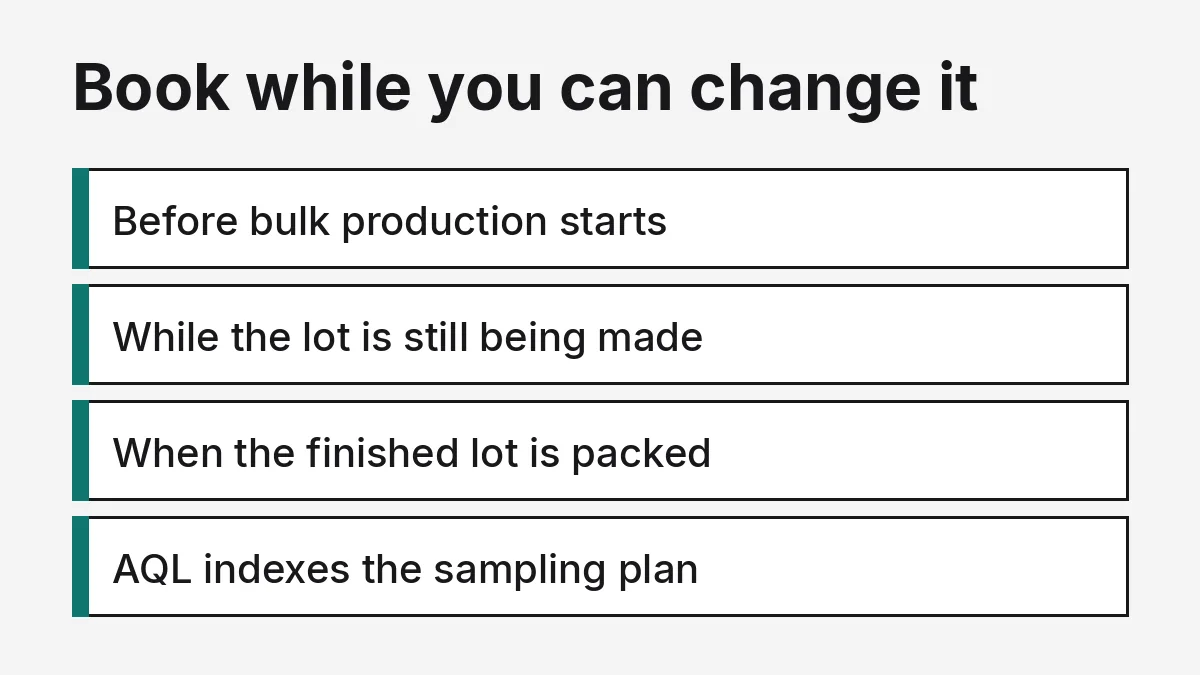
Book the inspection that can still change the order. A check after the balance is paid, and after the container has sailed, tells you what you already own. Match the visit to the risk you can still act on: the materials, the process, the finished lot, or the cartons that go into the box. The goods on this desk leave EXW from Yiwu. The inspection is booked against the lot that will leave that place.
Request a quote. First reply within 1 business day. Send the product, the lot size, the signed specification, and the stage you want watched.
Four visits, four moments you can still act
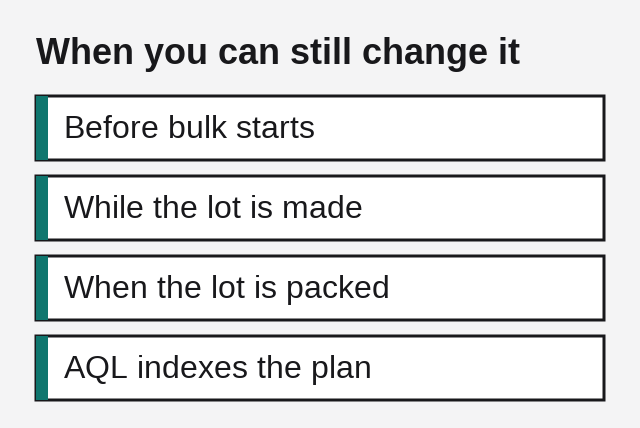
Pre-production happens before bulk materials are cut and before the first production lot starts. Use it when the risk is the fabric, the component, the construction, or a gap between the approved sample and the factory's reading of it. A failed result can still change the material or the method. It cannot judge the finished lot, because that lot does not exist yet.
During production happens while the lot is still being made. Use it when a defect would repeat across the remaining pieces: a colour drift, a skipped stitch, a wrong component. A failed result can still stop the rest of the run. It cannot sign off the packed lot. How two inspection firms phrase the completion window is recorded on during production versus pre-shipment. Copy the condition you agreed into the booking. A blog average of someone else's window is not your booking.
Pre-shipment happens when the lot is finished and packed enough to sample. Use it when the risk is the goods you are about to pay the balance on. The result can hold that balance, if the contract says a pass is the trigger. It sees the cartons that were presented. It does not see what happens after those cartons leave the inspection room. The working checklist is the pre-shipment inspection checklist.
Container loading happens at the door. Use it when the risk is the wrong cartons, the wrong marks, or a count that does not match the packing list going into the box. The record to keep is container loading supervision. Loading supervision checks the load. It resamples the lot only when the contract says so. The mode that then moves the box is shipping from China: sea, air, rail, LCL and FCL.
When to book which
| The risk you are paying to see | Book this visit | A failure can still change |
|---|---|---|
| Material, construction, or the approved sample | Pre-production, before bulk starts | The material and the method. The lot has not been made. |
| A defect that would repeat through the rest of the run | During production, while the line is open | The remaining pieces. The packed lot is still ahead. |
| The finished, packed lot you will pay the balance on | Pre-shipment, on the lot as presented | The balance, if the contract makes a pass the trigger. |
| Wrong cartons, wrong marks, or a short count at the door | Container loading supervision | What goes into that container, before the seal. |
| You will stand on the Yiwu floor yourself, before any of the above | A floor check, then one of the four visits if the lot is still ahead | Whether you buy the lot. It is not a sampling plan. |
Book one visit for the risk that would be most expensive to discover later. Add a second visit when two risks are both live. A during-production visit plus a pre-shipment visit is a common pair: the first can stop a repeating defect, and the second can hold the balance. Skip a visit only when that risk is already closed in writing. Closing it means the specification, the approved sample, and the previous report agree.
Book the inspector for a date when the lot will actually be in the state the visit requires. During production needs an open line. Pre-shipment needs a finished lot that can be sampled. Loading needs the container and the cartons in the same place. If production status is unclear, read how to track production before you lock the date. The quote for the visit is per inquiry. This page does not print a man-day figure.
AQL, for the buyer who has to sign the plan
BSI publishes BS ISO 2859-1:2026, dated 31 January 2026, as identical to ISO 2859-1. The title is sampling procedures for inspection by attributes: sampling schemes indexed by an acceptance quality limit (AQL) for lot-by-lot inspection. BSI describes it as a system of single, double, and multiple sampling plans used to accept or reject a batch from a statistical sample. The catalogue page does not print an accept number. This article does not invent one.
The contract names three things before anyone draws a sample. It names the standard, BS ISO 2859-1:2026 or the ISO edition the parties agree. It names the AQL. It names the inspection level and whether the plan is single, double, or multiple. The inspector then reads the sample size and the accept number from that plan for the lot size in front of them. The deeper walk-through of agreeing that plan is how to agree a sampling inspection before you order.
NIST describes acceptance sampling as a decision on the lot: accept it or reject it from a random sample. NIST's point is that the purpose is to decide whether the lot is likely to be acceptable. The purpose is not to estimate the quality of every piece in the lot. On the following page, NIST describes a single sampling plan as one sample, with the lot rejected when defectives exceed the number in the plan. That number is the plan's number. It is not a percentage you can multiply by the lot size on a scrap of paper.
NIST also describes AQL as a baseline percent defective: the producer wants a high probability of accepting a lot at or below that baseline. Read that as NIST's teaching definition. The accept and reject numbers you will live with are the ones in the standard's tables, for the AQL and the level written in the contract. Switching among normal, tightened, and reduced inspection is part of the scheme BSI describes. Use it when you have a continuing series of lots and the contract says the switching rules apply. A single first order is still a lot-by-lot decision under the plan you named.
Write the defect definition before the visit. A stain, a measurement miss, and a safety failure are different defects. The plan counts the ones the specification calls out. If the specification is silent, the inspector will use a house list, and you will argue about the report afterwards. The document that should hold the defect list, the AQL, and the consequence of a failure is the quality agreement and the specification. The plain-language term for the whole activity is quality control.
What a pass does, and what it leaves open
A pass records that the sample met the plan named in the contract, on the day the cartons were presented. If the contract says the balance follows a pass, the pass is the commercial trigger you agreed. Read the report for the sample size, the defect counts, the measurements, and any row left pending. How to read those rows is how to read a pre-shipment inspection report.
A pass is a record of that sample against that plan. A safety file for the market you sell into is a different document. Which document carries the compliance claim, for the Union mark, for Great Britain, for US radio equipment, or for a children's product certificate, is when a PSI pass is not a safety certificate. Product tests and labels sit on product testing and compliance. Book the test while you can still change the product. A passed sampling visit does not stand in for the test report.
A pass also leaves the load unchecked, unless loading supervision was part of the same booking. Cartons can be swapped after a pre-shipment visit. That is the reason the door has its own visit when the mix of marks is the risk.
A failure follows the clause in the quality agreement. Typical commercial consequences are a rework and a re-inspection, a sorted lot, or a held balance. The clause you signed is the one that applies. How a claim starts after the goods have already moved is defective-goods claims. The cheaper moment to use the clause is before the balance moves and before the container is sealed.
Who goes, and what you hand them
Go yourself when you are on the floor and the decision is whether to buy. That check is a Yiwu floor check before you ship. It can reject a lot you can see. It is not a substitute for a sampling plan on a finished production lot.
Hire an inspector when you will not be at the factory on the day the lot is in the right state. How to compare firms, and what to put in the instruction, is how to hire a third-party inspector. Give the inspector the specification, the approved sample reference, the defect list, the standard, the AQL, the inspection level, the lot size, and the address where the goods will actually be. An instruction that says "check the quality" produces a report you cannot tie to the balance.
Tell the inspector what a pending row should do. A missing barcode, an unfinished carton count, or a measurement still open is a decision. Decide it in the booking, so the report's last line has somewhere to land. The balance stays where the contract put it until that line is closed.
A sequence that matches an EXW Yiwu order
Agree the specification and the sampling plan before production starts. That is the quality agreement. If the material or the construction is new, book pre-production against the approved sample and hold bulk until that visit is closed.
If the run is long enough that a repeating defect would be expensive, book during production while the line is open. Use the status updates to confirm the line is actually open on the day you named.
Book pre-shipment on the finished lot, at the place the goods will be handed over EXW. The sample is drawn from the cartons presented there. The report is the record you use for the balance, when the contract says so.
If several booths or several lots will share a container, book loading supervision. Match marks and counts to the packing lines before the seal. The shipping hub covers which mode then moves the box. The inspection does not choose the mode. It confirms the cartons that the mode will carry.
A small market lot that you have already checked on the floor may need only the pre-shipment visit, or only the loading check, when the specification is simple and the contract says so. Write that choice down. Silence is how a finished lot sails on a handshake.
Frequently asked questions
Which inspection should I book first?
Book the visit that matches the risk still open. Materials and construction point to pre-production. A repeating process defect points to during production. The finished lot you will pay for points to pre-shipment. The cartons at the door point to loading supervision. Send the stage with the quote request.
What do I put in the contract for AQL?
Name the standard, the AQL, the inspection level, and whether the plan is single, double, or multiple. The inspector reads the sample size and the accept number from that plan for your lot size. This page does not supply those two numbers. BSI's catalogue of BS ISO 2859-1:2026 is the standards-body entry for the scheme. The tables stay in the standard.
Does a pass mean every piece is good?
A pass means the sample met the plan you signed, on the cartons presented that day. NIST describes acceptance sampling as a lot decision, not an estimate of every piece. Pieces outside the sample can still be defective. The plan is how you and the seller allocated that risk.
Does a pass let me sell the product?
Selling into a regulated market depends on the safety file that market requires. The PSI-pass page names which document carries that claim. Keep the inspection report and the safety file as two attachments. One does not replace the other.
When is loading supervision worth booking?
Book it when more than one lot will share the container, when marks have been wrong before, or when the count on the packing list is the count your broker will file. Skip it when a single sealed lot was sampled at pre-shipment and will not be reopened. The loading page is the record to keep at the door.
Send the product, the lot size, the specification, and the stage. Request a quote. First reply within 1 business day.
Sources
- BSI Knowledge: BS ISO 2859-1:2026. Identical to ISO 2859-1. Published 31 January 2026. Sampling schemes indexed by AQL for lot-by-lot inspection. Opened 22 November 2026. No accept number is copied from the catalogue page.
- NIST/SEMATECH e-Handbook: what acceptance sampling is. A decision on the lot, not an estimate of its quality. Opened 22 November 2026.
- NIST/SEMATECH e-Handbook: kinds of lot acceptance sampling plans. A single plan rejects the lot when defectives exceed the number in the plan. Opened 22 November 2026.
Submit sourcing request
Can't find what you need?
Start with a product or image link, an approximate quantity and destination. Other details can follow.