Import from China to Egypt in 2026: Duties, Documents and Landed Cost
Published by Aeonix Trade.
Last fact-checked: November 9, 2026.
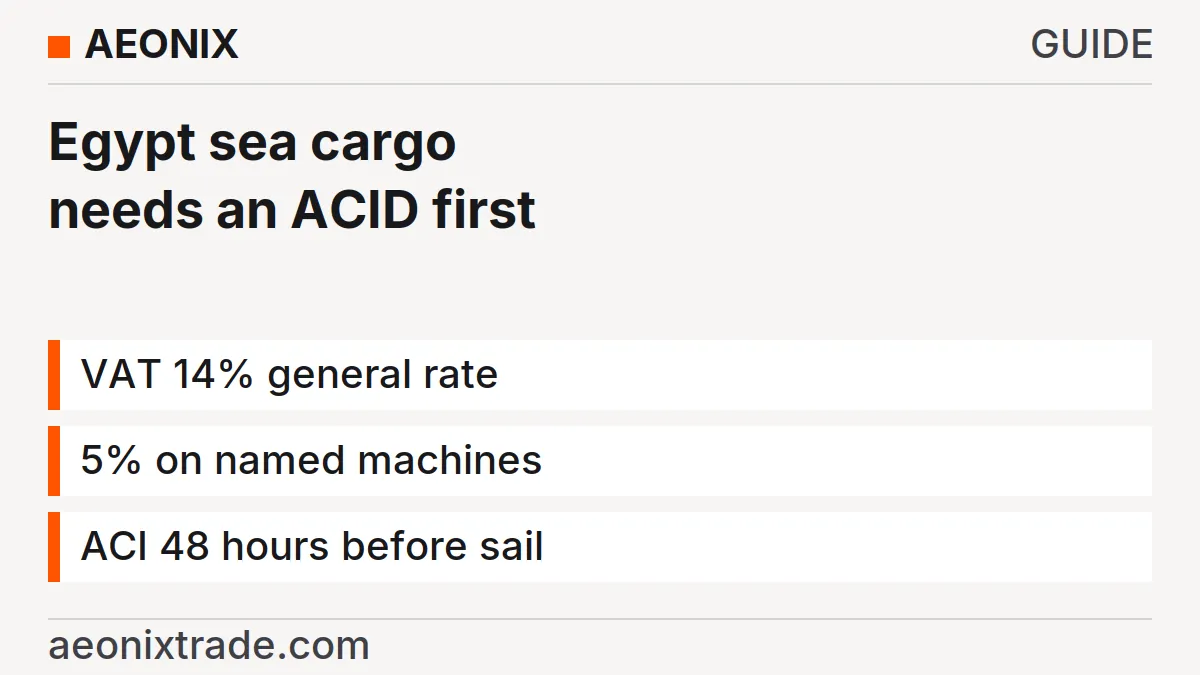
An importer in Cairo buys a 20-foot container of small kitchen appliances, FOB Shenzhen, and tells the factory to ship "as soon as the deposit lands." Egyptian Customs' ACI page says the advance cargo data for a sea shipment has to be in at least 48 hours before the goods are shipped, and that mandatory ACI on sea shipments has applied since 1 October 2021. Importing from China to Egypt starts before the vessel leaves, not when it reaches Alexandria or Sokhna.
A typical case
The appliances are finished goods for resale, not a production machine and not a car. The invoice is one commercial invoice, the packing list matches the cartons, and the bill of lading will name the Cairo company as consignee. The sea leg is a full container. None of that tells you the tax. The tax is the VAT law, plus whatever table tax the tariff heading carries, assessed when customs releases the goods.
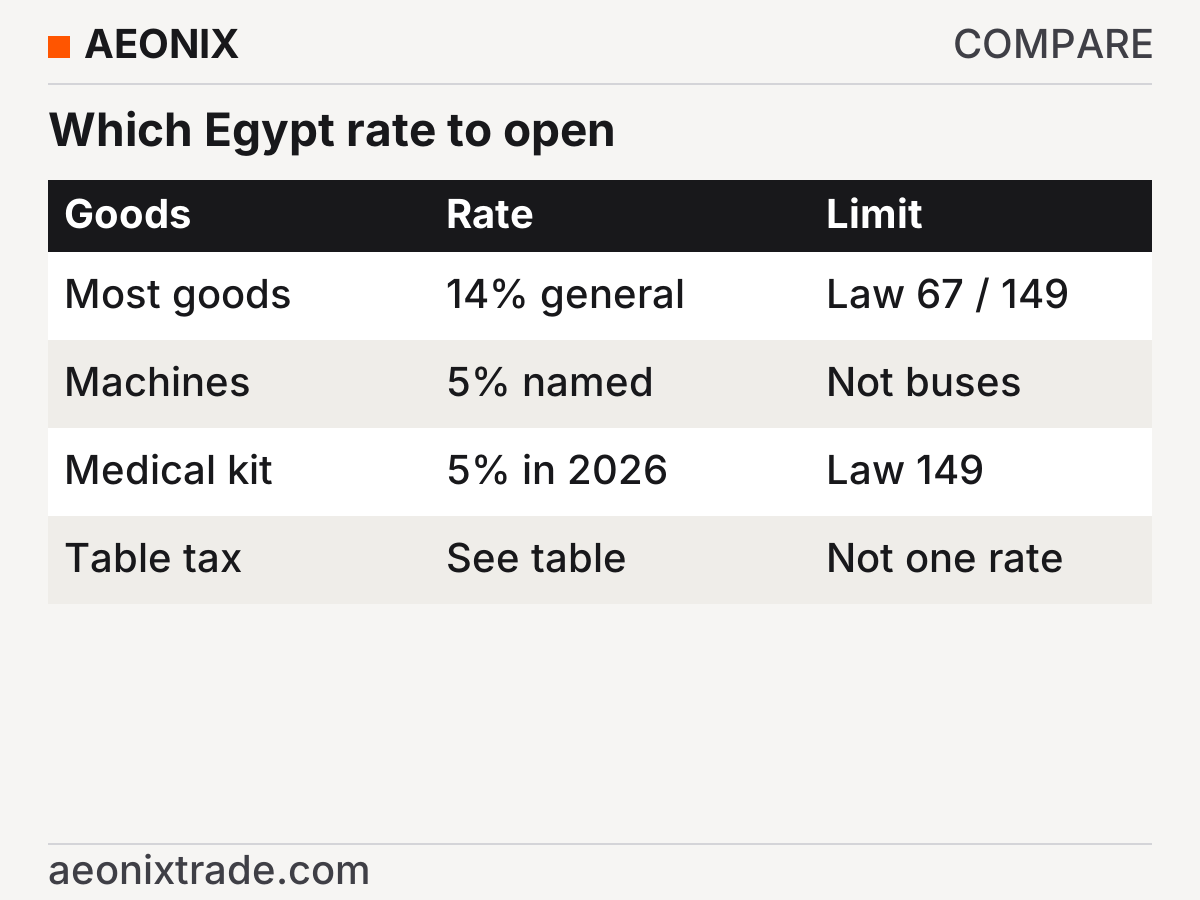
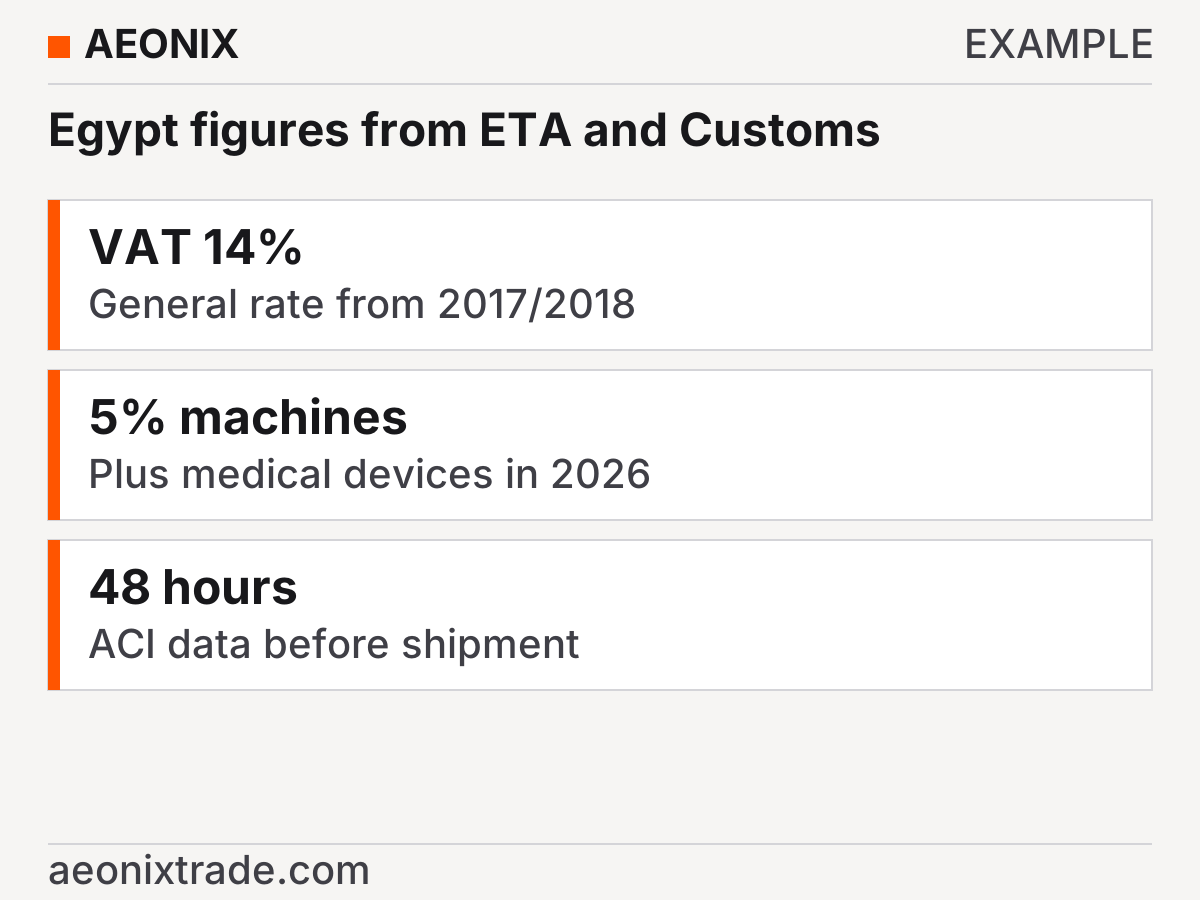
The English translation of VAT Law No. 67 of 2016, posted by the Egyptian Tax Authority and marked updated on 15 January 2023, says the standard rate is 13% for fiscal year 2016/2017 and 14% from the beginning of fiscal year 2017/2018. It says 1% of the tax is allocated to social justice programs. As an exception, machines and equipment used to manufacture a commodity or provide a service are at 5%, except buses and passenger cars. The same translation says imported goods are taxed at the customs-release stage, when the customs-duty point is fixed, whatever the purpose of the import, including personal use.
Law No. 149 of 2026, in the Official Gazette text the Tax Authority hosts, replaces the first paragraph of article 3 and still states the general rate as 13% for 2016/2017 and 14% from 2017/2018. It widens the 5% exception to machines, equipment and medical devices used to produce a good or provide a service, except buses and passenger cars, and it treats devices used for medical purposes as medical devices for that exception. The Gazette issue is dated 28 July 2026. If your SKU is a household blender, do not borrow the 5% line. If it is a machine a factory will use to make something, ask the broker to show which sentence applies.
Some goods also sit on a table attached to the law and can carry table tax as well as the general rate. The translation says the table tax follows the percentages and values in that table. This page does not copy a table rate. Open the table for the heading, or have the broker do it.
The number the ship needs
Egyptian Customs describes ACI as the advance cargo information system under article 39 of Customs Law No. 207 of 2020 and Minister of Finance decisions 38, 328, 430 and 490 of 2021. The trial on sea shipments started on 1 April 2021. Mandatory use on sea shipments started on 1 October 2021. The page says shipment data and documents, the commercial invoice and the final or initial bill of lading, must be available at least 48 hours before shipment so the risk system can see them.
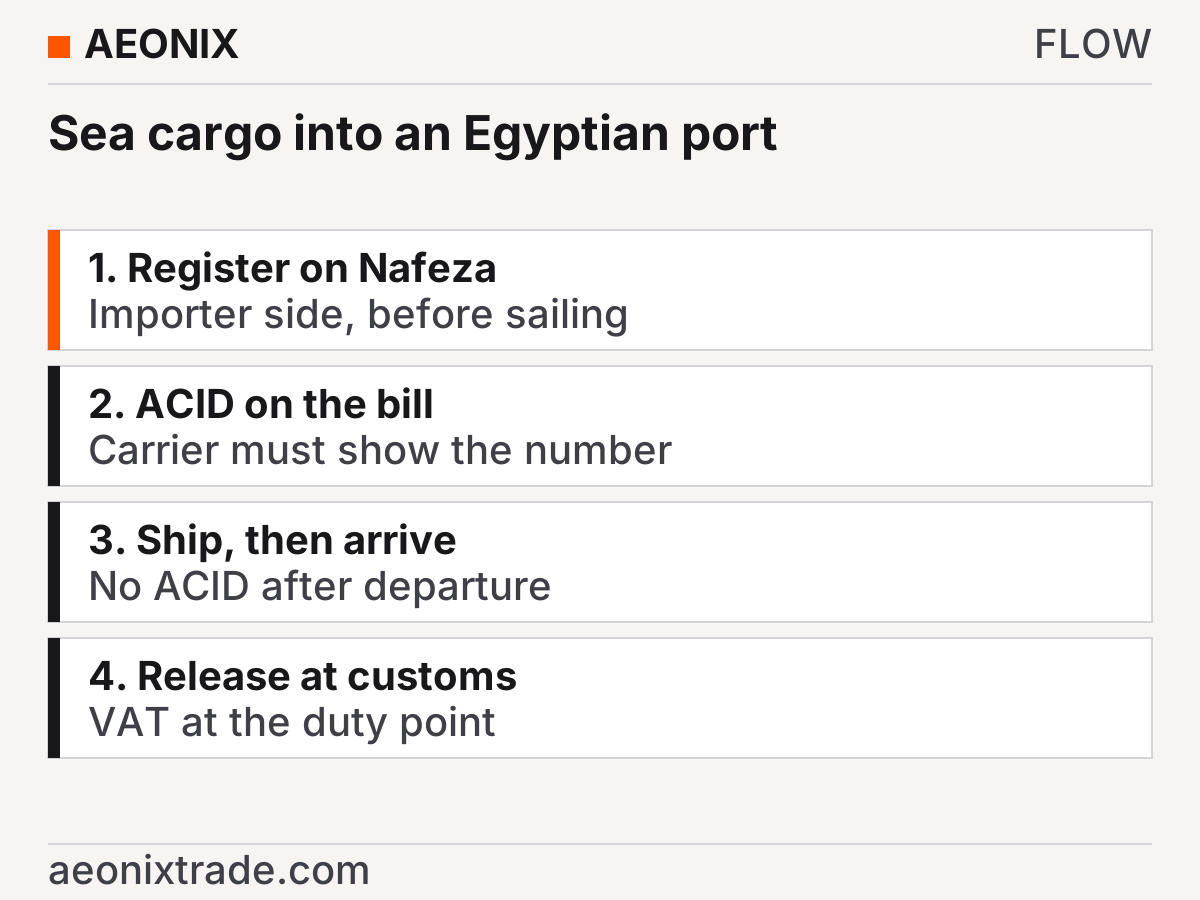
Nafeza is the platform that registration sits on. The customs page is the authority's description of the system. The practical trap is simple: an ACID number requested after the ship has sailed is not a plan, it is a problem at the Egyptian port. Put the ACID on the bill. Match the invoice description to the ACID file. A commercial invoice that says "appliances" and a packing list that says "blenders, kettles, irons" is how the file and the box fall apart. The bill of lading has to carry the number the carrier was given.
ACI as described on that customs page is a sea-shipment system. Do not assume an air courier uses the same 48-hour sea rule. Ask the broker which channel your cartons are actually on.
Who can be the importer
The goods are taxed at release in the name of someone Egyptian customs can accept. A Shenzhen factory is not, by itself, an Egyptian importer. If a local company will be the importer of record, that company needs to be able to register and to sign the Nafeza file. Agree that name before the deposit. A DDP offer from the factory does not create an Egyptian tax registration. Read what DDP actually assigns before you treat an all-in price as clearance.
FOB Shenzhen, Incoterms 2020, does not leave export or the ride to the ship with you. The ICC Academy's FOB note puts export clearance, the haul to the port, and loading on board with the seller. You book the ocean freight, and you still clear the import in Egypt. Build the landed cost as the FOB goods price, which already includes that origin work, then the freight you book, insurance if any, then duty, the 14% or the 5% if it truly applies, any table tax, and port charges. Do not add Shenzhen export clearance or origin haulage a second time. Leave the duty cell as "see the Egyptian tariff for this heading." This page does not state a customs-duty percent. The HS code is how that percent gets chosen.
When the container arrives
The vessel arrives, the declaration is filed against the ACID file, duties and VAT are paid, and release follows if the file matches the box. Storage starts if the ACID, the invoice or the heading is wrong. The arrival mechanics, free time and delivery, are the same shape as any port. Use what happens when cargo arrives for that sequence. A Gulf import is a different system: importing from China to the UAE will not tell you the ACID rule.
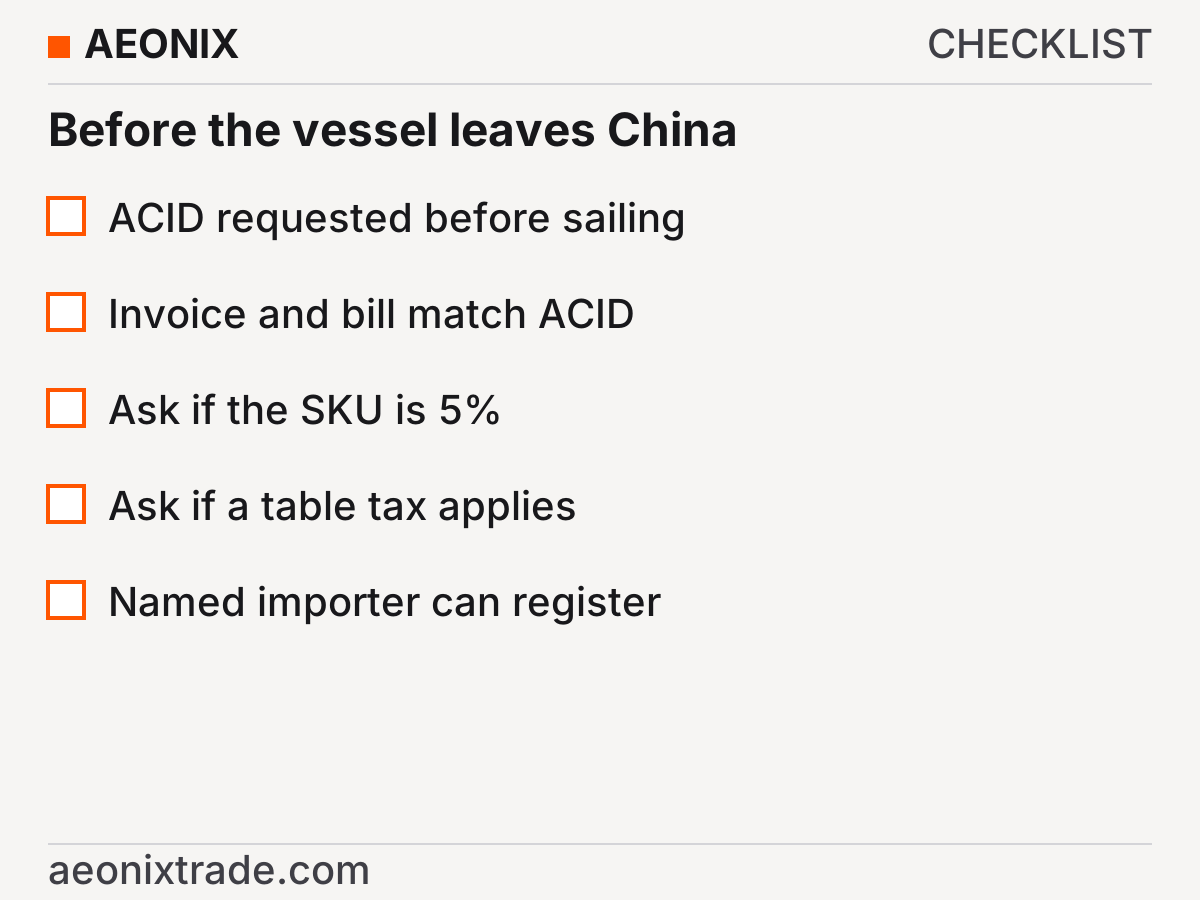
| Before the ship sails | Why it is on the list |
|---|---|
| ACID requested at least 48 hours before shipment | Customs says the data has to be in before the sea shipment leaves |
| Invoice, packing list and bill describe the same goods | The ACID file is what the risk system saw |
| 14%, or 5% if the 2026 sentence fits, or a table tax | The blender is not the machine rate unless the law says so |
| Named importer who can register | The factory in Shenzhen is not the Egyptian entry |
Mistakes
- Paying the factory to ship the same day, then discovering the ACID cannot be issued after departure.
- Putting household appliances on the 5% machine line because a broker once used it for a factory lathe.
- Ignoring table tax because the general rate was already 14%.
- Letting the bill of lading name a consignee who never registered on Nafeza.
- Using a UAE landed-cost sheet for an Alexandria shipment.
Questions buyers actually ask
Is Egypt VAT 14% on everything from China?
The general rate in the Tax Authority's translation, and again in Law 149 of 2026, is 14% from fiscal year 2017/2018. Machines, equipment and, under the 2026 law, medical devices used in production can be 5%, except buses and passenger cars. Some goods also have table tax. The heading decides.
Does ACI apply to air freight?
The customs page checked here describes mandatory ACI for sea shipments from 1 October 2021, and the 48-hour rule for data before shipment. Do not extend that sentence to a courier envelope unless the broker shows you the air rule.
Can the supplier clear DDP Cairo?
Only if someone who can be the importer actually files. DDP is a contract offer. It is not an Egyptian registration. If the seller cannot clear, price the entry yourself.
What should the supplier print on the invoice?
The same description, quantities and values that went into the ACID file, and the code your broker will defend. Then send the Shenzhen quote through the RFQ form if you want the Egypt file built before the deposit. The country list sits on import from China.
The quote and the entry are covered in which Incoterm to use, importing into Saudi Arabia, and the customs clearance sequence.
Official sources
- Egyptian Tax Authority: English translation of VAT Law No. 67 of 2016. Updated 15 January 2023. Standard rate 14% from fiscal year 2017/2018, 5% for machines and equipment used in production except buses and passenger cars, and tax on imports at customs release.
- Egyptian Tax Authority: Law No. 149 of 2026. Official Gazette text dated 28 July 2026. Restates the 14% general rate and extends the 5% rate to medical devices used in production, except buses and passenger cars.
- Egyptian Customs: advance cargo information. ACI under Customs Law 207 of 2020 and the 2021 finance decisions, mandatory for sea shipments from 1 October 2021, data at least 48 hours before shipment. Read 9 November 2026.
- Nafeza: advance cargo registration. The platform the importer registers on. Read 9 November 2026.
- ICC Academy: FOB, Incoterms 2020. The seller clears export, carries the goods to the port of shipment, and loads them on board. The buyer contracts the main freight and completes import formalities. Checked 10 November 2026.
Submit sourcing request
Can't find what you need?
Start with a product or image link, an approximate quantity and destination. Other details can follow.