Foshan Furniture Markets: Sourcing Guide for Overseas Buyers
Published by Aeonix Trade.
Last fact-checked: November 9, 2026.
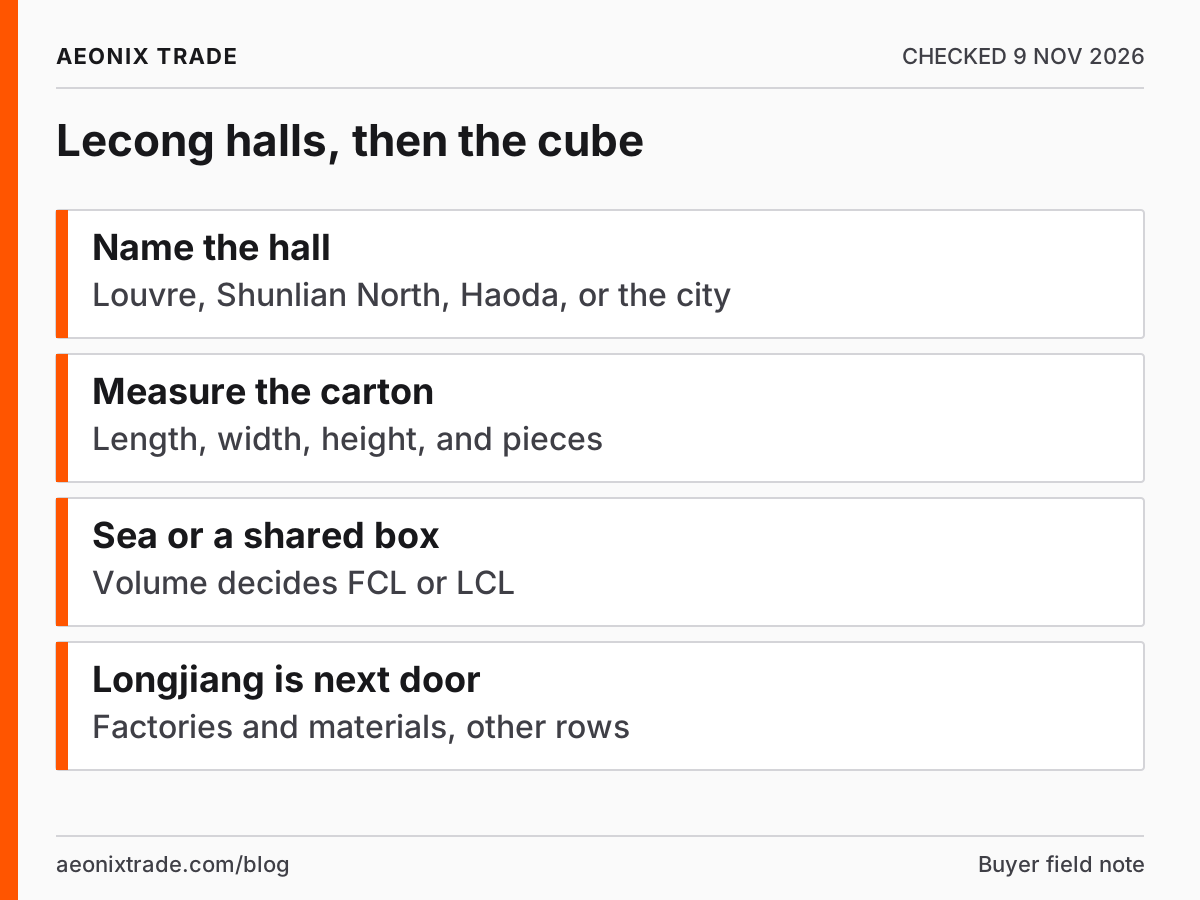
The Shunde page that opened on 9 November 2026 describes Lecong as the furniture sales halls and Longjiang as the manufacturing and materials side. It names four Lecong furniture buildings. It does not say when the dealer counts were taken.
Foshan furniture, for an overseas buyer, is usually this pair of towns in Shunde, not a single hall with a published English floor map. The page is a town profile on a Shunde education site. It is a government page. It is not a market operator's booth directory, and it prints no trading hours.
A typical case
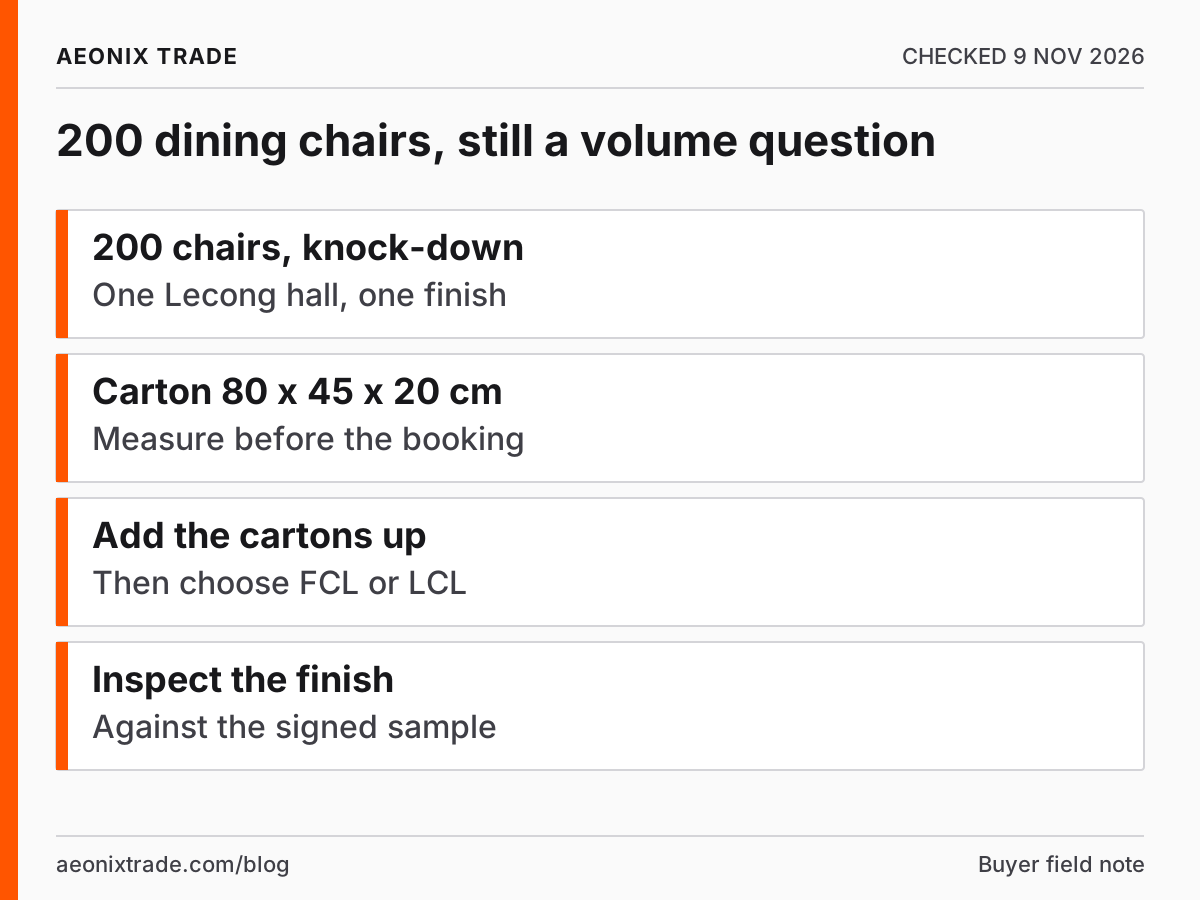
A buyer wants 200 dining chairs, one finish, shipped knock-down. A sample carton is assumed at 80 by 45 by 20 centimeters so the lesson has a number: 0.80 times 0.45 times 0.20 is 0.072 cubic meters a carton, and 200 cartons are 14.4 cubic meters, before odd sizes and the unusable space in a container. Whether that is an FCL or a shared LCL box is a volume decision, not a slogan. This is a typical case. The carton size is an assumption for the arithmetic. It is not a market measurement, and there is no price.
How cubic meters are read is on CBM meaning. When a shared box makes sense is on how LCL works and on FCL meaning. The service page for mixing suppliers is consolidation. Rate shopping without the cube is LCL from China only after the cartons exist on paper.
What the page says about Lecong
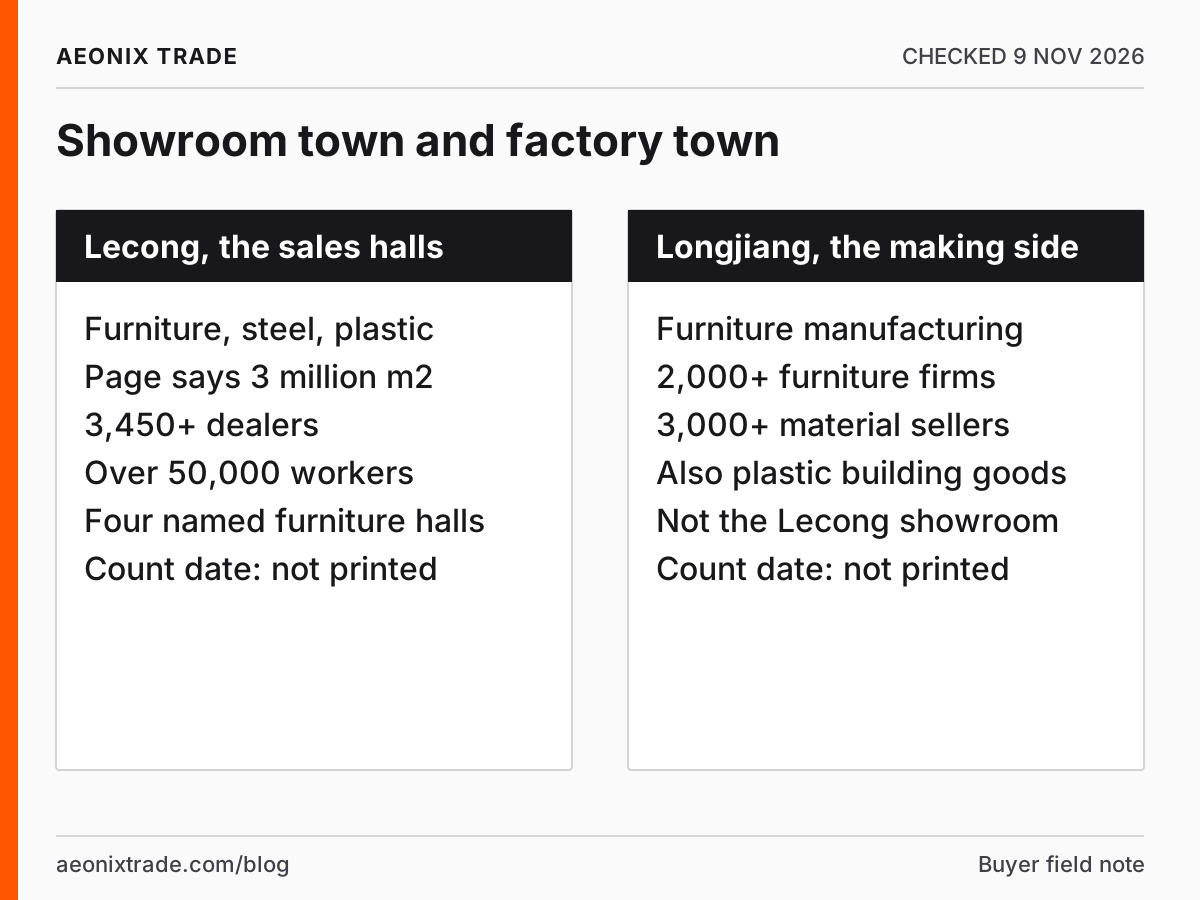
Lecong sits in northwest Shunde, south of Foshan's central city, about 30 kilometers from Guangzhou and a little over 100 kilometers from Hong Kong and Macau, on the page's own distances. The town profile gives 78 square kilometers, 19 villages, 4 neighborhood committees, 100,000 registered residents, and about 130,000 temporary residents. It calls Lecong a "China furniture trade capital" and a "China plastic trade capital."
On furniture it says Lecong is a sales center stretching more than ten li, with 3 million square meters of mall space, more than 3,450 dealers from China and abroad, more than 50,000 workers, more than 20,000 furniture styles, more than 20,000 furniture-truck trips a day, and more than 30,000 visitors a day, and that its sales volume ranks first among furniture markets in the country. It names Lecong International Furniture City, Lecong International Furniture Expo Center, Shunlian North Furniture City, and Haoda Furniture City as the group of buildings. The Chinese names on the page are 乐从国际家具城, 乐从国际家具博览中心, 顺联北区家具城, and 豪达家具城. It also says the town has steel and plastic markets. The steel line is more than 1,500 steel traders and more than 100 processing firms. The plastic line is more than 600,000 square meters, more than 600 dealers, more than 5,000 workers, and more than 1 million tons of resin a year.
None of those counts carries a year on the page. Quote them as "the Shunde town page says," and say the count date was not printed. Do not introduce them as this year's census.
Longjiang is the other half of the sentence
The same page's Longjiang section calls furniture manufacturing a traditional industry there: more than 2,000 furniture manufacturers and more than 3,000 material sellers. Plastic building materials are described as Longjiang's largest industry, with 220 firms. Those figures are also undated.
A showroom in Lecong and a factory in Longjiang can both be "Foshan furniture." The invoice, the sample room, and the loading place are three addresses until someone proves they are one. Ask which.
Steel and plastic on the same page are easy to wander into. A buyer who came for a chair does not need a coil of rebar or a bag of resin. If the email really is about resin, the Ningbo-side market that a government page describes is China Plastics City in Yuyao, covered in the Hangzhou and Ningbo note. Lecong's plastic line and Yuyao's plastics city are both resin markets on the pages that opened. This article does not rank them. It says: do not let a furniture appointment become a resin appointment by accident.
What to photograph, once you are in the right hall: the building name at the door, the booth number, the finish chip next to the chair, the hardware, and the carton with a tape measure in the frame. A beauty shot of a dining room does not give the cube. The page gives no booth map, so the photos are your map.
Guangzhou is the neighboring city on this page's 30 kilometer line. A clothing day there is a different product: Baima, Shisanhang, and Shahe. Do not add a sofa stop to a garment day unless the cube and the appointment both fit.
What to freeze before the deposit
Knock-down versus assembled changes the cube more than the chair's style does. Finish, hardware, and the signed sample are the inspection standard. Carton strength matters because a dining chair's corner dies in a shared container more often than the fabric does. The hall name matters because Lecong, on this page, is four named buildings plus a ten-li stretch, not one door.
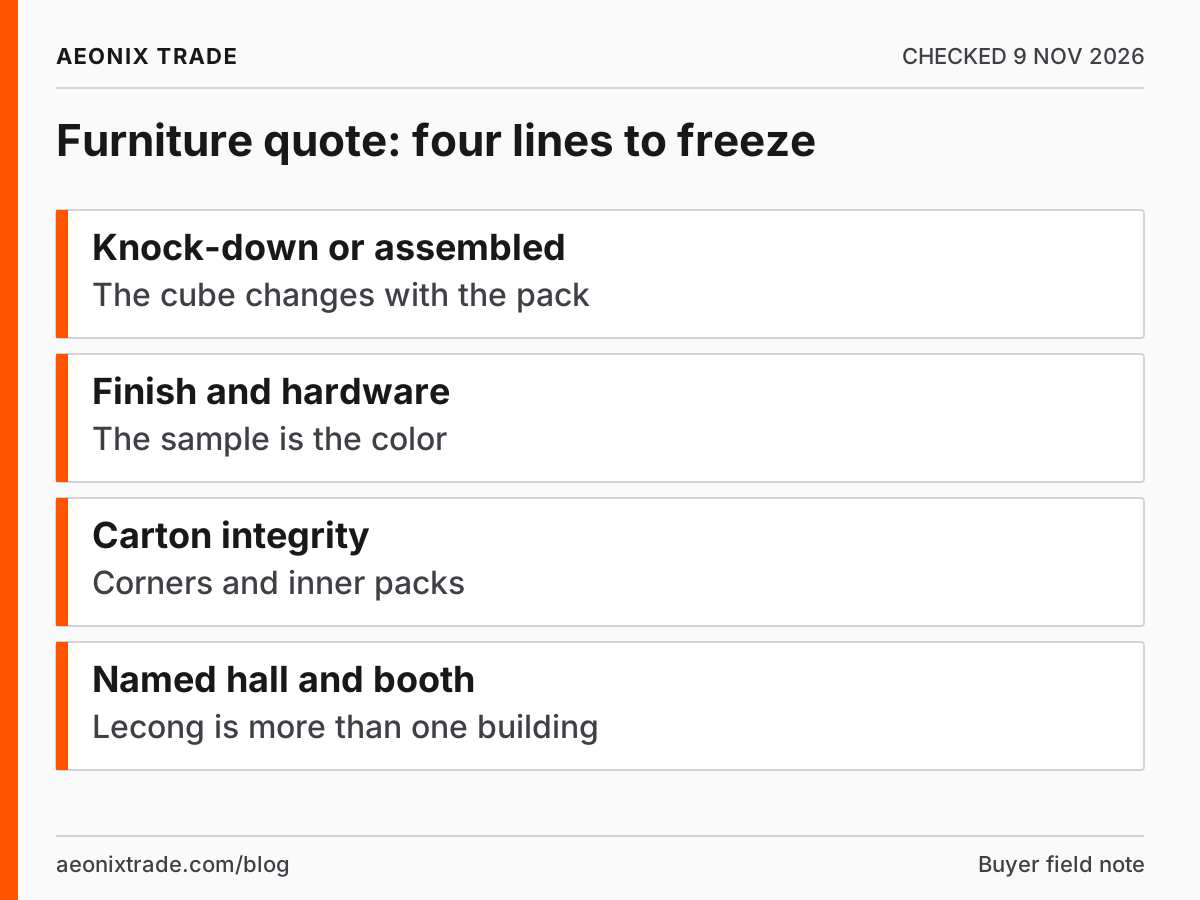
The page does not print opening hours, a booth map, or a fee. A driver instruction that says only "Lecong furniture city" can land at any of the four names. Put the building in the RFQ with the piece count, the finish, and whether the goods ship knock-down.
What usually goes wrong
- Quoting "3,450 dealers" as a current headcount. The page never dates it.
- Booking LCL from a photo of one chair. The carton, not the chair, makes the cubic meter.
- Inspecting in Lecong and loading in Longjiang without writing both addresses on the order.
Frequently asked questions
Is there one Foshan furniture market?
The page describes a Lecong stretch and names four furniture buildings, plus steel and plastic markets in the same town, plus Longjiang's factories. Plan for more than one door.
How old are the area and dealer figures?
Unavailable. They are printed without a count date. The page was opened on 9 November 2026, which dates the reading, not the census.
Does the page give trading hours?
No. Ask the hall.
Other markets for the same kind of buy are China Wholesale Markets by Product Category, US clothing distributors versus importing, auto parts, and Guangzhou wholesale markets.
Sources
- Shunde: town profiles, including Lecong and Longjiang. Opened 9 November 2026. Distances, the undated furniture figures, the four hall names, and the Longjiang factory and material counts. No count date and no trading hours.
- ICC: Incoterms 2020. The rules for whoever books the truck and the vessel once the carton exists.
- International Trade Administration: Know Your Incoterms. Tasks, costs, and risks on the same quote as the cube.
Submit sourcing request
Can't find what you need?
Start with a product or image link, an approximate quantity and destination. Other details can follow.