Guangzhou Clothing Wholesale Markets: Baima, Shisanhang, Shahe Compared
Published by Aeonix Trade.
Last fact-checked: November 9, 2026.
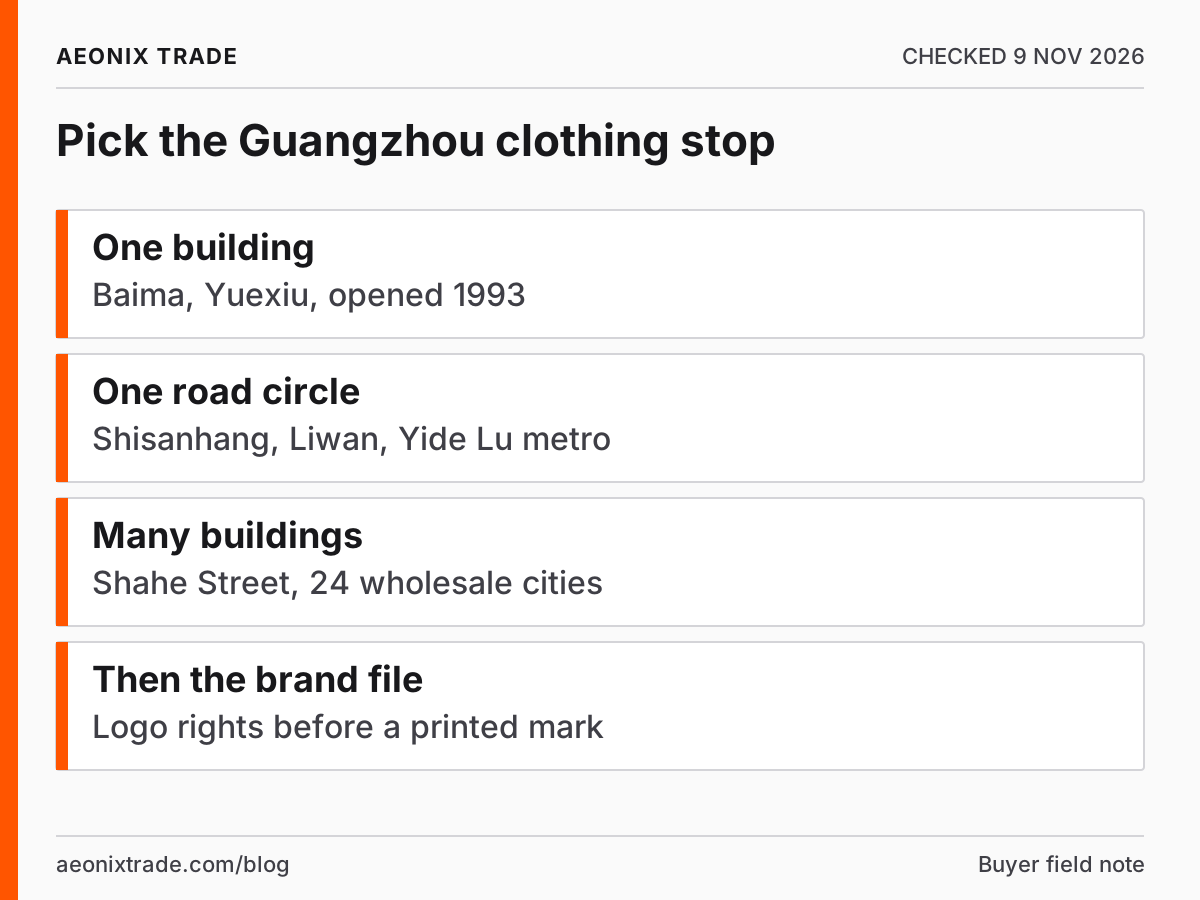
Baima, Shisanhang, and Shahe are three different shapes of Guangzhou clothing trade. Baima is one market in Yuexiu. Shisanhang is a road and a business circle in Liwan. Shahe is a street of many wholesale cities, described by the city government as 24 of them inside Shahe Street.
A search for a Guangzhou wholesale clothing market usually dumps all three into one list. The pages that opened on 9 November 2026 do not. Use the shape of the place to decide the day, then use the brand file to decide the booth.
A typical case
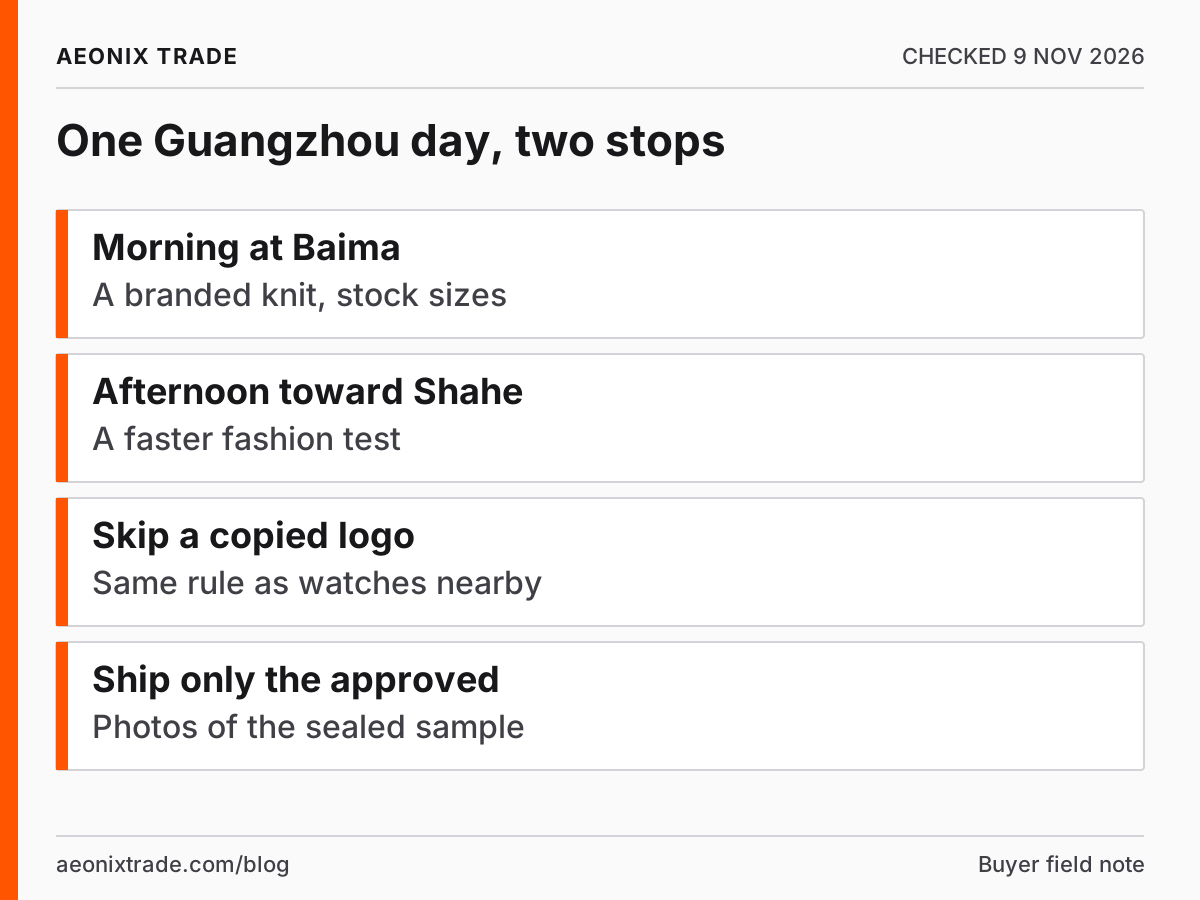
A buyer needs a mid-range knit with a stable size run for a standing shop, and a smaller test of a faster style for a four-week window. One day in Guangzhou. Morning in a single building where brands already show a line. Afternoon in a cluster where the style turns over quickly. This is a typical case. It names no booth and no price.
Baima fits the morning on the Yuexiu government's own description: stock wholesale, retail, and franchise, opened in 1993, more than 1,000 garment firms. Shahe fits the afternoon only if you already know which of the buildings you are entering. Shisanhang fits a Liwan day tied to Yide Lu metro, not a substitute address for Baima.
Baima, from the Yuexiu page
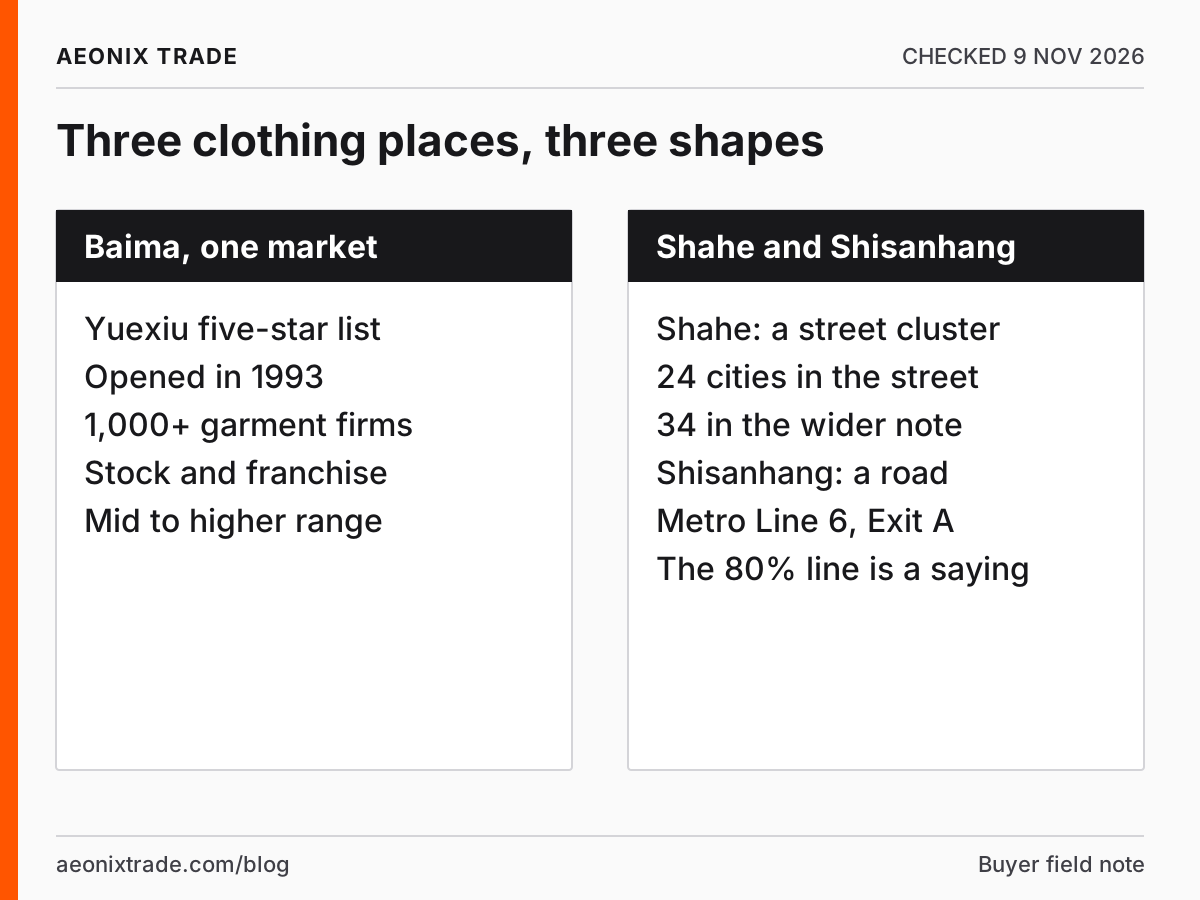
On 17 June 2024 the Yuexiu government published the first batch of Guangzhou's starred commodity markets, citing the municipal commerce bureau. Guangzhou Baima Clothing Market is on the five-star list for industrial consumer goods. The same article says Baima opened in 1993, calls it the first modern department-store-style clothing market in the country, and says it brings together more than 1,000 garment firms from around China, with buyers it describes as concentrated in Russia, the Middle East, Southeast Asia, and Western Europe, across more than 70 countries. It calls the market both a mid-to-higher ready-goods wholesale and retail center and a franchise center, with wholesale, retail, sample orders, agency, and chain formats.
The page also lists honors. Those are the page's claims. This article does not re-rank them. What a buyer can use is the format: one market, brands already in a building, stock and franchise both on offer. The page does not print a floor directory or today's trading hours.
The same starred list includes other Yuexiu clothing markets, among them Hongmian International Fashion City and Liuhua. Hongmian is described there as about 60,000 square meters, about 1,500 brand merchants, and about 800 designer brands. Liuhua is described as an early foreign-trade clothing market. They are not Baima. If a driver says "the clothing market," ask which name is on the door.
Shisanhang is a circle, and the 80 percent line is a saying
The Liwan government English page, released 21 July 2023 and sourced to GDToday, says the name Shisanhang goes back to the Qing dynasty and that today it means the business circle on Shisanhang Road. Address: Shisanhang Road, Liwan District. Metro: Exit A, Yide Lu Station, Line 6.
The same page says it is said that 80 percent of China's clothes are produced in Guangdong, 80 percent of Guangdong's clothes are produced in Guangzhou, and 80 percent of Guangzhou's clothes come from Shisanhang. That is printed as a saying. It is not a measured production statistic on the page, and this article does not treat it as one. There is no booth count, no floor list, and no opening hour.
Yide Road also holds other markets. The Yuexiu star article describes Wanling Plaza, on Yide Road, as a modern trade center of 120,000 square meters covering eight product groups, including toys, gifts, and home goods, with more than 2,000 merchants. Wanling is not the Shisanhang clothing circle. Getting off at Yide Lu and walking into the first loud building is how those two get confused.
Shahe is many buildings
A Guangzhou municipal feature published 6 August 2025 describes Shahe Street as 1.26 square kilometers holding 24 clothing wholesale cities. Later in the same piece it says the wider Shahe clothing district has 34 wholesale cities, of which 24 are inside Shahe Street, and that the street moves more than a million pieces of clothing a day. The piece is a culture feature. It attributes crowd memories, including a 1992 morning, to a chamber secretary. It does not publish an operator booth directory, a map of the 24 buildings, or trading hours. The daily piece-count is the feature's wording. The page does not show how it was counted.
What you can use: Shahe is a cluster, not a front door. "Go to Shahe" without a building name is an incomplete instruction. The feature's point about speed, that styles turn over inside a week, is a reporter's account of how merchants work, not a rule you can hold a supplier to.
Brand marks, and the watch market next door
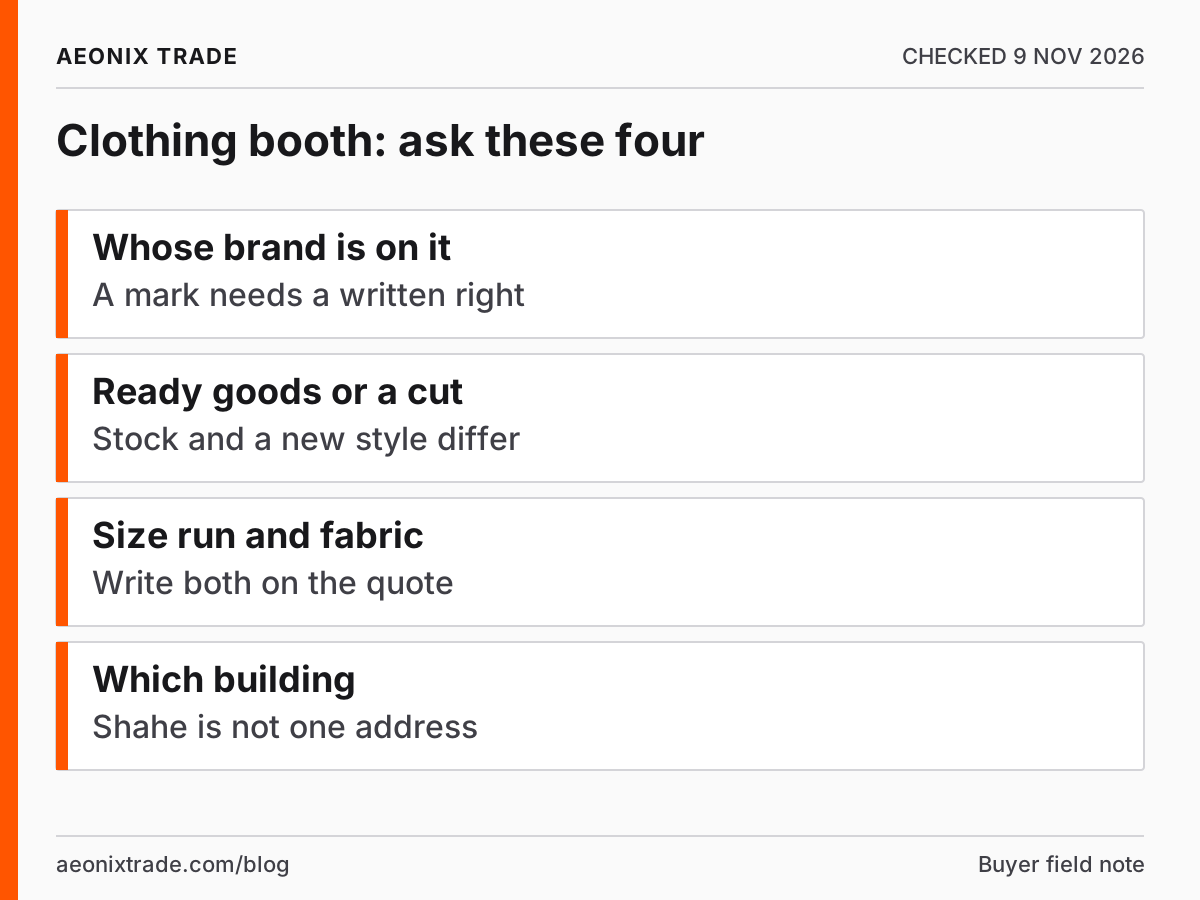
All three places can show a logo that the booth does not own. Guangzhou also has a watch trade, and the Guangzhou watch market page is the one that separates an authorized product from a copy. Use the same habit on clothing: a stripe, a wordmark, or a cartoon on a tee needs a written right before it is sewn in. The marketplace safety note is the wider version of that check. Who you pay is a separate question, on verifying a supplier before payment.
Fabric by the meter, if you are cutting rather than buying a finished garment, is Keqiao, not these halls. Socks and underwear in Yiwu are a different building: District 4. Hangzhou's clothing street is a different city: Hangzhou and Ningbo. Buyers comparing a US wholesale catalog with a China import are on wholesale clothing distributors.
What usually goes wrong
- Booking a hotel "near the clothing market" and discovering three markets and twenty buildings. Name Baima, or name the Shahe building, in the note to the driver.
- Repeating the 80 percent chain as a fact. The Liwan page marks it as something people say.
- Accepting a logo sample because the stitch looks clean. Clean stitch is not a trademark license.
If the day needs a walker who already has the building names, start with the Yiwu desk only when the goods are actually in Yiwu. For Guangzhou clothing, put the market name, the size run, and the logo question on the RFQ.
Frequently asked questions
Which one is the Guangzhou clothing market?
There isn't one. Baima is a single Yuexiu market on the 2024 five-star list. Shisanhang is a Liwan road. Shahe is a cluster the city feature counts as 24 wholesale cities inside the street.
Does Baima publish floors and hours?
Not on the Yuexiu page opened on 9 November 2026. You get the 1993 opening, the 1,000-plus firms, and the trading formats. Ask the market for the day's hours.
Is Wanling part of Shisanhang?
The pages describe them separately. Shisanhang is the clothing circle on Shisanhang Road. Wanling Plaza is described on the Yuexiu page as a Yide Road center whose range includes toys and gifts.
See also China Wholesale Markets by Product Category.
Sources
- Yuexiu District: first batch of starred markets, 17 June 2024. Baima on the five-star list, the 1993 opening, the 1,000-plus firms, and the short notes on Hongmian, Liuhua, and Wanling Plaza.
- Liwan District: Shisanhang Clothing Wholesale Market, 21 July 2023. The road, the metro exit, and the 80 percent line printed as a saying.
- Guangzhou municipal site: Shahe feature, 6 August 2025. 24 wholesale cities in Shahe Street, 34 in the wider note, and the daily volume as the feature states it.
Submit sourcing request
Can't find what you need?
Start with a product or image link, an approximate quantity and destination. Other details can follow.