How to Compare Supplier Quotes from China
Last fact-checked: November 9, 2026.
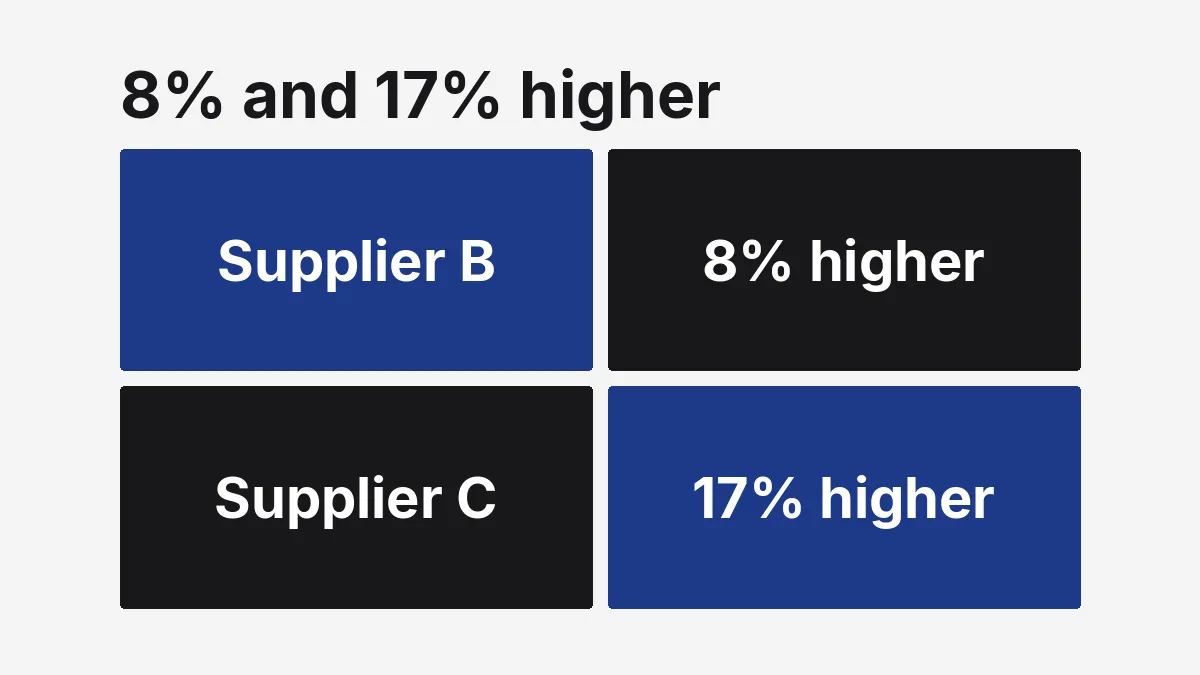
Three quotes for one product can still be three different orders. In this case Supplier A is the cheapest, Supplier B is 8% higher, and Supplier C is 17% higher. A looks like the winner until you read the pages. A left out the individual pack. B included a stronger export carton. C included a better material grade and a longer lead time, because the color is a custom run. The cheapest quote is not a bargain. It is incomplete.
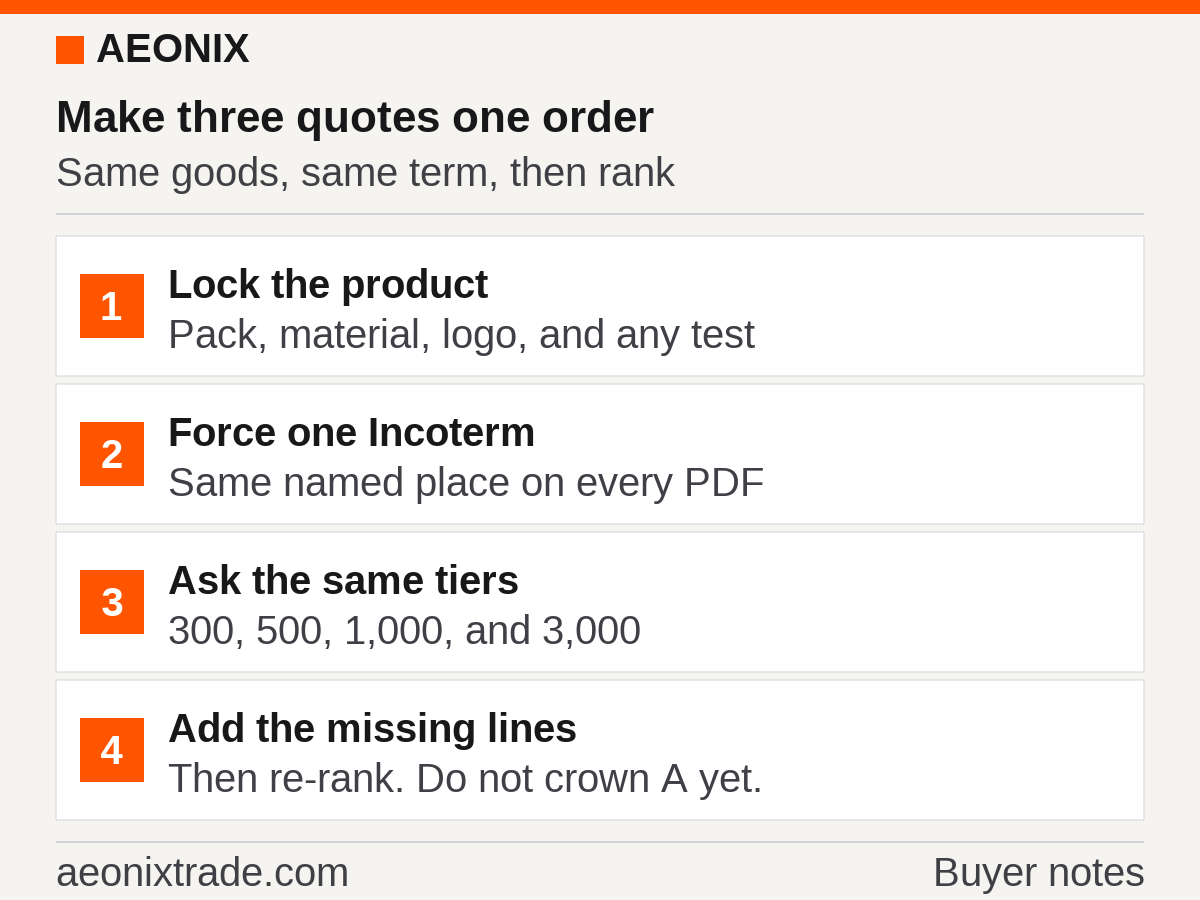
Lock the goods, force one Incoterm, ask the same tiers, then add back whatever A left out. Rank after that, not before.
Same goods, then the same term
Lock the product before you lock the price. Size, material, color, weight, function, logo, packaging, accessories, carton, and any test the destination will ask for. If those differ, the 8% and the 17% are not a comparison.
Then force one Incoterm. EXW, FOB, CIF, and DDP are not the same price. The ICC Incoterms 2020 checklist and the Incoterms 2020 rules say where delivery happens and who pays for which leg. The International Trade Administration makes the same point for buyers: the rule allocates cost and risk, and it does not list your customs documents. Ask all three suppliers to quote the same named place. For cartons that will go into a container, also ask for FCA at the named warehouse. The ICC Incoterms 2020 checklist says that if the goods travel in containers or by multimodal transport, or if delivery is to an inland or port terminal, choose FCA. It says to choose FOB when the goods are general cargo or bulk to be loaded on board, or when you want the risk and the cost to divide once the goods are on the ship, including a container the seller loads that way. FOB still appears on most China proformas. If you accept it, you are accepting on board, not the factory door. The plain-language version of the split is on Incoterms and shipping documents.
A typical case: line the three quotes up
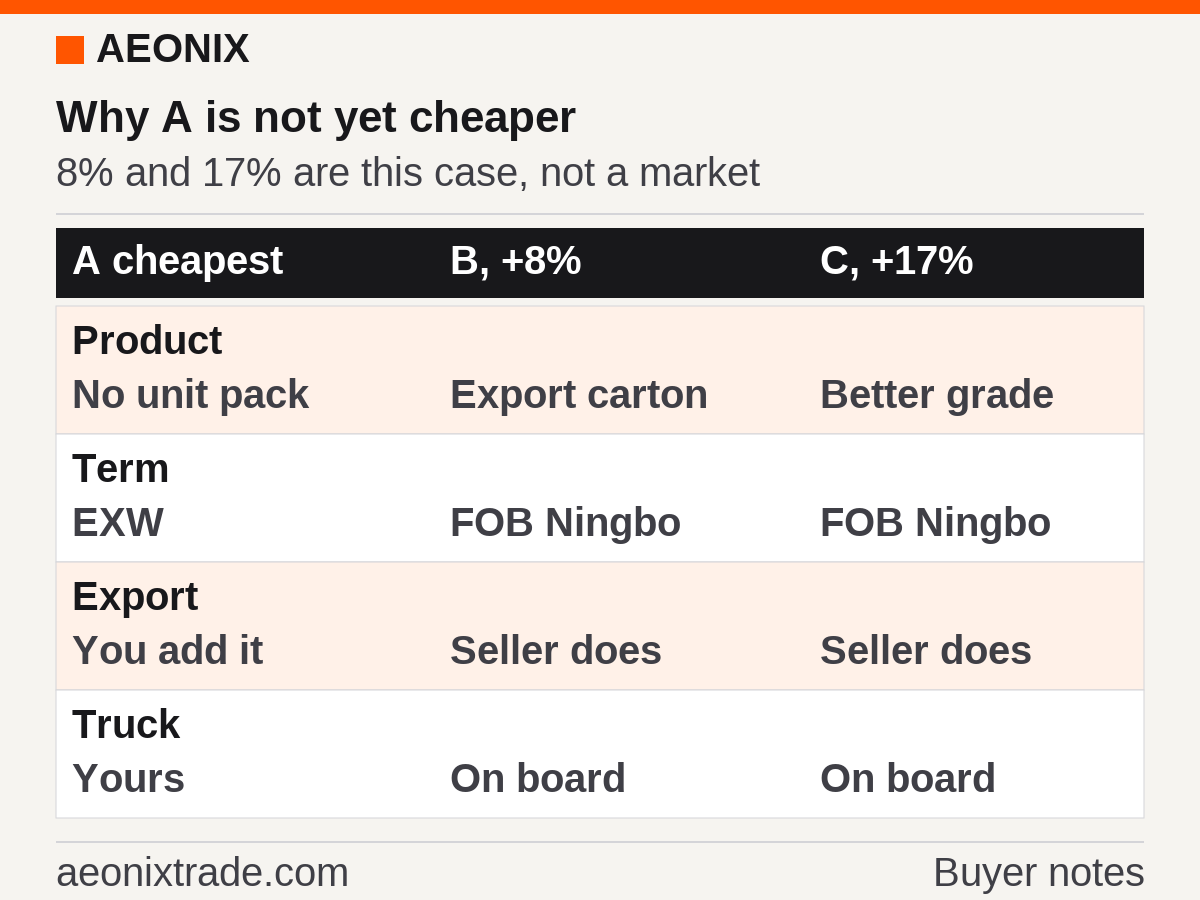
A is 8% under B only on the PDF. A is EXW and has no individual pack. B and C are FOB Ningbo. Add A's missing lines before you rank.
Ask each supplier for the same tiers: 300 units, 500 units, 1,000 units, 3,000 units. The best factory at 300 units is often the wrong factory at 3,000, because the lower tier is stock packaging and the higher tier is a printed carton and a different material price.
| Line | Supplier A, cheapest | Supplier B, 8% higher | Supplier C, 17% higher |
|---|---|---|---|
| Product | Base spec, no individual pack | Same spec, export carton | Better material, custom color |
| Term on the PDF | EXW the factory | FOB Ningbo | FOB Ningbo |
| Export clearance in China | Not in an EXW price. You add it, or you are not comparing | On the seller under FOB | On the seller under FOB |
| Truck to the port or warehouse | Yours under EXW | Seller's, to on-board | Seller's, to on-board |
| Ocean freight and insurance | Not included | Not included | Not included |
| What would make them comparable | Add export clearance, origin truck, and the missing pack, then re-rank | Confirm the carton is the one you will actually ship | Separate the material upgrade from the lead time |
EXW stops at the seller's premises, not cleared for export. An EXW quote that looks 8% under an FOB quote has often left out the export declaration, the truck, and the handling that FOB already folded in. Add those lines before you call A the winner. CIF would add ocean freight and insurance and still would not add duty at destination. DDP that "includes duty" is only as good as the rate they assumed. Duty belongs on your landed-cost sheet, from the destination tariff, under the WCO valuation rules. Do not let the supplier's all-in number be the duty.
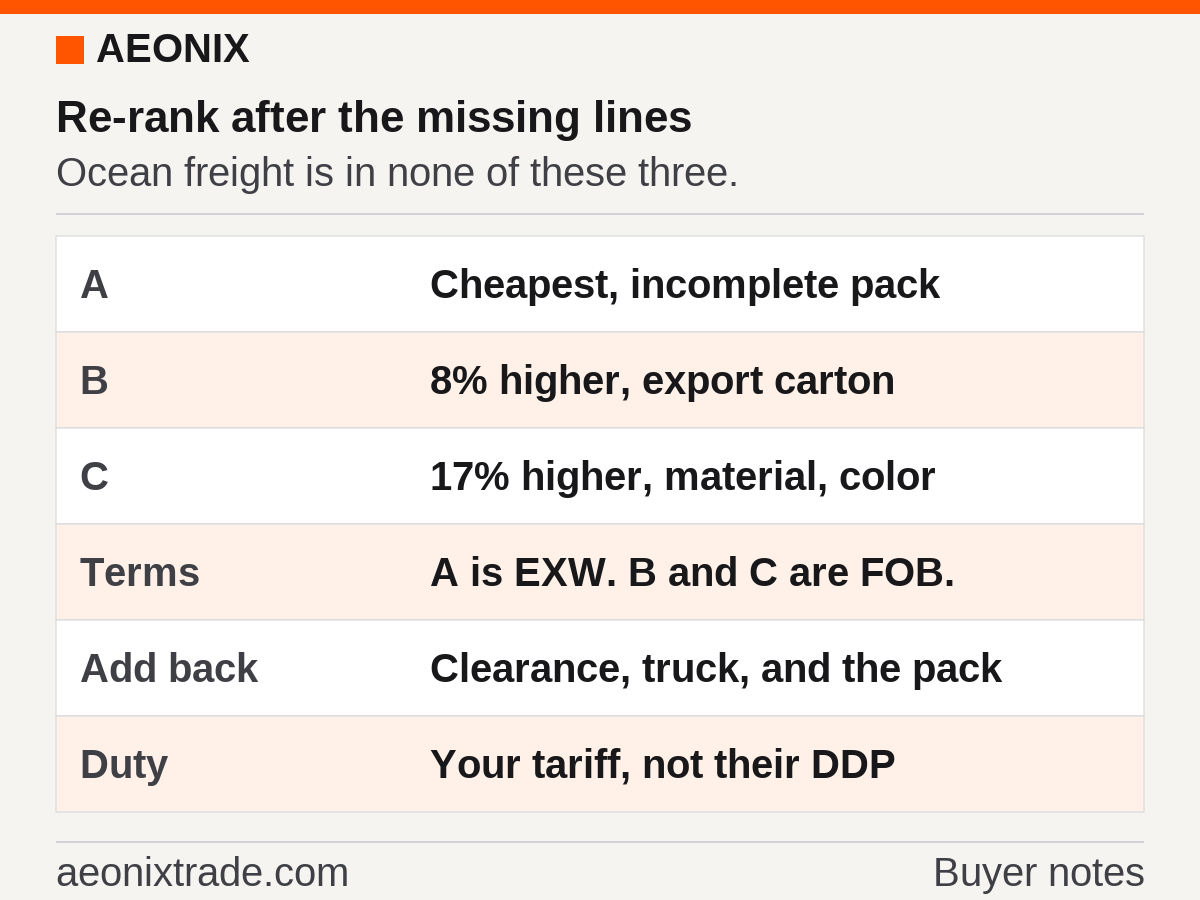
Ocean freight is in none of the three. Duty stays on your sheet, from the destination tariff, not inside a supplier's DDP line.
Add the missing lines, then rank
Write A's gaps as lines, not as a feeling. Export clearance in China is not inside an EXW price. The truck from the factory to the port or the warehouse is not inside it either. The individual pack is a different product. Put those three next to A's unit, in the same currency as B and C, and only then see whether A is still cheaper. If the factory will not price them, they have not quoted your order.
Do the same for the carton. A smaller box changes the CBM, the damage rate, and what the store can put on a shelf. Ask for the carton size on the proforma and on the packing list you expect later. A quote with no cube is a quote your forwarder cannot price.
CIF adds ocean freight and insurance to the named port. It still does not add duty. A DDP line that "includes duty" is only as good as the rate they assumed, and you cannot see that rate unless they show the code and the figure. Keep duty on the landed-cost sheet.
The second reply is the one you rank
Send the gaps back as blanks, not as a new specification. If you let A "improve" the quote by changing the material, you are back to three products. The request that produces comparable replies is an RFQ with the spec, the tiers, the Incoterm, and the place written down. The same fields sit on the RFQ brief builder if you want them in one file before you email anyone. Send that, not a photo and the word "price."
Who helps you hold the factories to one file is a sourcing question, not a discount question. A sourcing agent is useful here only if they show you all three quotes on the term you named. An agent who sends one "best price" has already ranked the column for you.
Mistakes
- Ranking A, B, and C while A is EXW and the others are FOB. The missing export clearance is the discount.
- Ignoring the 300 / 500 / 1,000 / 3,000 tiers and negotiating only the quantity you hope to buy.
- Treating a faster lead time as free. It can be stock goods, a skipped process, or a date the factory will miss.
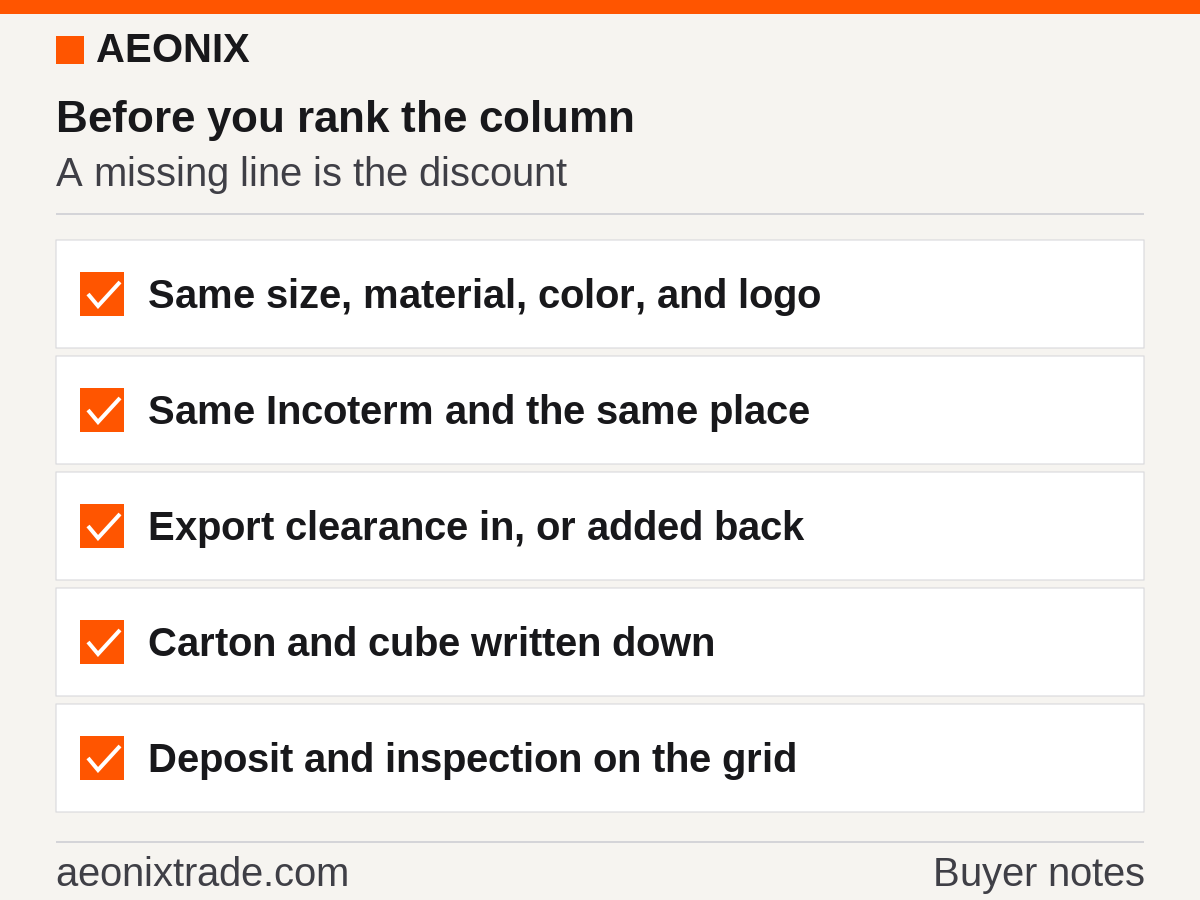
A missing line is the discount. Do not average a complete quote with a unit price that left the blanks empty.
Payment terms move the ranking too. A slightly higher unit with inspection before the balance can beat a low unit that wants the balance before anyone opens a carton. Compare the deposit, the account name, and the currency on the same grid. If the names do not match, stop and verify the supplier before the percentage matters.
Use the RFQ form when you want those three quotes pulled onto one term and one packing assumption.
Frequently asked questions
Should I pick the lowest unit?
Only after the goods, the pack, the Incoterm, and the named place are the same. In this case the 8% and the 17% are not a ranking until A's missing pack, export clearance, and truck are added back.
Is FOB wrong for a container?
The ICC checklist points container and multimodal cargo to FCA, and points on-board bulk or general cargo to FOB. Most China proformas still say FOB. If you accept FOB, say so, and know the risk passes on board rather than at the warehouse.
Can the supplier include duty?
They can type a number. It is your duty only if it comes from the destination tariff for the code you will actually declare. Otherwise it is their guess. Look the rate up, or write "see the official tariff" and link it. Do not adopt a figure you cannot open.
Official sources
- ICC: Incoterms 2020 checklist. Delivery, cost, and risk. FCA for container cargo.
- ICC: Incoterms 2020 rules.
- International Trade Administration: Know Your Incoterms.
- WCO: customs valuation. Duty is not a line the factory can fold into EXW.
Submit sourcing request
Can't find what you need?
Start with a product or image link, an approximate quantity and destination. Other details can follow.