Canton Fair Guide for First-Time Buyers: Plan, Booth Routine and Follow-up
Published by Aeonix Trade.
Last fact-checked: November 10, 2026.
A Canton Fair guide for buyers starts with the phase, not with a packing list. The current-session page puts the 141st session on 15-19 April, 23-27 April and 1-5 May 2027, with talks from 9:30 to 18:00. If your product is not on that phase, the rest of this routine does not matter. Dates and groups are on the phase and category page. The badge steps are on the registration and badge guide.
This page is for someone attending for the first time who will talk to exhibitors, not for someone who only wants a photo in the atrium. It is a poor use of the fare if you have no spec, no authority to ask for a sample, and no way to follow up when you land back home.
Three weeks before you fly
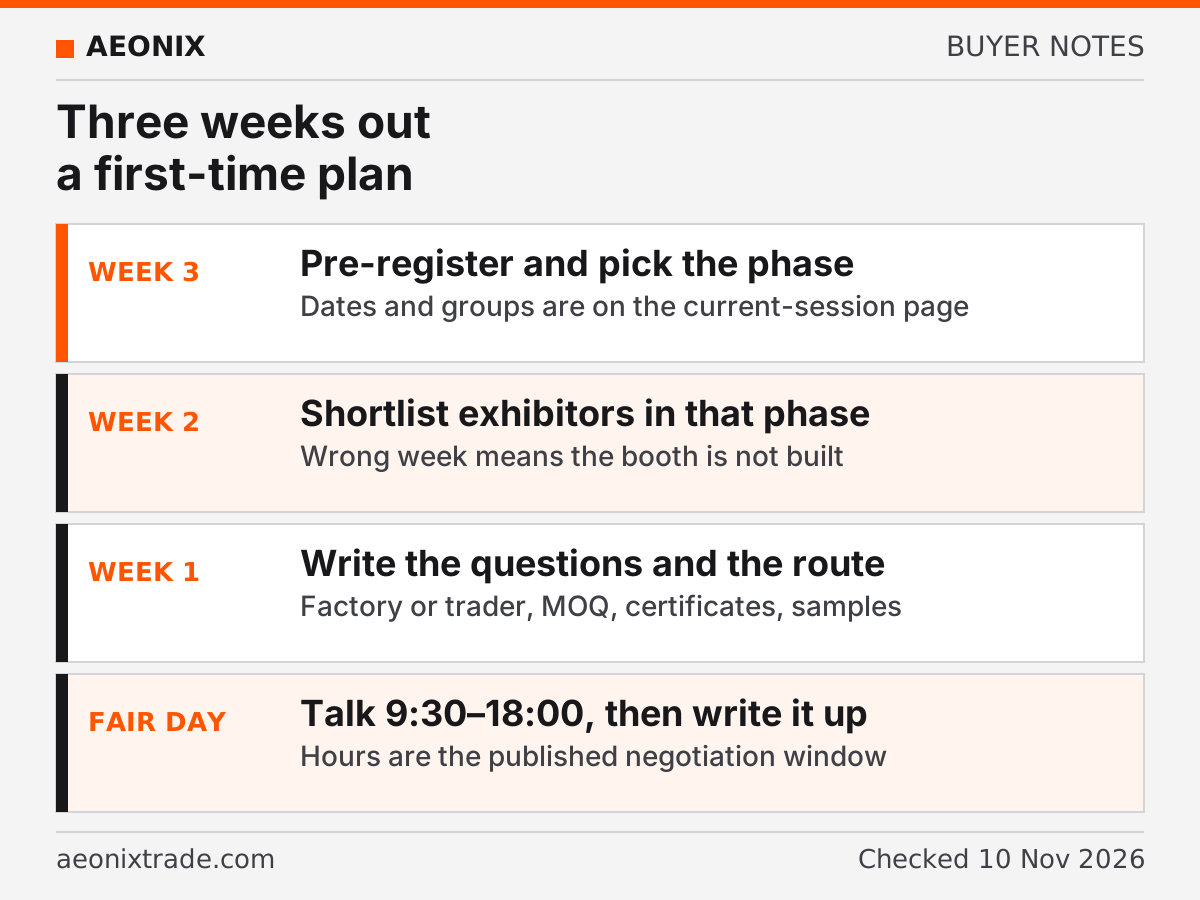
Three weeks out, pre-register and lock the phase. Two weeks out, build a short list of exhibitors in that phase only. A booth number from a previous session is a rumour until you see it on the current list. One week out, write the questions and the order you will walk them. On the day, the published window is 9:30-18:00. Plan inside that window. The organiser has not, on the page checked, described the gap days between phases as open.
One day, without pretending you can see the whole hall
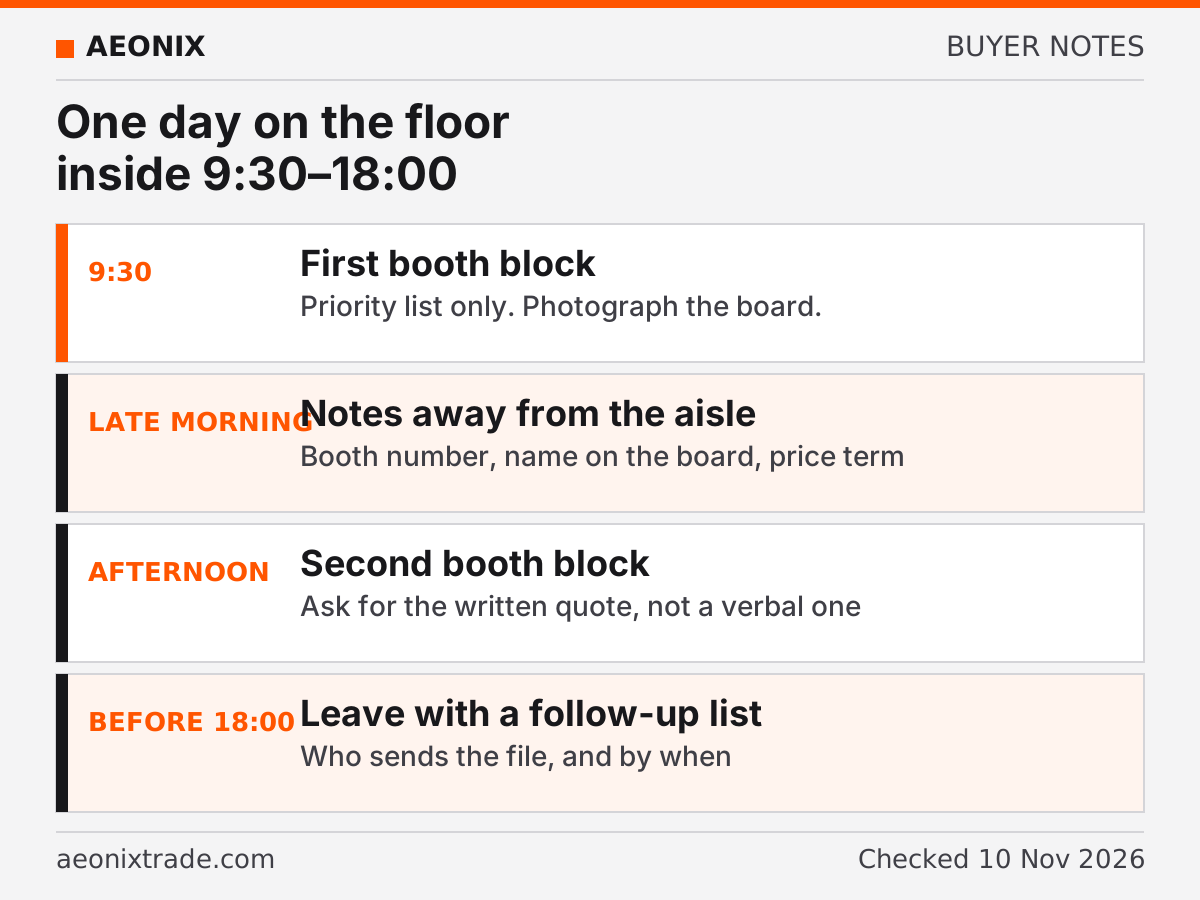
Open with the booths that match the spec you actually buy. Photograph the board, not just the product. Step away and write the company name as it is printed, the booth number, and the price term they offered. Go back in the afternoon for the booths that survived that note. Leave before 18:00 with a list of who sends a file, and by when. A day spent collecting catalogues is a day you will not be able to reconstruct on the plane.
Carry a printed spec, a tape, spare cards, the pre-registration slip, and a power bank. The measure is for the sample in your hand, not for the hall. Write booth numbers in your own notebook even if you are photographing everything. A dead phone at 16:00 is a normal failure, and the notebook is the backup. Do not carry another company's certificate "to compare on the spot." You will not authenticate a mark in an aisle. You will only confuse the conversation. Ask whose name is on the document and have it sent as a file.
What to ask before you step back into the aisle
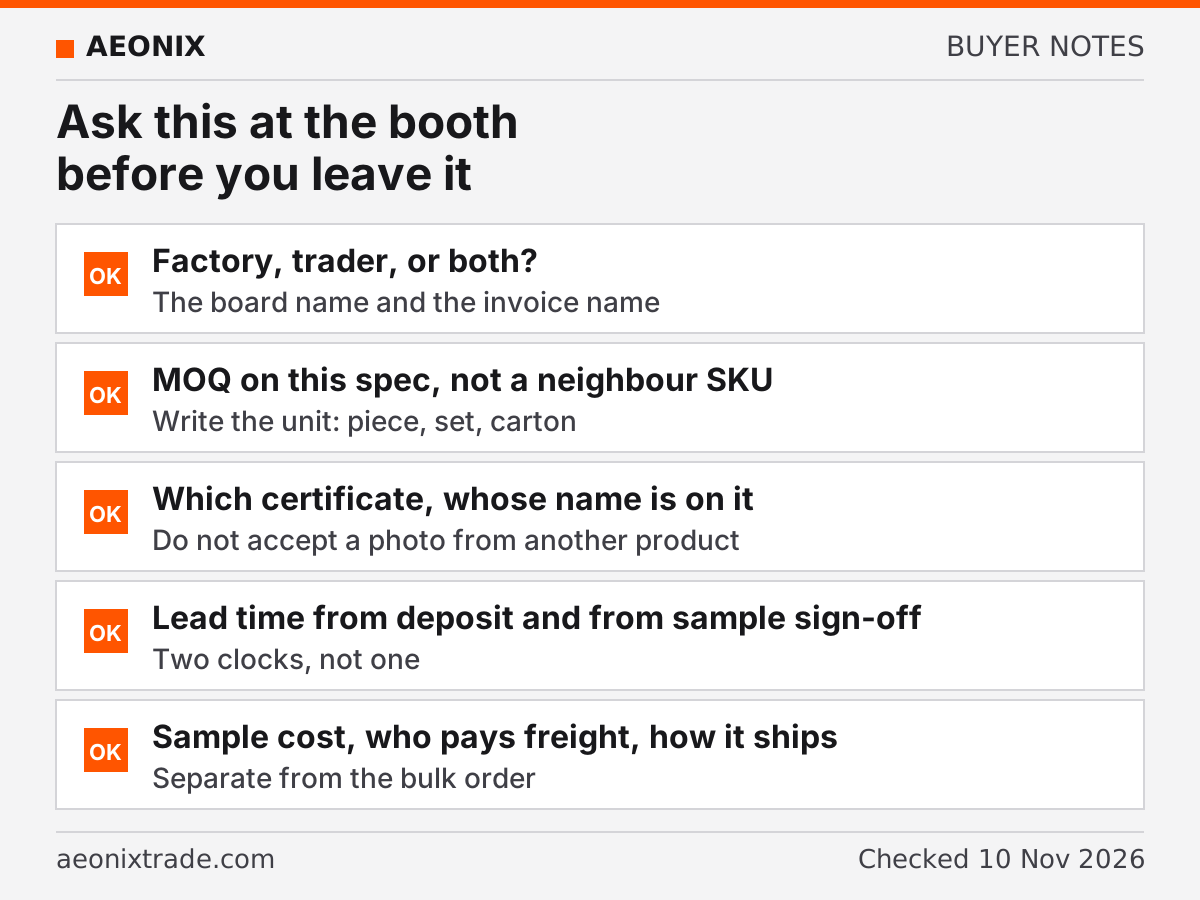
| Ask | Write down | Walk away if |
|---|---|---|
| Factory, trading company, or both? | The name on the board and the name that would be on the invoice | They will not say who sells |
| MOQ for this spec | The unit: piece, set, or carton | The MOQ is for a different SKU |
| Certificates | Which mark, and whose name is on the document | The only proof is a photo of another product |
| Lead time | From deposit, and again from sample sign-off | One number is supposed to cover both |
| Sample | Who pays, how it ships, what sign-off means | The sample is "the same as the catalogue" |
MOQ as a term is covered on MOQ in sourcing. Checking the company before you wire is on verify the supplier before payment. The inspection you book after the sample is on the pre-shipment inspection checklist.
The 48 hours after
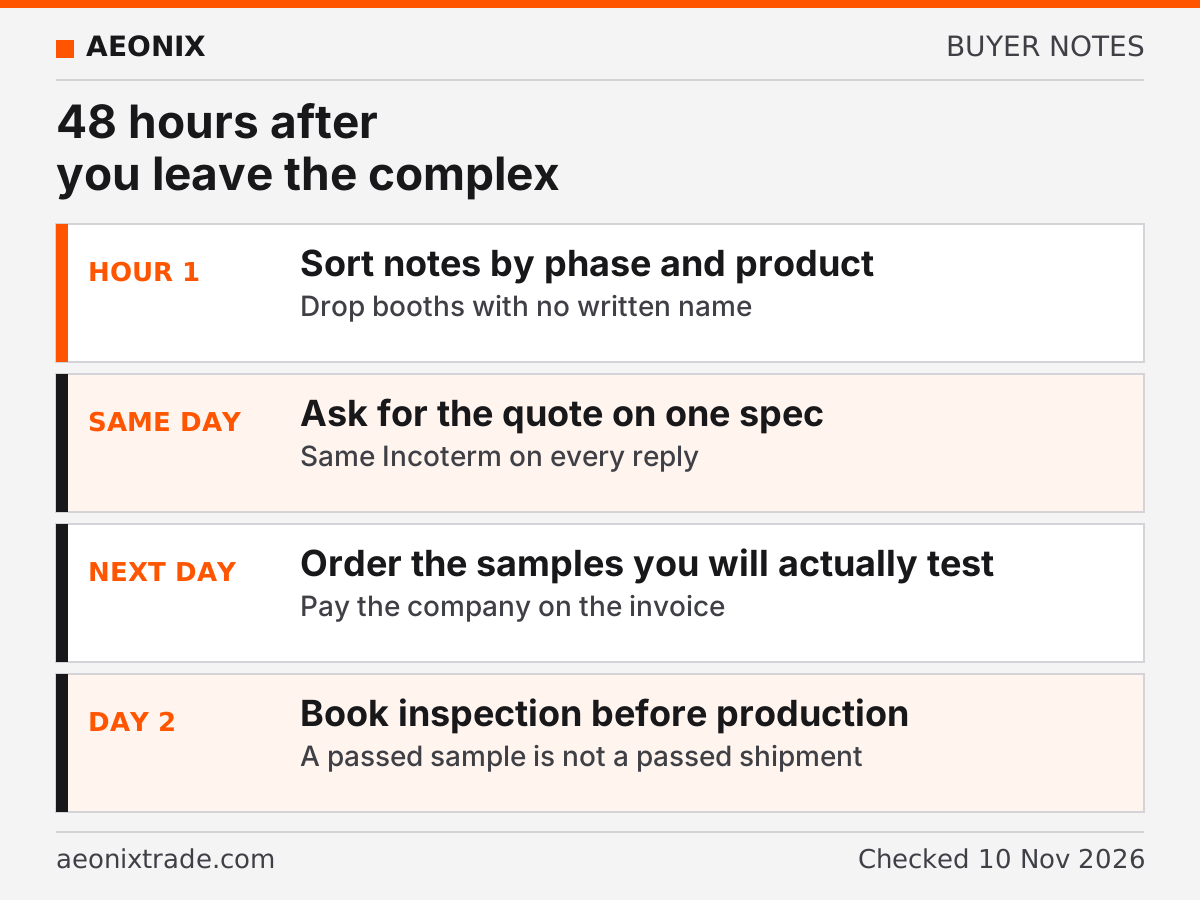
Sort the notes the evening you leave the complex. Drop any booth where you cannot read the legal name. The next morning, send one specification and ask every survivor to quote it on the same Incoterm. FOB and EXW are not the same offer. If the replies come back on different terms, you are not comparing prices. Order samples only for the lines you will test. Then decide who inspects the bulk before anyone talks about a balance payment.
A usable quote names the spec, the unit, the MOQ, the packing, the price term, the sample cost, and the lead time from the day you approve the sample. A catalogue page with a circled price is not that file. Reply to the person who can send the proforma, and keep the booth number in the subject line so the thread is still findable when three halls blur together. If two booths quote the same SKU, put them in one table before you answer either of them. The first booth to chase you on chat is not automatically the right one.
A typical case
A buyer of home gifts attends phase 2, wants about a dozen SKUs, and expects the first shipment to move LCL on FOB terms out of Guangzhou if the cube stays small. The fair day produces eight conversations and three written quotes. Two quotes are EXW at the factory gate. One is FOB. Only the FOB quote can be put next to a freight idea without inventing the inland leg. The buyer orders two samples, pays the company named on the proforma, and does not pay a personal account "to make the sample faster." The follow-up file is the same shape as an RFQ: spec, quantity, packing, term.
What first-time buyers regret
- No phase check. The category was real. The week was wrong.
- A verbal price with no term and no name. It cannot be compared and it cannot be paid safely.
- A deposit sent the same afternoon to a personal account, because the booth was busy and the catalogue looked finished.
If you are still choosing between the fair and a wholesale market, use the comparison with Yiwu. If you want the short list built before you fly, the sourcing agent page and the buying-trip page are the commercial routes. The spec itself goes on the RFQ form.
The fair logistics around this are badge and registration fees, whether a small buyer should go, opening hours and a day plan, and the Pazhou hall map.
See also China Buying Trip Checklist.
Official sources
- 141st session dates, 9:30-18:00 talks, and product groups.
- Overseas buyer badge guide, 26 September 2026.
- Year-round pre-registration notice, 19 August 2026.
- ICC Incoterms 2020 for the price-term words on the quote.
Submit sourcing request
Can't find what you need?
Start with a product or image link, an approximate quantity and destination. Other details can follow.