November 14, 2026Import markets & compliance4 min read
Yiwu Underwear: Floor 4 Label Check
Published by Aeonix Trade.
Buy bra and underwear on floor 4 of Yiwu District 4. Yiwugo's paragraph and its product table, as of 10 November 2026, both put bra and underwear there, with belts and scarves. Floor 1 is socks. Floor 2 is daily goods, gloves and hats. For the European Union, Your Europe's textile-label page, as of 10 November 2026, says the labelling requirement concerns products made up of at least 80 percent textile fibres by weight. Article 9(1) of Regulation (EU) No 1007/2011 requires the name and percentage by weight of every constituent fibre, in descending order. The label must be firmly attached, for example sewn in, when the goods are sold to a consumer. The building has been in operation since 21 October 2008, with 1,080,000 square metres and above 16,000 booths.
Pajamas and other garments are the Huangyuan clothing market, not this floor.
Send the waist measurement, the fibre line and the pieces per carton with an underwear sourcing RFQ.
What the label has to carry
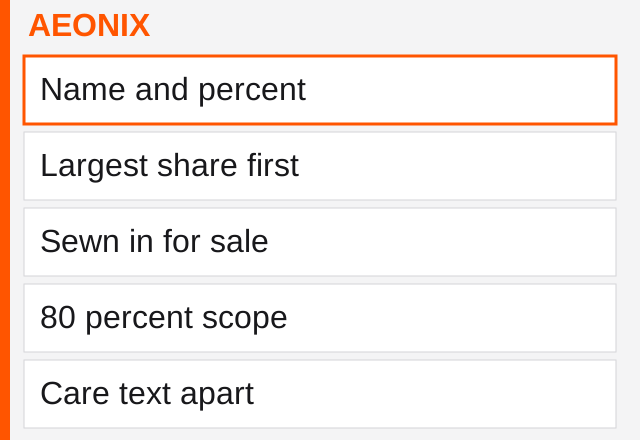
Your Europe also says business-to-business sales may use commercial documents instead of, or as well as, the label, and that "100%", "pure" or "all" is only for a product of one fibre. Fibre text and care text must be clearly separated. If you sell to consumers in more than one EU country, the text has to be in the official languages of those countries. For England, Scotland and Wales, GOV.UK's textile labelling guidance, published 31 December 2020, says a business that manufactures, distributes or sells textiles must follow special rules, and the label must show the fibre content, including fur and other animal parts.
| Check | Where it is required | What you record |
|---|---|---|
| Every fibre name and its percentage by weight, largest share first | EU consumer sales, Regulation (EU) No 1007/2011 Art. 9(1) | Name and percent for each fibre |
| At least 80% textile fibre by weight | Same page, scope of the rule | Yes or the product is outside that scope |
| Sewn in, or a commercial document | Consumer label, or B2B papers | Which one you have |
| Fibre content, including animal parts | England, Scotland, Wales, GOV.UK, 31 Dec 2020 | The fibre line |
| Size on the garment and the carton | Your packing list | Waist and leg opening in mm |
Measure the size set
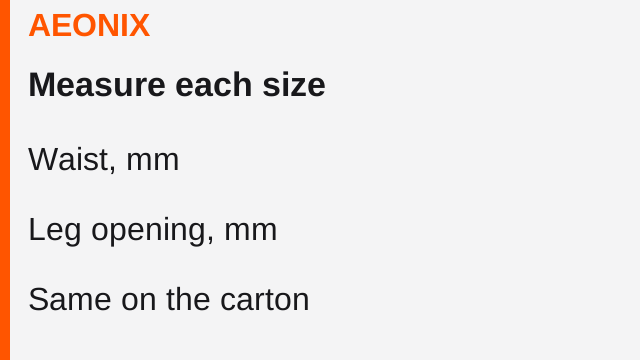
Write the waist and the leg opening in millimetres for each size. Stretch the elastic, let it recover, and note whether it returns. That is a booth look, not a wash-cycle test. Pieces per carton and the carton count go on the packing list. How the first sample is agreed is product samples from China. Holding the bulk to this sheet is the market-floor check.
The Harmonized System, as the World Customs Organization describes it on 10 November 2026, identifies each commodity group with a six-digit code. Ask the broker for those six digits plus the national digits. The booth does not assign them.
Send the completed sheet with the underwear sourcing RFQ.
Source notes
- Yiwugo, District 4, as of 10 November 2026. Floor 4 is bra and underwear. Operation date, area and booth count as printed.
- Your Europe, textile label, as of 10 November 2026. The labelling requirement concerns products made up of at least 80 percent textile fibres by weight. Sewn-in label, and the single-fibre wording.
- Regulation (EU) No 1007/2011, Article 9(1). The name and percentage by weight of all constituent fibres, in descending order. Article 2(2)(a) treats a product of at least 80 percent textile fibres by weight the same way as a textile product.
- GOV.UK, textile labelling, published 31 December 2020. England, Scotland and Wales. Fibre content, including animal parts.
- WCO, Harmonized System, as of 10 November 2026. Six-digit codes.
Submit sourcing request
Can't find what you need?
Start with a product or image link, an approximate quantity and destination. Other details can follow.