Find out who you are actually paying before the deposit leaves. We check the business licence against the receiving account, look at what the factory really runs, and write down what we could not verify.
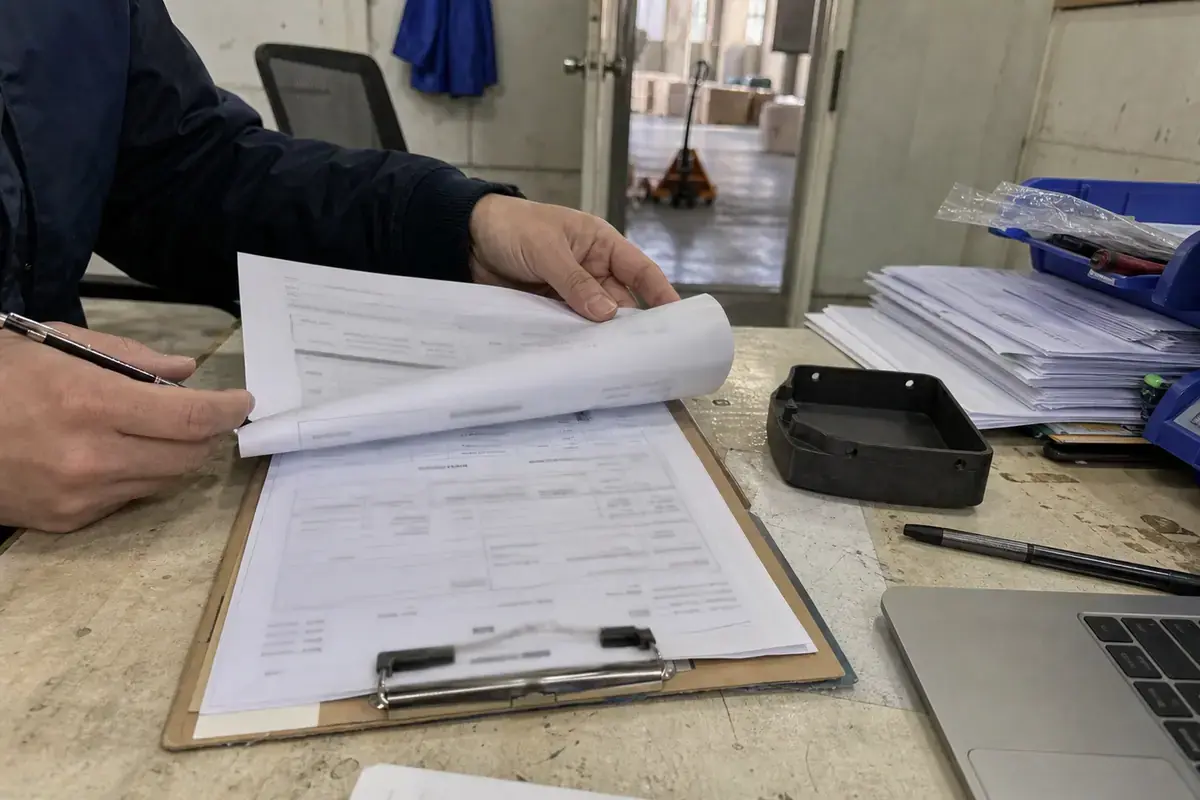
Illustrative scene · Supplier document review — Redacted supplier documents and workshop notes prepared for review.
Business scope
License
Onsite review
Factory
Risk signals
Quote
Readiness
QC
Buyer fit: use this when the supplier must be credible before the order moves forward.
An audit cannot remove risk. It can tell you who you are actually paying, what the factory can build, and where the quote is hiding cost. That is enough to decide whether a deposit is safe. It is not enough to replace lab testing, certification, or legal review — those stay with the people licensed to do them.
New supplier verification
A new supplier, a first order, and a payment about to leave for an account you have never used before.
Suspicious quote review
The price is well under everyone else's, the MOQ keeps moving, and the lead time sounds too good. Usually one of those is explained by something you cannot see from the quote.
Production readiness
You want to know whether the workshop can actually carry your order, or whether it quietly goes out to somebody else's factory.
Not a fit: certification, legal, or finance assurance
Lab testing, destination-market compliance, legal advice and payment guarantees are not what an audit gives you. It records what is visible and names what is not.
Choose the buyer route before the sourcing motion.
Buyer route
Choose the buyer route before the sourcing motion.
The same sourcing service has different risk controls for ecommerce, private-label, wholesale, and procurement buyers. Choose the buyer route before supplier search, samples, QC, and shipment work are scoped.
Supplier audit should support a buying decision and the next payment gate, not just produce photos.
We check the business licence against the account you are being asked to pay. We look at what the factory actually runs, not what the catalogue claims. Then we mark which parts of the quote depend on assumptions rather than confirmed inputs. Everything reviewed is written down; so is everything we could not verify.
01Check identity and documents
Licence, business scope and the payment account, checked against each other rather than one by one.
Document review
02Review workshop context and capability
What the workshop actually runs, and which steps go outside. Subcontracting is normal; not knowing about it is not.
Capability note
03Connect quote and order risk
Which parts of the quote the visit supported, and which turned out to rest on assumptions.
Quote risk
04Prepare QC handoff
Whatever the audit could not settle becomes a checkpoint for inspection later, so it does not quietly disappear.
QC readiness
Verification should show what was checked and what was not.
Factory selection and testing are assessed for the specific product, model and destination. We can coordinate appropriate suppliers and testing within the agreed scope. A factory certificate or a previous product report does not establish compliance for every product or market.
Business license and documents
Whether the company on the licence, the factory at the address, and the account on the invoice are the same business.
Production capability and boundaries
What the workshop can carry, and which steps quietly go out to someone else.
Audit evidence/release gate
Which quote assumptions survived the visit, and which ones you should treat as unconfirmed before paying a deposit.
Verification file
Whether the business licence matches the account you are being asked to pay.
What the factory actually runs, against what the catalogue claims.
Which parts of the quote rest on assumptions, and what we could not verify. An audit narrows risk; it does not remove it.
Supplier audit questions buyers ask first.
Is supplier audit the same as factory verification?
It is document review plus a look at the actual factory. It is not lab testing, legal due diligence or certification, and treating it as any of those is how buyers get caught out.
Can Aeonix review a business license and export readiness?
Yes. We check the licence, the business scope and the onsite documents against each other. Destination-market compliance is a different question and needs the right specialist.
When is an audit most useful?
Before the deposit — especially when a quote is unusually attractive. That is the only point where you can still change supplier, change scope, or change the payment terms.
Turn supplier verification into an RFQ, quote benchmark, and QC release plan.
Send the supplier name, the quote, and the account you were asked to pay. We come back with what checked out, what did not, and what is still unknown. The unknowns are named, not smoothed over.
See how supplier audit evidence becomes a buyer-ready decision packet.
This sample report structure shows how Aeonix organizes onsite audit, qualification review, production capability, and document verification. It is not a file-download promise; it shows what evidence the RFQ should collect before supplier selection, quote comparison, and QC planning. The buyer evidence path starts with supplier proof, then moves into sample proof, quote proof, inspection proof, and shipping proof.