Mold Ownership When Manufacturing in China
Published by Aeonix Trade.
Last fact-checked: November 10, 2026.
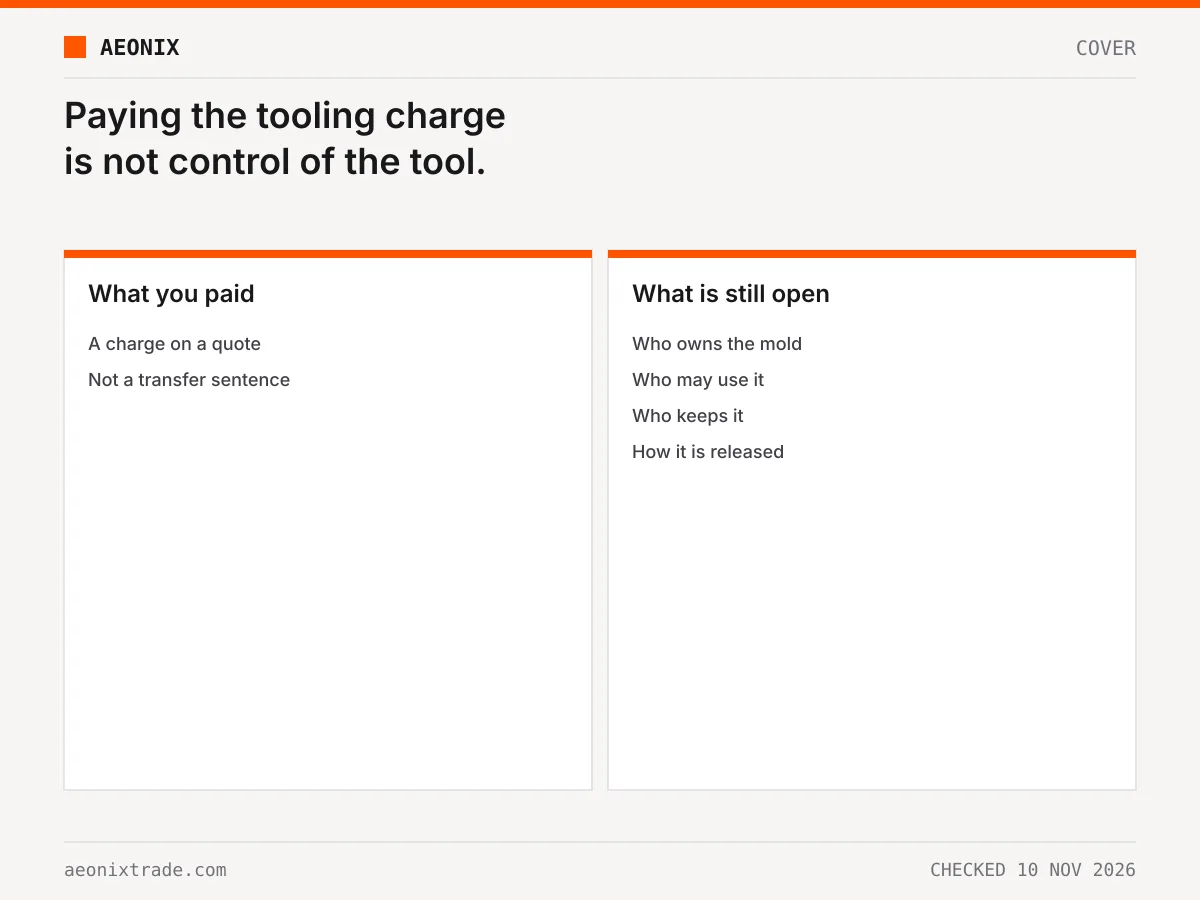
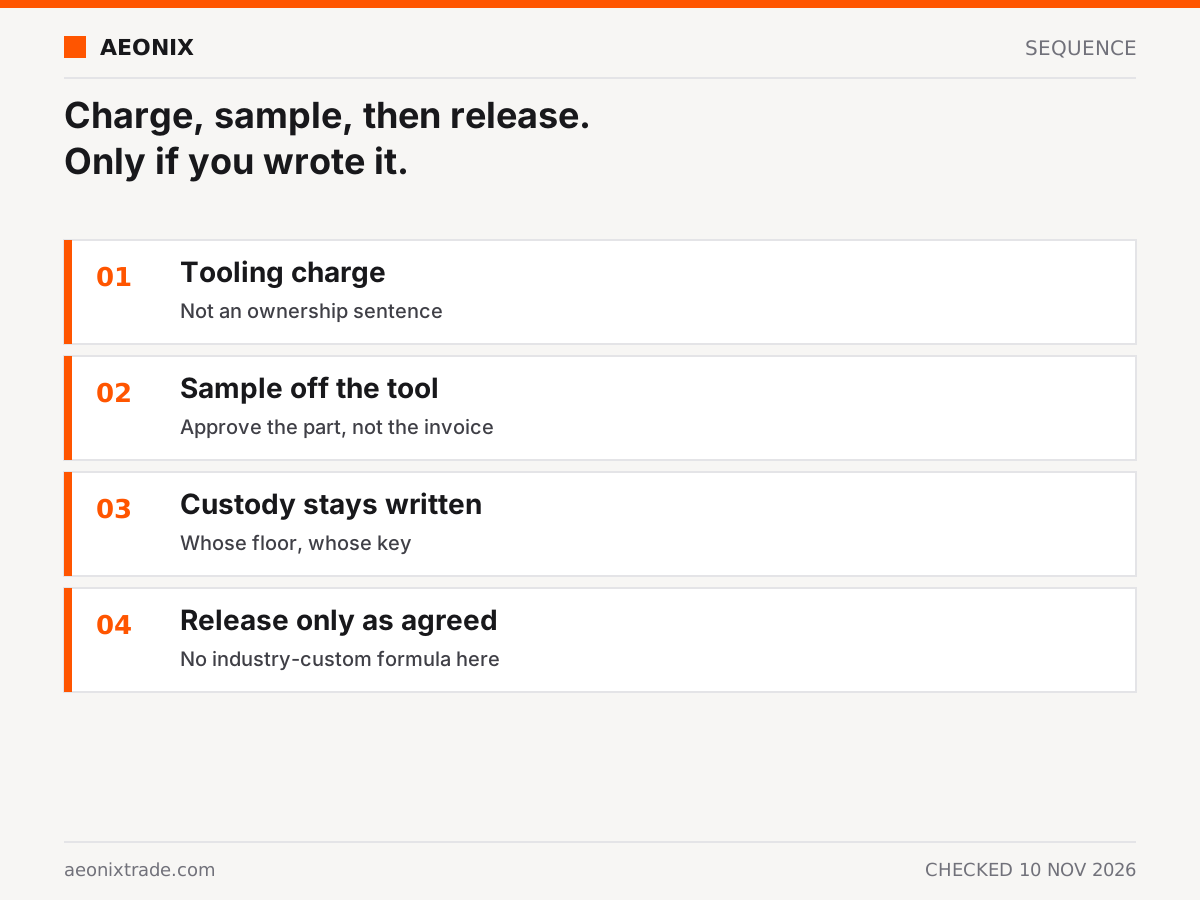
Paying a tooling charge does not, by itself, say who owns the mold, who keeps it, who may run it, or how you get it back. I could not find a single official "mold law" that works as an instruction sheet. The English Civil Code, on the State Council attachment checked November 10, 2026, never uses the word mold in the articles cited here. Ownership, custody, permitted use, and release are clauses you write. A factory's spoken custom is not that clause. This page does not invent a depreciation formula, and it is not legal advice.
If the shape itself is a design you want on a register, that is an intellectual-property filing, not a line on a tooling invoice. Start at CNIPA's English site. Do not treat a mold payment as a design patent.
A cap mold that stayed on their floor
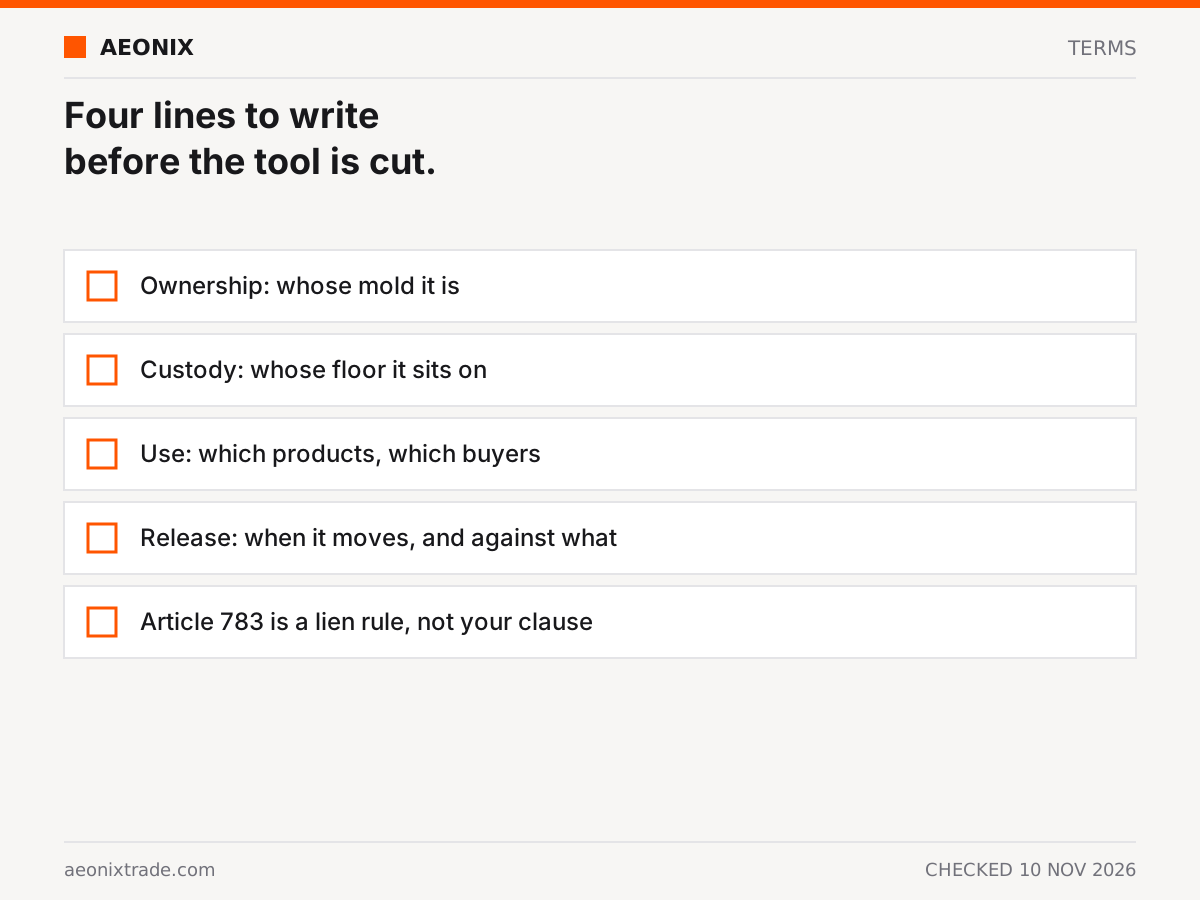
A buyer pays a tooling charge for a bottle-cap mold. The quote shows the charge and a sample date. It does not say whose mold it is. The tool is cut, a sample is approved, and production starts. Months later the buyer hears that a similar cap is being offered to another brand. The mold is still at the factory. Nothing in the file says whether that use was allowed, or what it would take to move the tool. No fee is stated here. The charge is whatever the quote said.
Article 770 describes a work contract as a contractor completing work to the client's requirements, and it includes manufacturing on order. Article 779 says the contractor accepts the client's necessary supervision and inspection, and that the client may not disturb the normal work by doing so. Article 783 says that where the client fails to pay remuneration or materials fees, the contractor may retain the work product under lien or refuse delivery, unless otherwise agreed. Whether a mold is that "work product" is a question for counsel reading the Chinese text. What you can do without guessing is write the four lines below, including what happens if a fee is unpaid.
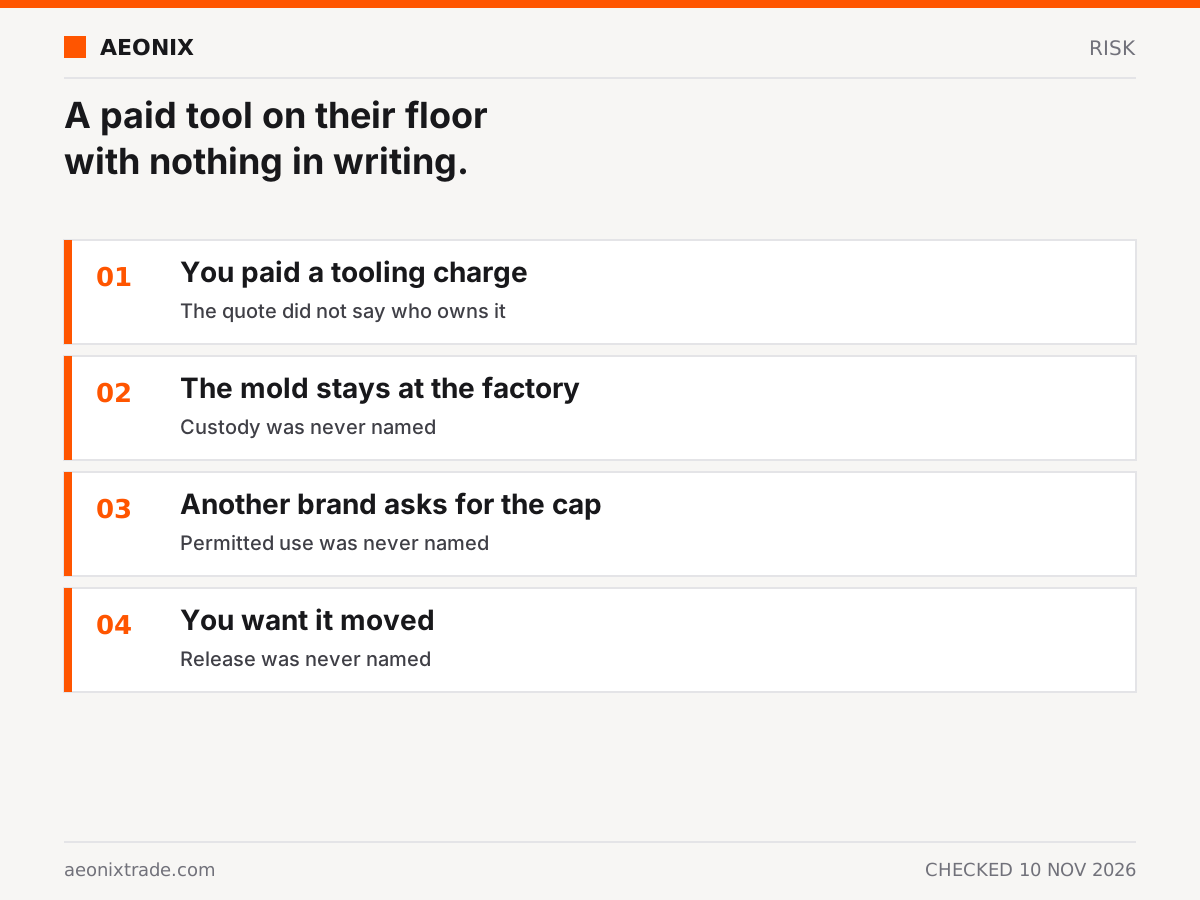
Ownership, custody, use, and release
| Line | The question | What a tooling charge does not answer |
|---|---|---|
| Ownership | Whose mold is it after the charge is paid? | Payment is not a transfer sentence |
| Custody | Whose floor does it sit on, and who holds the key? | "It stays here for convenience" is not custody |
| Permitted use | Which products, and for which buyers, may it run? | Silence is not an exclusive |
| Release | When may it move, and against which papers or unpaid items? | Article 783 is a lien rule, not your release clause |
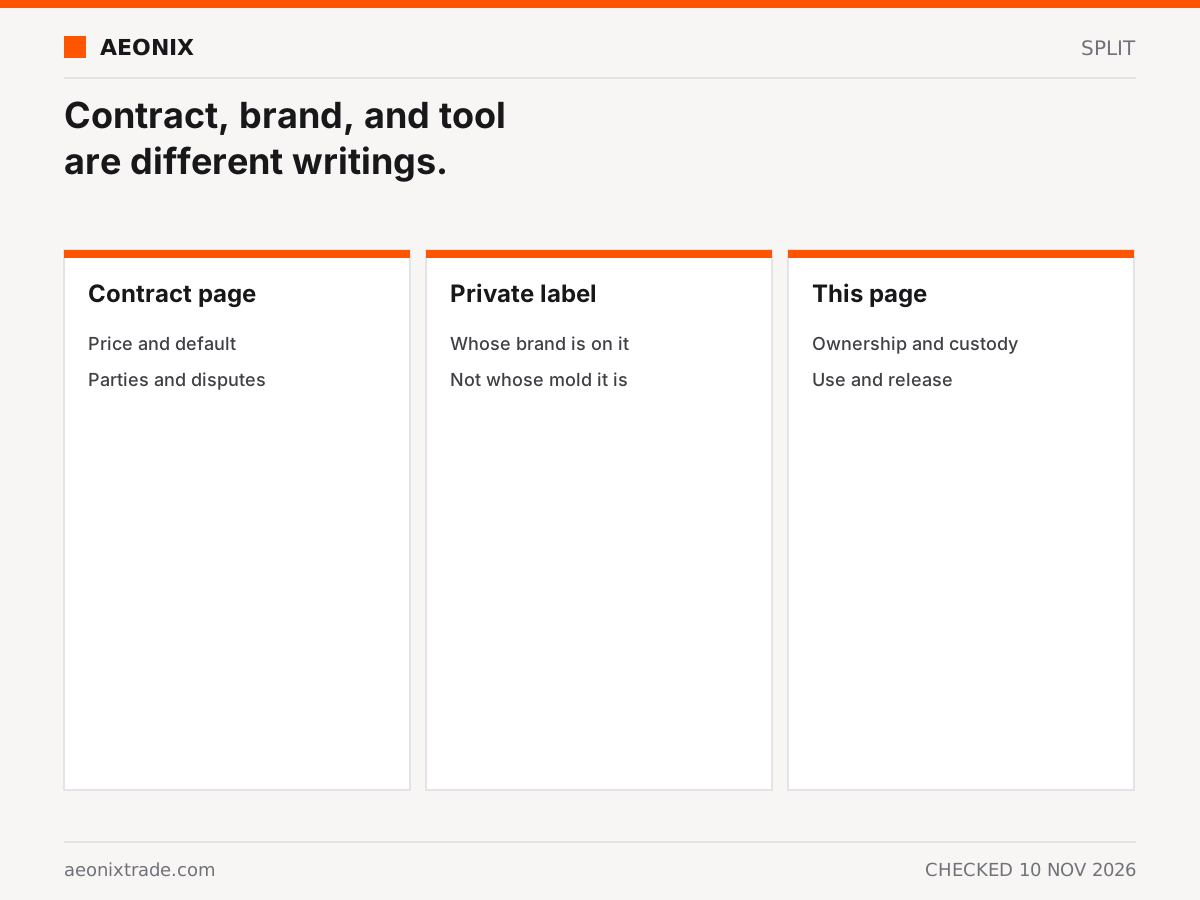
Write the four lines while the tool is still a drawing. Once steel is cut, you are negotiating a release from a weaker seat. Identify the mold in the file the way you would identify a shipment: a number you both can see on the tool, the drawing revision it was cut from, and the cavity count. Do not describe it only as "the cap mold." Two tools in one shop can share that nickname. Put the lines in the purchase contract, or in a schedule the contract points to. The quality agreement says what a part off that tool must measure. It does not say who owns the steel. Brand on the cap is the private label question, and the making-to-your-drawing question is OEM. How the charge is paid is T/T payment, which still needs the account matched to the company.
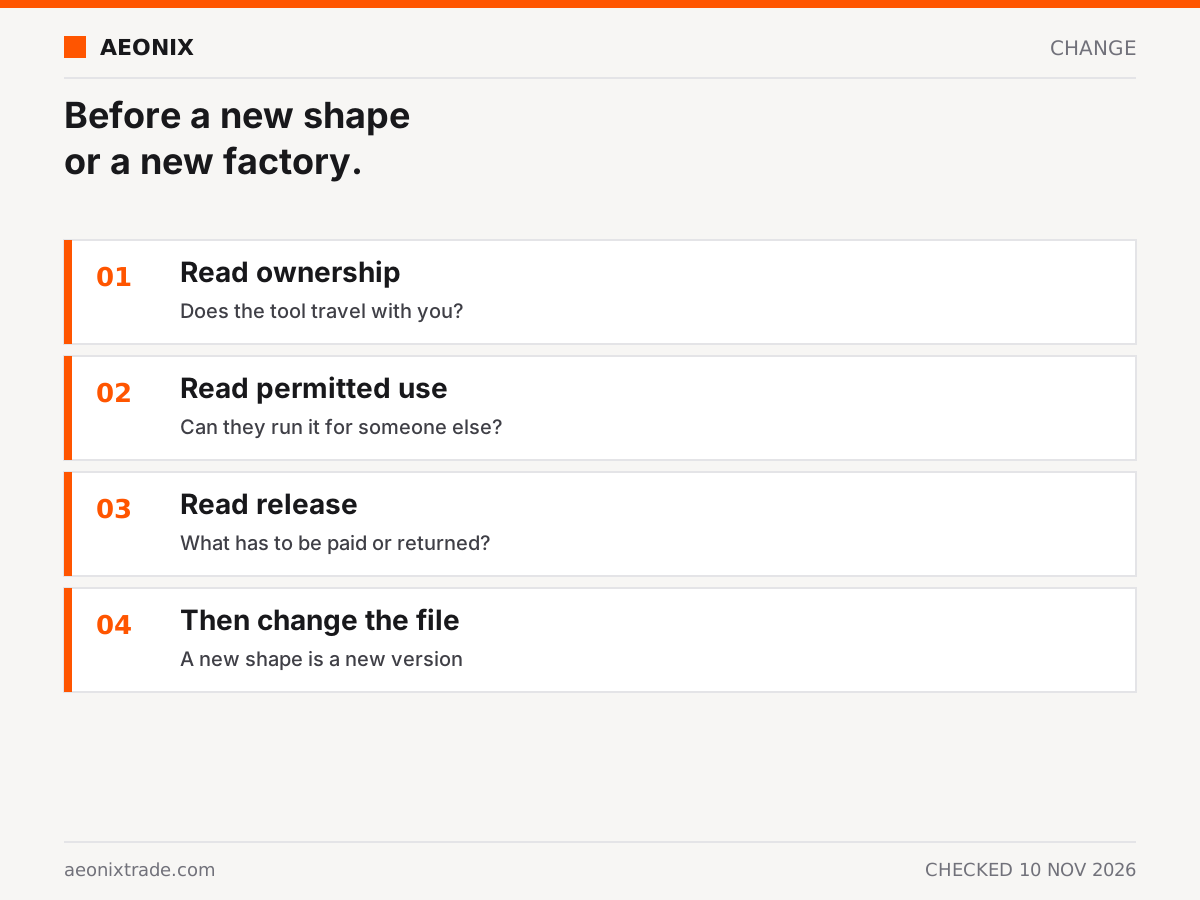
Before you change the shape or the factory
- Read ownership before you assume the tool travels with you.
- Read permitted use before you accuse anyone of selling your cap. The file may never have forbidden it.
- Read release before you book a truck. Name the condition: samples approved, charges paid, or whatever you actually agree.
- Mark the tool with an identification you both record, so "the cap mold" is not an argument later.
- Version the drawing when the shape changes. A new cavity is not covered by a sentence about the old one.
- Do not write a depreciation percentage you invented. If you want a formula, it has to be one you both agree, not an industry myth.
Pitfalls
- Treating the tooling line on a quote as proof that you own the mold.
- Leaving the tool at the factory with no custody sentence, then discovering another buyer's goods came off it.
- Assuming "the buyer always owns the tool" because someone called it a custom. I could not find that rule in the Code articles checked on November 10, 2026.
- Ignoring Article 783. If fees are unpaid, a contractor's lien or refusal to deliver is in the work-contract chapter, unless you agreed otherwise. Do not find out which object it reaches by arguing after the fact.
- Moving factories on a handshake. Release is a written step.
Name ownership, custody, use, and release on the RFQ before anyone cuts steel. Development work that includes tooling sits with OEM and product development.
Frequently asked questions
If I paid for the mold, do I own it?
Not from the payment alone. The English Code text checked for this article does not say a tooling charge transfers a mold. Write ownership in the contract. Ask counsel if you need the Chinese text applied to a tool you already paid for.
Can the factory keep the mold if I owe money?
Article 783 says a contractor may retain the work product under lien, or refuse delivery, where remuneration or materials fees are unpaid, unless otherwise agreed. Whether your mold is that work product is not decided here. The practical step is to agree release, including what must be paid, before the tool exists.
Does a design patent ride along with the mold?
No. A design right, if you want one, is a filing at the intellectual-property office. CNIPA's English site is the entry checked on November 10, 2026. This page does not tell you whether your cap qualifies.
The production file next to this one is starting a private label from China, an NNN agreement versus an NDA, trademarks before production, and Amazon Brand Registry.
Official sources
- State Council Civil Code notice and the English attachment. Articles 770, 779, and 783. Checked November 10, 2026. The Chinese text prevails.
- CNIPA English site. Checked November 10, 2026. Use it for design and patent questions. It is not a mold statute.
A third official "mold ownership" page was not found on November 10, 2026, so none is invented here. This is not legal advice.
Submit sourcing request
Can't find what you need?
Start with a product or image link, an approximate quantity and destination. Other details can follow.