Thailand ended the 1,500 baht parcel exemption: what it means for samples and small orders from China
Published by Aeonix Trade.
Last fact-checked: 5 November 2026. Sources are Thai Customs and Revenue Department notifications linked below. This is general guidance, not a customs ruling. Confirm HS codes and duty rates with a licensed Thai customs broker.
For years, the standard advice for sending a few samples to a buyer in Thailand was simple: keep the declared value under 1,500 baht and the parcel goes through with no duty and no VAT. That advice is now wrong for ordinary goods. Since 1 January 2026, Category 12 only exempts imported goods valued at 1 baht or less. Goods above that are no longer exempt under Category 12. They pay import duty at the normal tariff rate plus VAT, whether they arrive by post, by express courier, or through an online platform, unless another exemption applies. Category 14 samples that can only be used as samples and have no commercial value are still duty-exempt. Section 81(2)(c) then removes VAT on those samples as well.
If your supplier shortlist assumed free sample shipments, change the budget. Here is what changed, where it is written, and how to handle samples now.
What the old rule actually was
The 1,500 baht figure came from Category 12, Part 4 of the Customs Tariff Decree. Category 12 lets the Director-General of Customs set a value below which imported goods are duty-exempt. From 2018 that value was 1,500 baht of customs value, meaning the price including freight and insurance (CIF). Under Section 81(2)(c) of the Revenue Code, goods in a duty-exemption category are also exempt from import VAT. So a parcel under the threshold paid nothing at all.
It changed in two steps:
- 5 July 2024 to 31 December 2025. Customs temporarily cut the Category 12 threshold to 1 baht. A separate Ministry of Finance notification kept import duty at zero for goods over 1 and up to 1,500 baht CIF. A second notification extended that through 2025. The practical result was 7% VAT but no duty on low-value parcels. Customs' stated reason, in the preamble of Customs Notification No. 116/2567, was that foreign sellers were escaping the VAT Thai sellers pay.
- From 1 January 2026. Customs Notification No. 219/2568 set the Category 12 threshold permanently at 1 baht and repealed the 2018 notice. The MoF duty relief ran until 31 December 2025, and the government has said Customs now collects both duty and VAT from the first baht.
How tax is worked out now
For a dutiable parcel, the duty is the tariff rate for the HS code applied to the customs value. VAT is then charged on CIF plus that duty (plus any excise), per Section 79/2 of the Revenue Code. The VAT rate is 7%. The Revenue Department confirmed that rate is extended to 30 September 2027.
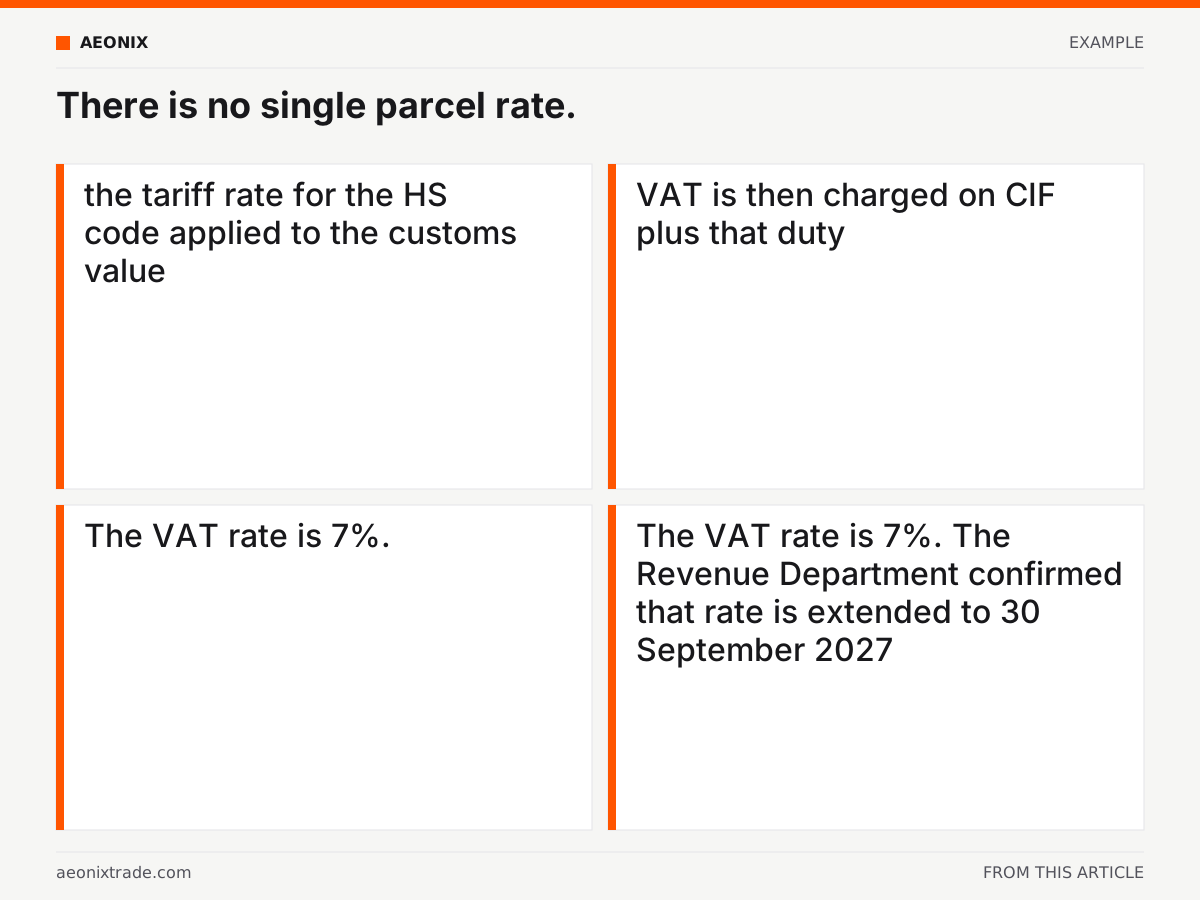
There is no single parcel rate. Duty depends on the HS code, so without the HS code you cannot know the landed cost.
Who collects it, by channel
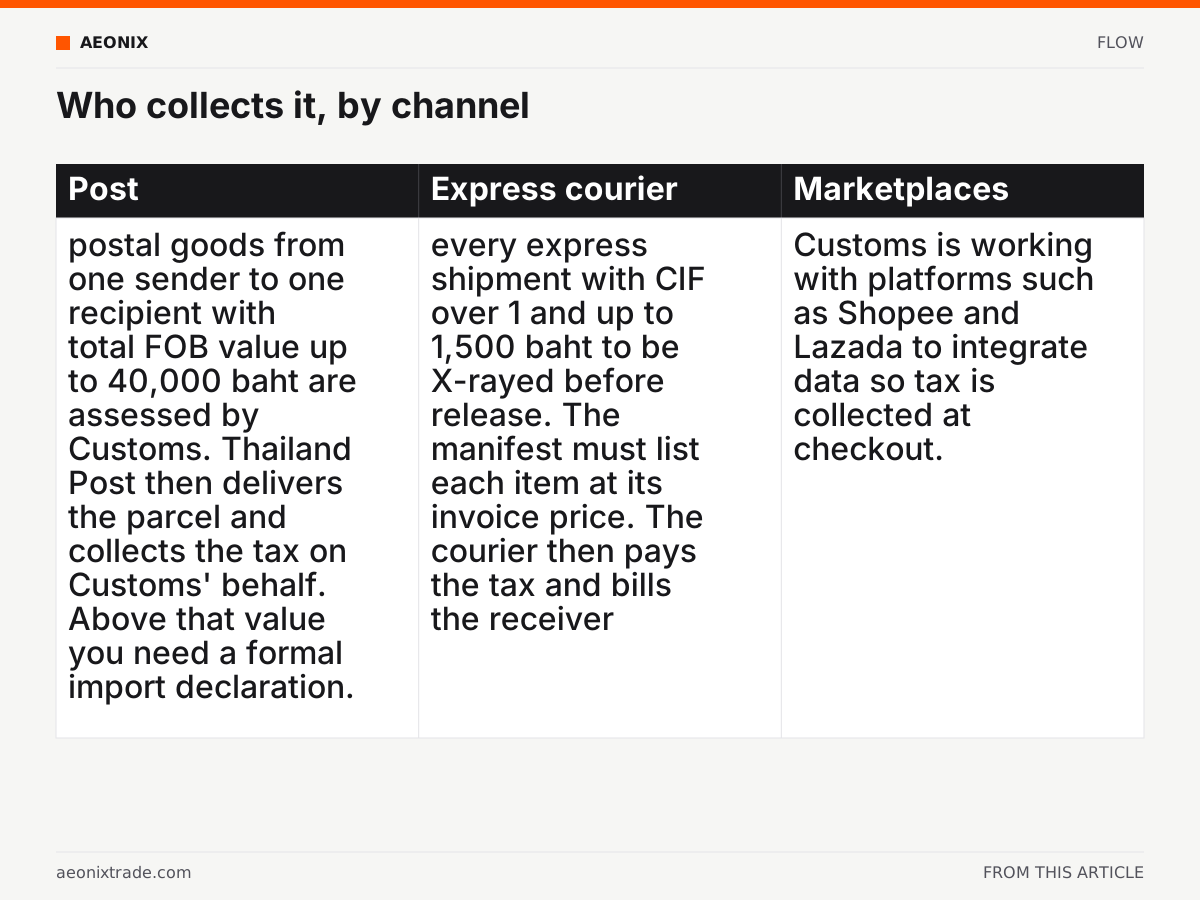
- Post (EMS, China Post). Under Customs Notification No. 243/2568, effective 1 January 2026, postal goods from one sender to one recipient with total FOB value up to 40,000 baht are assessed by Customs. Thailand Post then delivers the parcel and collects the tax on Customs' behalf. Above that value you need a formal import declaration.
- Express courier (DHL, FedEx, UPS, SF and similar). Customs Notification No. 230/2568, also effective 1 January 2026, requires every express shipment with CIF over 1 and up to 1,500 baht to be X-rayed before release. The manifest must list each item at its invoice price. The courier then pays the tax and bills the receiver, usually with its own handling fee on top. Check your courier's current fee schedule.
- Marketplaces. According to the Thai government's public relations department, Customs is working with platforms such as Shopee and Lazada to integrate data so tax is collected at checkout. That affects retail shoppers more than B2B buyers taking samples straight from a factory.
A typical case: three suppliers, one courier box each
Say a Bangkok buyer is choosing a supplier for stainless drinkware and asks three factories to send two finished units each by express courier. Under the old rule, each box would be declared at a small value and arrive with nothing to pay.
Now each box goes through X-ray, and the courier asks for duty and VAT before delivery. A common problem is a factory writing "sample, no commercial value" on the waybill while the commercial invoice shows a unit price. Customs goes by the invoice and treats the units as dutiable goods. If nobody at the buyer's office knows a payment is due, the box just sits there.
The duty on two units is rarely large. The real cost is the week lost on a decision the buyer wanted to make quickly.
Is there still a sample exemption?
Partly. Category 14 of the same Part 4 exempts duty on samples that can only be used as samples and have no commercial value. Notification 243/2568 still lists those as duty-free in the postal channel. Section 81(2)(c) then removes VAT as well. In practice, Customs decides whether a sample qualifies. A sellable finished product in retail packaging is unlikely to count. Cut swatches, a marked or defaced unit, or a single "SAMPLE NOT FOR SALE" piece has a better case. Do not build your budget on getting it.
Before and after
| Up to 4 Jul 2024 | 5 Jul 2024 – 31 Dec 2025 | From 1 Jan 2026 | |
|---|---|---|---|
| Duty-exempt threshold (Cat. 12) | CIF ≤ 1,500 baht | ≤ 1 baht, but MoF relief kept duty at zero for CIF > 1 to ≤ 1,500 baht | ≤ 1 baht |
| Import duty on a CIF 1,500 baht parcel | None | None | Tariff rate for the HS code |
| Import VAT | None | 7% | 7% on CIF + duty |
| Courier parcels CIF > 1 to ≤ 1,500 baht | Duty- and VAT-free | Declared with the LVG code for duty relief | Mandatory X-ray before release |
| Samples with no commercial value (Cat. 14) | Duty-exempt | Duty-exempt | Duty-exempt |
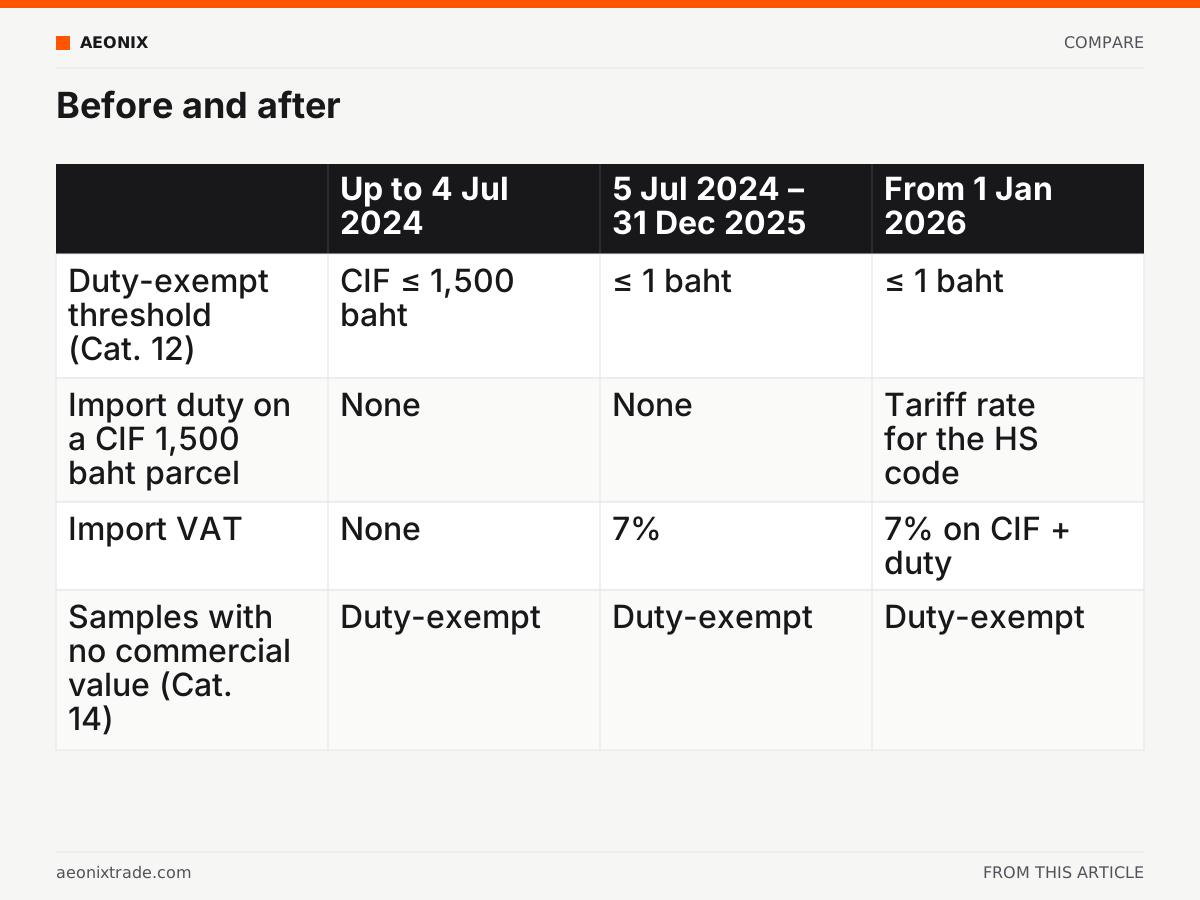
The LVG declaration code for the duty relief in 2024 to 2025 is in Customs Notification No. 129/2567.
Pitfalls we keep seeing
- Trusting the old English page. At the time of writing, the Thai Customs postal import page in English still describes the 1,500 baht Category 1 exemption. The Thai-language notifications are the current law.
- Under-declaring to stay "below the line". There is no line left to stay below. A low value only makes the X-ray inspection stricter and risks a penalty.
- No commercial value on the waybill and a price on the invoice. Customs reads the invoice.
- Nobody ready to pay. Courier parcels wait until the receiver pays duty and VAT. Name a contact who can pay the day the bill arrives.
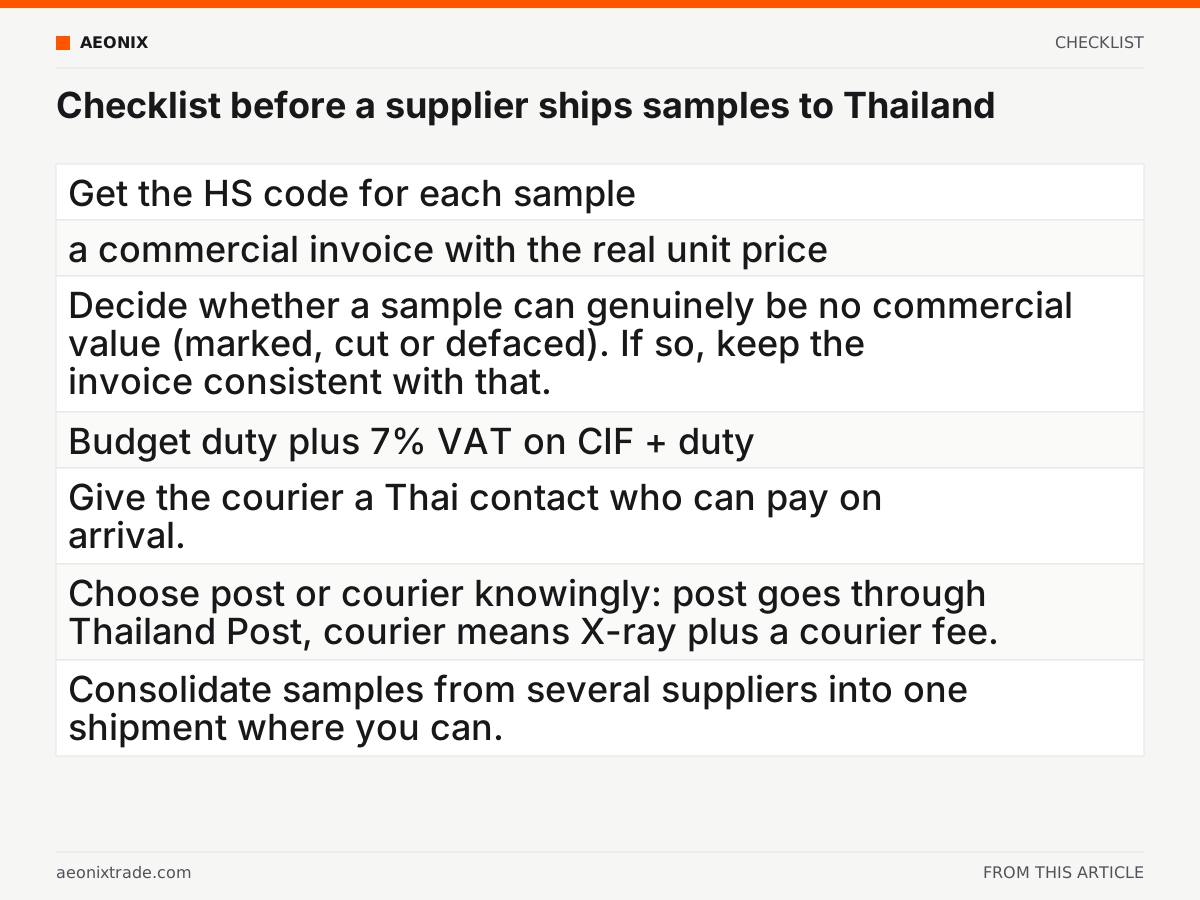
Checklist before a supplier ships samples to Thailand
- Get the HS code for each sample from the supplier or your broker.
- Ask for a commercial invoice with the real unit price, quantity and description.
- Decide whether a sample can genuinely be no commercial value (marked, cut or defaced). If so, keep the invoice consistent with that.
- Choose post or courier knowingly: post goes through Thailand Post, courier means X-ray plus a courier fee.
- Budget duty plus 7% VAT on CIF + duty for every box.
- Give the courier a Thai contact who can pay on arrival.
- Consolidate samples from several suppliers into one shipment where you can.
When samples become an order
Once you move past samples, LCL sea freight with a proper declaration is usually the cheaper route. Our China to Thailand import guide walks through that process. If you want us to collect samples from several factories, check the invoices and ship them as one consolidated box, send us an RFQ with the products and your Thai delivery address.
Submit sourcing request
Can't find what you need?
Start with a product or image link, an approximate quantity and destination. Other details can follow.