5 Practical B2B Sourcing Priorities for 2026
Published by Aeonix Trade.
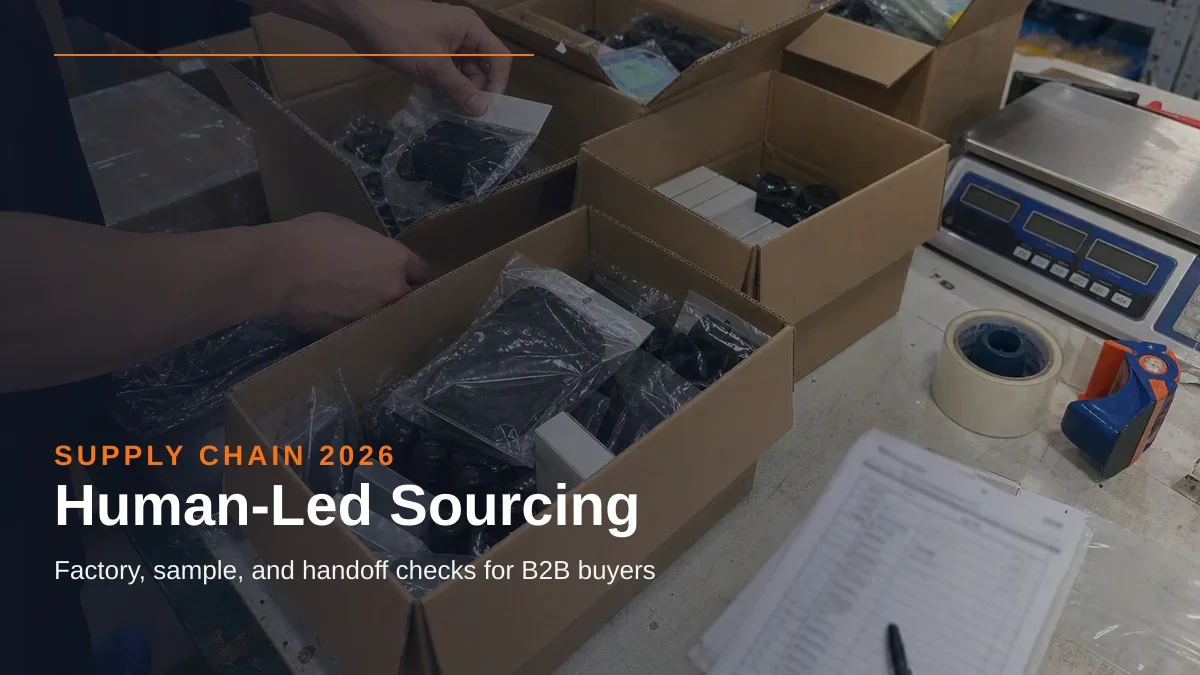
B2B sourcing priorities
5 practical B2B sourcing priorities for 2026
Focus B2B sourcing on supplier proof, specification control, landed cost, QC checkpoints and replenishment planning before scaling orders.
- Verify suppliers with license checks, product scope, references, samples and export readiness.
- Turn product requirements into specifications, tolerances, packaging notes and approval samples.
- Model landed cost with freight, duty/VAT, destination fees, inspection and inland delivery.
- Set quality control checkpoints before deposits, production balance and shipment release.
- Plan reorder cadence, safety stock, supplier backup and document ownership before repeat orders.
Introduction
Most sourcing teams are entering 2026 with the same pressure: protect margin, reduce avoidable delays, and keep supplier decisions defensible. In practice, that usually comes from better process discipline rather than dramatic predictions.
For importers, distributors, retailers, and brand owners buying across borders, the highest-impact work still looks familiar: diversify where it matters, write clearer RFQs, move quality checks earlier, plan compliance before production starts, and verify suppliers with more than a document review.
This guide focuses on practical sourcing priorities for 2026. It avoids hard forecasts because freight, lead times, testing requirements, and supplier risk can vary widely by product, market, and order size.
1. Build sourcing resilience before you need it
Single-source dependence is still one of the fastest ways to turn a manageable issue into a costly delay. Not every program needs a full "China plus one" strategy, but most buying teams benefit from understanding where they have concentration risk.
The move
Keep your primary supplier if performance is strong, but qualify at least one credible backup path for your most important SKUs, components, or packaging inputs. In many categories, the priority is not changing countries for the sake of it. The priority is knowing what happens if your first option slips, changes material, or cannot scale on time.
- List the SKUs where a delay would materially affect revenue or launch timing.
- Identify whether the real bottleneck sits at final assembly, a key component, or packaging.
- Keep updated comparison notes on MOQ, tooling, lead time assumptions, and quality history for at least one backup source.
Practical check: If your team cannot name a realistic fallback for a high-priority SKU, resilience is still theoretical.
2. Tighten RFQs and sample approvals
Many sourcing problems start well before production. They start when buyers and suppliers are working from different assumptions on spec, finish, packaging, tolerance, testing, or shipment terms.
The move
Treat the RFQ and sample stage as a control point, not a formality. A more detailed RFQ often saves more time than a rushed negotiation because it reduces repricing, resampling, and preventable disputes later.
- Specify materials, dimensions, finish expectations, labeling, and packaging requirements in writing.
- State target order quantity, repeat-order scenario, and Incoterm assumptions so price comparisons stay meaningful.
- Document what exactly counts as an approved sample, including color, construction, fit, and retail-pack details where relevant.
Practical check: If two suppliers interpret your RFQ differently, their quotes are not truly comparable.
3. Move quality control upstream
Final inspection still matters, but relying on a last-minute pass or fail decision is expensive. By that stage, materials are consumed, schedules are tight, and correction options are narrower.
The move
Bring quality checkpoints forward. For many programs, the most useful sequence is pre-production alignment, a mid-production review when appropriate, and a final inspection before shipment. The right cadence depends on product risk, order size, and how stable the supplier is.
- Confirm critical quality points before mass production starts.
- Use in-process or mid-production checks when the product has fit, finish, assembly, or packaging risk.
- Record acceptable tolerance, defect thresholds, and packaging standards in the PO or inspection brief.
Practical check: The earlier a defect pattern is found, the more options you still have to correct it without missing the shipment window.
4. Treat compliance as part of sourcing, not a final paperwork step
Compliance requirements differ by product and destination market, so there is no universal checklist that fits every order. What does stay consistent is timing: if you leave market requirements until the end, the sourcing team usually inherits avoidable rework.
The move
Bring compliance questions into supplier selection and sample review. For example, import programs for the United States, Germany, or the UAE can each involve different labeling, testing, documentation, or material restrictions depending on the product. Confirm what evidence is needed before the PO is locked.
- Ask early which reports, declarations, labels, or traceability records the product category may require.
- Check whether the supplier can provide the underlying documents, not just say that they are "compliant."
- Where the category is regulated, review requirements with a qualified testing, legal, or customs partner before production scales.
Practical check: A cheaper quote is not a better quote if the supplier cannot support the documentation your destination market expects.
5. Strengthen supplier verification with layered evidence
Document review still matters, but it should not carry the full supplier decision on its own. Registration records, sample consistency, live communication, and third-party checks reveal different risks. That does not mean every supplier is suspect. It means verification should rely on more than one signal.
The move
Use layered verification based on order value and risk. Business registration, capability checks, sample consistency, live conversations, reference orders, and third-party audits each answer different questions. The goal is not to create friction for its own sake. The goal is to reduce avoidable surprises.
- Verify who the legal entity is and what role they play in the supply chain.
- Match claimed factory capability against the product category, tooling needs, and expected order profile.
- Increase verification depth when the order is high value, customized, or market-sensitive.
Practical check: Strong verification is cumulative. One file or one video call should not carry the full decision on its own.
The bottom line
The sourcing programs that hold up better in 2026 are usually the ones that are easier to verify, easier to compare, and easier to adjust when conditions change. That usually comes from clearer preparation and better documentation.
If your team can diversify critical exposure, standardize RFQs, move quality checks earlier, plan compliance in advance, and verify suppliers with layered evidence, you will be operating from a clearer and more defensible sourcing base.
Aeonix can support supplier review, RFQ preparation, and sourcing coordination when those steps need to move faster and with better documentation.
Submit sourcing request
Can't find what you need?
Start with a product link or photo, an approximate quantity and destination. Other details can follow.